In this guide
Quick answer
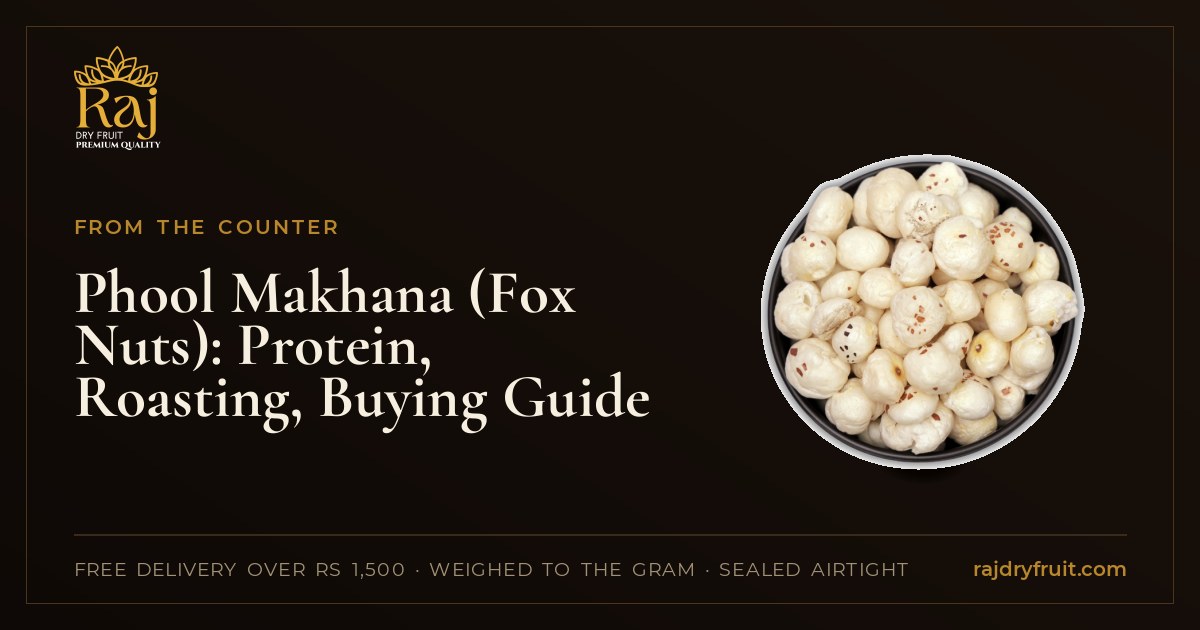
Phool makhana is the popped seed of the prickly water lily, Euryale ferox, known in English as fox nut or gorgon nut. The seeds are harvested from ponds, roasted and cracked so that the white kernel puffs up. The result is a light, crunchy, mild-tasting snack that is low in fat and widely eaten on fasting days.
Most of India’s makhana comes from the ponds and wetlands of Bihar, particularly the Mithila region. The work of gathering the seeds from the pond bed, drying, roasting and popping them is still largely done by hand, which is why good makhana costs more than people expect for something so light.
What is makhana called in English?
Makhana is called fox nut in English, and sometimes gorgon nut or euryale seed. It is often sold as “lotus seed”, but that is not quite right: makhana comes from the prickly water lily, a different plant from the lotus.
“Phool” makhana simply refers to the popped, flower-like white kernel, as opposed to the hard black seed before popping. The word makhana itself is understood across most of India, so it is the name to ask for. Our list of dry fruit names in English and Hindi has more of these.
How much protein is in makhana?
Makhana contains about 9 to 10 g of protein per 100 g, with very little fat. The rest is mostly carbohydrate, and the energy comes to roughly 350 kcal per 100 g.
The number looks modest next to nuts, and that is fair. But makhana is so light that 100 g is a very large bowl. A normal snack serving of 25 to 30 g gives you a big, crunchy handful with a little protein, and it fills you up more than its weight suggests.
| Snack | Protein per 100 g | Fat per 100 g | Texture |
|---|---|---|---|
| Makhana | About 9 to 10 g | Under 1 g | Light, crisp |
| Almonds | About 21 g | About 50 g | Dense, crunchy |
| Cashews | About 18 g | About 44 g | Dense, creamy |
| Pumpkin seeds | About 30 g | About 49 g | Small, crunchy |
That is the real appeal of makhana: a large volume of snack for very little fat. For more protein, many people toss roasted makhana with a handful of Roasted Almonds (Badam) or Pumpkin Seeds. Our protein-rich dry fruits page compares the options.
How do you roast makhana at home?
Dry-roast makhana in a heavy pan on low heat for about 8 to 10 minutes, stirring often, until a piece crushes with a clean crunch between your fingers. Then add a little ghee and seasoning and toss for one more minute.
- Heat a thick kadhai on low. High heat browns the outside before the inside turns crisp.
- Add two to three cups of makhana and stir every minute or so.
- After about eight minutes, take one out, let it cool for a few seconds and press it. If it crunches and breaks cleanly, it is ready. If it is chewy, keep going.
- Push the makhana to one side, add a teaspoon of ghee, and toss to coat.
- Add salt, black pepper, chaat masala or turmeric, and toss for a minute more.
- Cool completely before putting it in a jar, or it will go soft.
For a sweet version, melt a little jaggery with a spoon of ghee, toss the roasted makhana through it quickly and spread it out to set.
How do you pick good makhana?
Good makhana is large, round, white and light, with only small brown spots from the seed coat, and it crushes cleanly with a dry crunch. Check a handful for these things:
- Size: bigger pieces are graded higher. They look better and roast more evenly.
- Colour: creamy white. A few small brown patches are normal; lots of dark or yellowed pieces are not.
- Whole pieces: a lot with many broken halves and crumbs has been handled roughly or is at the bottom of the batch.
- Smell: almost none. A musty or damp smell means moisture has got in.
- No insects or webbing: check the corners of the pack.
We keep Makhana (Fox Nut) on our makhana shelf, sorted for size.
Can makhana be eaten during a fast?
Yes. Makhana is one of the most common foods on vrat days such as Navratri, Ekadashi and Janmashtami, and most households treat it as permitted fasting food. Families follow different rules, so go by your own tradition, and use sendha namak rather than ordinary salt if that is your practice.
Popular fasting dishes include makhana roasted in ghee with sendha namak, makhana kheer cooked in milk, and makhana added to a dry fruit mix with Kishmish. Our Navratri farali dry fruits guide has more ideas.
How should you store makhana?
Store makhana in an airtight jar in a dry, cool place. Its biggest enemy is humidity, which makes it soft and chewy within a day or two in an open bowl, especially in the monsoon.
- Close the pack tightly after every use.
- If it has gone soft, dry-roast it for a few minutes on low heat and it will crisp up again.
- Roasted, seasoned makhana is best eaten within a week or two.
We send makhana across India; orders start at ₹1,500 and every order ships free. See today’s price on the Makhana (Fox Nut) page.
Questions people ask
Is makhana a nut or a seed?
It is a seed, from the prickly water lily. It is called fox nut and sold beside nuts, but botanically it is not a nut.
Is makhana the same as lotus seed?
Not exactly. Makhana is often labelled lotus seed, but it comes from Euryale ferox, the prickly water lily, which is a different plant from the lotus.
How much makhana can you eat in a day?
A bowl of about 25 to 30 g is a common snack serving for an adult. Watch the ghee and salt you add, as those change the picture more than the makhana does.
Why does makhana go soft?
It absorbs moisture from the air. Keep it sealed, and re-crisp soft makhana in a dry pan for a few minutes.
Can small children eat makhana?
Roasted makhana is soft enough to break easily and is often given to older children as a snack. For children under five, crush or soften it and ask your doctor first.
Written at our counter, where these questions get asked every week.