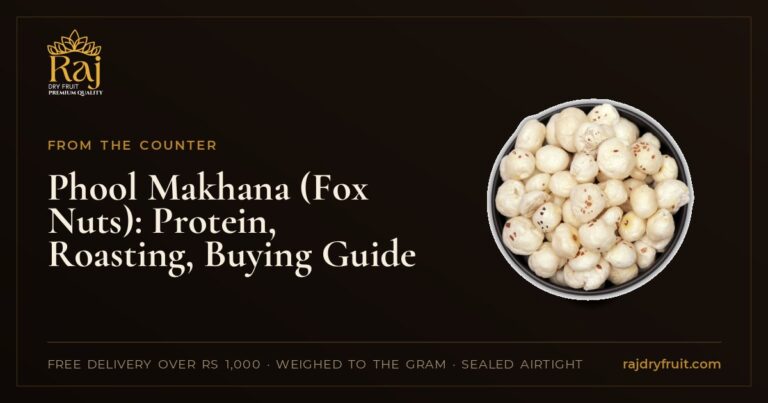

Makhana is priced almost entirely on size. The biggest, roundest, whitest pops come from the largest seeds, there are fewer of them in any lot, and hand popping loses a share along the way. Crispness and how clean the pops are do the rest. Today’s rate per pack is in the panel below.
Why do bigger makhana cost more?
Because the size of the pop is set by the seed, and the large seeds are a small part of any harvest. Seeds are graded before popping, and only the biggest give those round, light, evenly white pops that puff up fully and look the part in a bowl. Smaller seeds give smaller, denser pops, often with a speck of dark shell still clinging to one side.
The popping itself adds to the difference. It is done by hand, quickly, and not every seed opens cleanly, so a lot sorted for large pops has also been sorted away from everything that broke or half opened. Add the sorting after popping, where the specked and broken ones are taken out by hand, and you have the reason a large grade sits well above a plain one. Our makhana guide goes through the grades in more detail.
| Grade | Size and look | Feel | Best for |
|---|---|---|---|
| Large, hand-sorted | Big, round, bright white, matched | Very light, shatters on a bite | Roasting as a snack, serving to guests |
| Medium | Slightly smaller, mostly round | Light and crisp | Everyday roasting, kheer |
| Small or specked | Denser pops, some dark shell marks | Firmer, chewier at the centre | Curries, kheer, grinding into flour |
| Broken pieces | Half pops and fragments | Crisp but uneven | Grinding, thickening gravies |
Is makhana expensive for what it is?
It looks dear by the kilo and is not, and this is worth saying because the rate per kilo puts people off. Makhana weighs almost nothing, so a kilo is an enormous volume, far more than most families get through in a month. Judge it by the pack in your hand and by how many bowls it gives you, not by the figure per kilo.
How to judge crispness before you cook
Press a pop between two fingers. It should give way at once with a dry, papery crack, and the pieces should feel weightless. If it bends, squeaks or feels leathery, it has taken in moisture, and the taste will be flat no matter what you do with the masala. Shake the pack too: good makhana rattles and sounds hollow.
Colour tells you the rest. The best pops are an even white with the odd faint mark; a greyish or yellow cast means age. If a pack has softened at home, spread the pops in a dry pan on a low flame for a few minutes and they come back crisp. Store them airtight the moment they cool, because a humid kitchen undoes the roasting within a day. Today’s sizes are on our makhana shelf.
Where we send it
We pack makhana to order at our counter in Rajasthan and send it in a box rather than a bag, because pops crush easily in transit. Ahmedabad is usually 2-4 days, Lucknow 3-5, Bangalore 3-5, Delhi NCR 3-5 and Kolkata 4-6. Across the country, orders start at ₹1,000 and every order ships free, and makhana is light enough that adding a pack or two barely changes a parcel. The rest of the shop is there if you are building a mixed order.
Questions people ask
What is the price of 1 kg makhana?
It moves with the crop and the season, so the figure lives in the panel above rather than in this paragraph. A kilo works out at roughly the pack rate for the grade you choose, and remember that a kilo of makhana is a very large quantity.
Which makhana size should I buy?
Large if you are roasting it to eat by the handful, because the pops stay light and crisp. Medium or small for kheer, curries and anything ground, where size disappears into the dish and paying for it makes little sense.
Why has my makhana gone soft?
Moisture, almost always from a pack left open or a box put away while the pops were still warm. A few minutes in a dry pan over a low flame fixes it. Let them cool fully before sealing the box again.
Do the dark specks mean the makhana is bad?
No, those are bits of the seed shell that did not come away in popping. They are harmless and simply mark a lower grade. Hand-sorted lots have far fewer of them, and that sorting is part of what the higher grade costs.
Today’s rate for something else: Kaju · Badam · Mamra badam · Anjeer · Akhrot · Khajur · Kishmish · Pista · Charoli