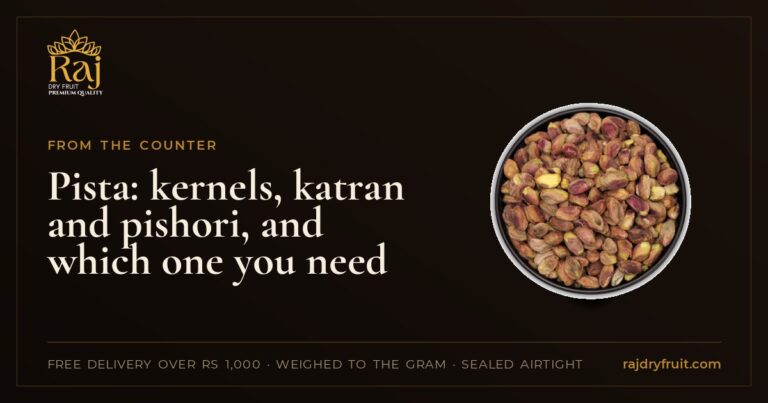

Pista is priced on what you are actually buying: shell and kernel together, or kernel alone. Kernels cost more because the shell weight is gone and somebody has done the shelling. Size, how green the kernel is, and the season’s crop move the rest. Today’s rate sits in the panel below.
Why are pista kernels dearer than in-shell pista?
Two reasons, and they stack. The first is weight: a good part of any in-shell kilo is shell, so a kilo of kernels stands for a great deal more fruit. The second is labour. Pistachio shells have to be opened and the kernels picked out and graded, and unlike walnut the kernel is small, so the work per kilo is considerable. That is why the kernel rate is not a small step up from in-shell but a real one.
In-shell earns its place anyway. The shell keeps the kernel fresh far longer, it is the form people put out in a bowl, and slow eating is half the point. Kernels are for cooking and garnish, where you want colour and no shells on the table. Our note on kernels, katran and pishori sets the forms side by side.
Pishori, regular and katran
Pishori is the large, long in-shell pistachio, split wide open and heavy in the hand, and it is the grade people ask for when the bowl is for guests. Regular in-shell is smaller and rounder and is what most homes keep. Among kernels, whole green kernels are the top grade, and the greener and more even they are the higher the rate, because green is what shows up on a plate of mithai.
Katran is the broken kernel, sold as pieces and slivers. It tastes the same and costs noticeably less, so for anything chopped, sprinkled or folded into a sweet it is the sensible buy. If the pista is going to be cut anyway, do not pay for whole kernels.
| Form | Size and look | Feel | Best for |
|---|---|---|---|
| Pishori in-shell | Long and large, shell split wide | Firm, heavy in the hand | Serving in a bowl, gifting |
| Regular in-shell | Smaller, rounder, mostly split | Firm and crisp | Everyday snacking |
| Whole kernels | Even kernels, skin on, green centre | Firm with a soft bite | Garnish, mithai, ice cream |
| Katran (pieces) | Broken kernels and slivers | Same as whole kernels | Chopping, sprinkling, barfi, kulfi |
| Blanched green kernels | Skin off, bright green | Softer, denser | Decorating, pista paste |
Roasted and salted, or plain?
Roasted and salted is the one that empties the bowl fastest, and it is what most in-shell pista is sold as. Plain, unroasted kernels are what you want in the kitchen, because they keep their colour when they hit heat and they do not carry salt into a sweet. Roasting also shortens the life of the nut a little, so plain kernels are the better thing to keep a stock of.
Whichever you take, store it airtight. Pista turns soft quickly once the pack is open, and salt draws moisture, so a salted lot goes limp sooner. Today’s forms and pack sizes are listed on our pista shelf.
Where we send it
We weigh pista to order at our counter in Rajasthan, and kernels go out in a sealed pack so they do not soften on the way. Jaipur is usually 1-3 days, Pune and Surat 2-4, Hyderabad 3-5 and Chennai 4-6. Across the country, orders start at ₹1,000 and every order ships free. Pista also carries a box well, and our gift boxes usually have it alongside kaju and badam.
Questions people ask
What is the price of 1 kg pista?
It moves with the crop and the season, and in-shell and kernels move on separate lines. The panel above shows today’s figure for each form and pack size, and a kilo works out at roughly the pack rate for the one you choose.
Is katran worth buying instead of whole kernels?
If the pista is being chopped, yes, every time. Katran is the same kernel in pieces, so a garnish or a barfi tastes identical and costs less. Keep whole kernels for when the shape is on show.
Why are some pista kernels greener than others?
Green varies with the lot and with how the kernel was handled after shelling. Deep green kernels are sorted out and priced above paler ones because mithai makers want them. On taste there is very little between them.
How should pista be stored at home?
Airtight and out of the heat, and in the fridge for kernels during the hot months. Keep salted pista in its own box, because the salt pulls moisture and will soften anything sharing the tin.
Today’s rate for something else: Kaju · Badam · Mamra badam · Anjeer · Akhrot · Khajur · Kishmish · Makhana · Charoli