In this guide
Quick answer
Pistachio is the most expensive thing most kitchens buy regularly, and the one people most often buy in the wrong form. A garnish and a grinding pista are not the same purchase, and the gap between them is large enough to be worth two minutes of reading.
In the shell, for eating
Roasted Pistachio is the one that goes in a bowl. The shell is doing real work: it keeps the kernel from oxidising, which is why pistachios sold in the shell taste fresher for longer than shelled ones do.
You are paying for shell weight, which sounds like a bad deal and is not, if the pistachios are going to be eaten over a few weeks rather than in one evening.
Kernels, for cooking
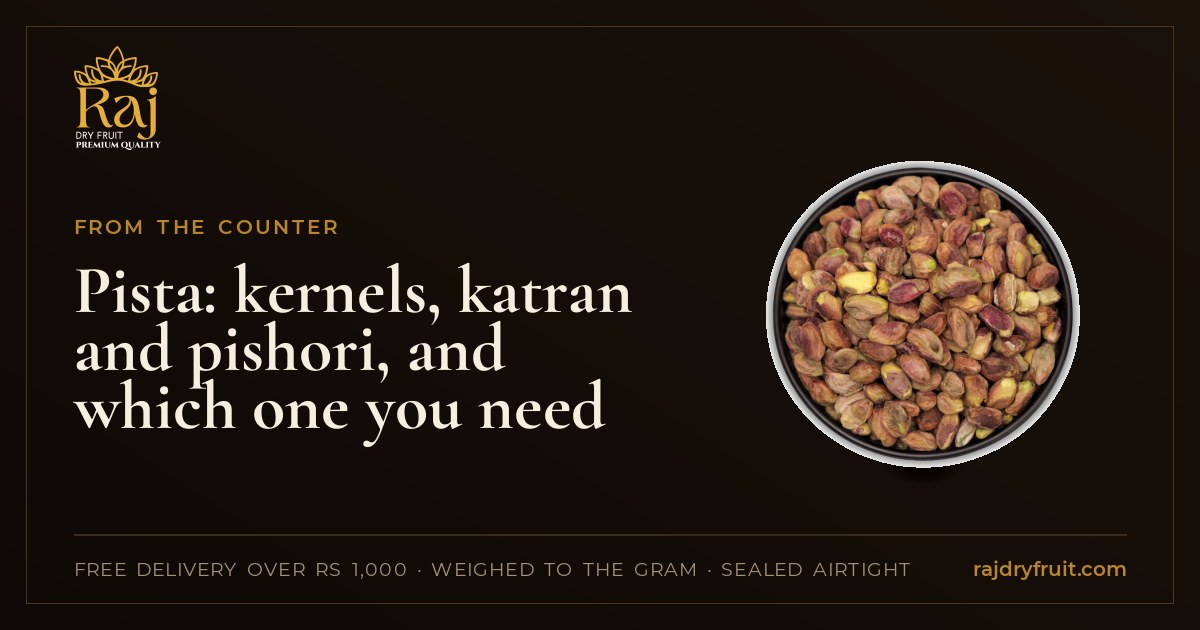
Pista Kernels are shelled and ready. Buy these when the pistachio is going into something — a barfi, a kulfi, a stuffing — and you do not want to spend an hour shelling.
They cost more per kilo than in-shell and less per kilo of actual food, which is the number that matters. They also go stale faster with nothing protecting them, so buy what you will use.
Katran, for putting on top
Pista Katran is pistachio already cut into slivers. This is purely a labour question: if the pistachio is going on top of kheer, barfi, thandai or a tray of mithai, somebody has to cut it, and it may as well not be you at eleven at night before a function.
It is also the cheapest way into pistachio on this shelf, because slivers are cut from kernels that were never going to be sold whole.
Pishori, for milk masala
Pista Pishori is a grade rather than a shape, and it is kept back for one job: grinding into milk masala and thandai.
What that job needs is a kernel that grinds smooth and holds its green rather than going grey in the mix. Not every pistachio does. If you have ever made thandai at home and wondered why yours came out the colour of dishwater when the shop version is green, this is usually why.
How to judge pistachio
- Green is the whole game, and it fades. A bright kernel is a young one. Dull olive or yellow-grey means age, not a different variety.
- The shell should be split naturally. A naturally opened shell means the kernel matured properly. Mechanically opened shells often mean it did not.
- Reject anything with a shrivelled kernel rattling loose. That kernel dried out before it was picked.
- Salt hides age. Heavily salted pistachio is worth a second look, not because salt is bad but because it is the easiest thing to put over a flat kernel.
The short version
Eating from a bowl over a fortnight: in the shell. Cooking this week: kernels. Garnishing anything: katran, and do not pay kernel prices to cut them yourself. Grinding into milk: pishori, and nothing else will look right.
All four are weighed to order here, so you can buy a hundred grams of katran and a hundred of kernels and stop guessing.
Wondering what it costs today? Pista prices are on their own page, read off the shop as the page loads.
We deliver across India See 87 city pages
Written at our counter, where these questions get asked every week.