
In this guide
Quick answer
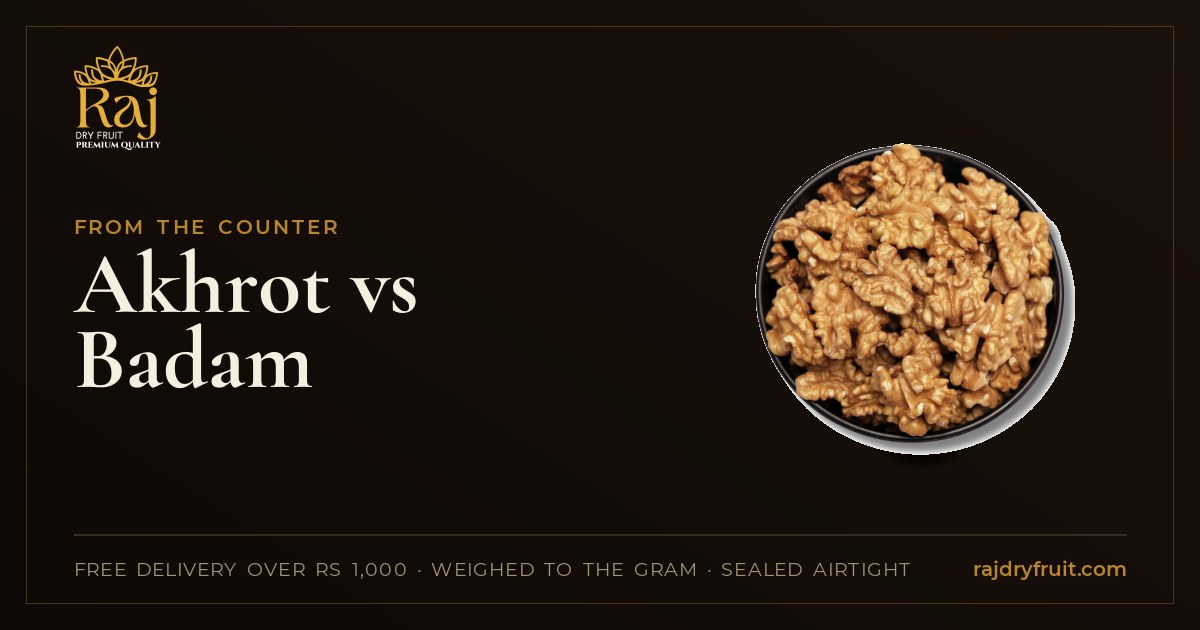
In akhrot vs badam, neither is simply better; they are good at different things. Badam carries more protein, fibre, vitamin E and calcium per gram. Akhrot is one of the few nuts rich in ALA, the plant omega-3, which almonds barely contain. That is why many families eat five or six badam and two or three akhrot halves a day.
How do akhrot and badam compare, gram for gram?
The figures below come from USDA FoodData Central, per 100 g of raw kernels. They show why the two nuts complement each other rather than compete.
| Per 100 g | Akhrot (walnut) | Badam (almond) | Which is higher |
|---|---|---|---|
| Energy | 654 kcal | 579 kcal | Akhrot |
| Protein | 15 g | 21 g | Badam |
| Total fat | 65 g | 50 g | Akhrot |
| Plant omega-3 (ALA) | About 9 g | Almost none | Akhrot, by a long way |
| Fibre | 7 g | 12.5 g | Badam |
| Vitamin E | Under 1 mg | About 26 mg | Badam, by a long way |
| Calcium | 98 mg | 269 mg | Badam |
| Magnesium | 158 mg | 270 mg | Badam |
Read across the rows and a pattern appears. Badam wins on most of the everyday nutrients, while akhrot stands almost alone on omega-3. So the honest answer to “akhrot ya badam” is that they do different jobs, and a small amount of each covers more ground than a larger amount of one.


Which should you choose if you can buy only one?
Badam, for most households. It is the more versatile nut in an Indian kitchen, it keeps much longer once opened, and its nutrients are the ones most diets are short of. Children take to it easily, it soaks and peels well, and it goes into milk, halwa and sweets without overpowering them.
Choose akhrot instead if your diet has little fish or flaxseed, because walnuts are one of the easiest ways to add plant omega-3. Choose it too if you simply prefer the taste: soft, buttery and slightly tannic. For any specific health goal, speak to your doctor about which suits you.
How many of each should you eat a day?
Portions differ because the nuts differ in size and fat. A common daily habit:
- Badam: 5 to 8 almonds, about 7 to 10 g, often soaked overnight and peeled. Our guide on how many almonds a day covers this in detail.
- Akhrot: 2 to 4 halves, about 8 to 12 g. Walnuts are larger and richer, so fewer pieces go further.
- Both together: 5 badam plus 2 akhrot halves is a balanced daily handful of about 15 g.
Soak both overnight in the same bowl if you like. Akhrot softens and loses a little bitterness from its skin; badam peels easily in the morning.
Which one keeps longer in the kitchen?
Badam, comfortably. Its skin protects the oil inside, and an opened jar stays good for three to four months in a cool cupboard. Akhrot kernels have no such protection, and their delicate fat turns in four to eight weeks at room temperature, faster in humid weather. Keep walnut kernels in the fridge if a pack will last more than a month.
This affects how you buy. Badam can be bought a kilo at a time for a large family; akhrot is best bought 250 to 500 g at a time, even if you eat it daily. Our akhrot guide explains how to check that a walnut lot is fresh when it arrives.
How do they differ in the kitchen?
Badam is the more useful cooking nut. It grinds into a smooth paste for korma and badam milk, slices neatly for garnish, and holds its crunch in barfi and chikki. Soaked and peeled, it is the classic morning nut in most Indian homes, and our post on soaked almonds explains why the soak is so popular.
Akhrot shines in fewer dishes but shines brightly in them: akhrot halwa, brownies and cakes, chutneys in Kashmiri homes, and salads, where its soft crunch and slight bitterness balance sweet fruit. It does not grind as cleanly as badam, because its high oil turns it into a paste quickly, so pulse it briefly when chopping. In a winter laddoo, a mix of both gives the best texture: badam for crunch, akhrot for richness.
What do akhrot and badam cost today?
Today akhrot works out to at today's shop rate and badam to at today's shop rate across our lots. Mamra, the richer almond many families keep for the morning soak, is a separate shelf at at today's shop rate. The akhrot price page and the badam price page list every grade and pack.
Our orders start at ₹1,000 and every order ships free. A simple monthly basket for a family of four is 500 g badam, 250 g akhrot, 500 g kaju and 250 g pista, which crosses the minimum and keeps both jars fresh.

Questions people ask
Is walnut vs almond better for the brain?
Walnuts are often linked with the brain because of their ALA omega-3, and almonds bring vitamin E. No single nut is a brain food on its own; a varied diet matters more than one choice.
Can I eat akhrot badam together every day?
Yes. A small handful of both, such as five almonds and two walnut halves, is a common daily habit. Keep the total portion modest because both are energy-dense.
Akhrot ya badam, which is better for children?
Most families start with soaked, peeled badam because it is mild and easy to chew. Add a walnut half chopped into food as children get older.
Is akhrot better than badam for weight loss?
Neither is a weight-loss food. Both are rich in energy, so the portion matters more than the choice. Badam has more fibre and protein per gram, which some people find more filling.
Written at our counter, where these questions get asked every week.


