In this guide
Quick answer
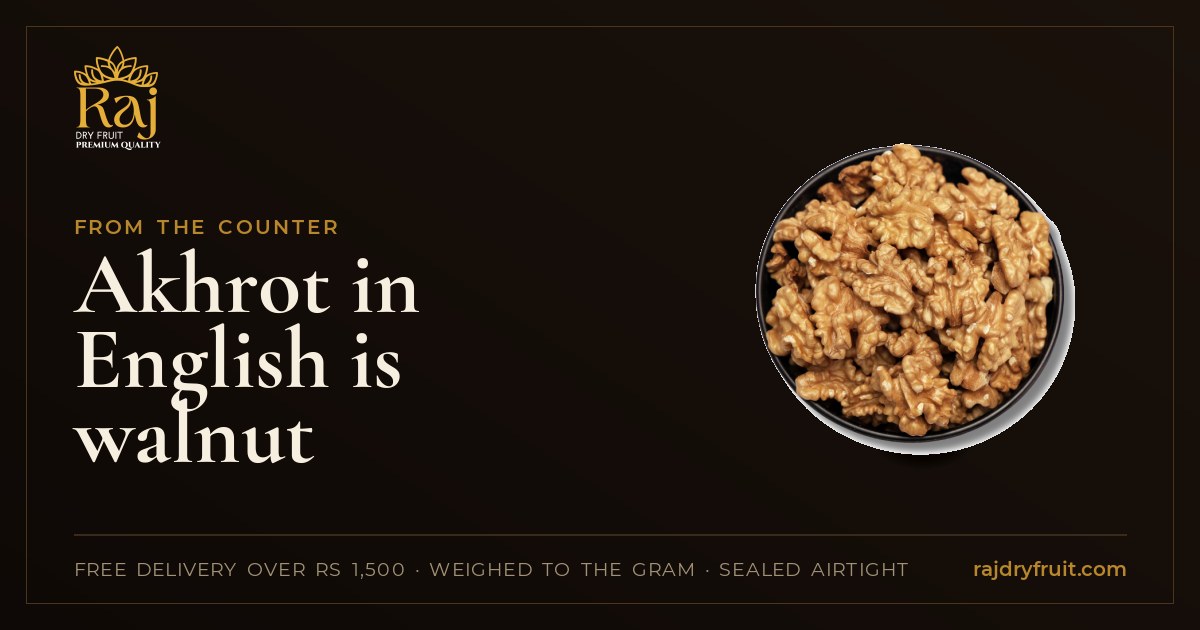
Akhrot in English is walnut. The akhrot you buy in India is the common walnut, sold either whole in its hard brown shell or as shelled kernels, the wrinkled, brain-shaped nut inside. Most families eat a few walnut halves a day, soaked or plain, and use the kernels in halwa, laddoos and cakes.
The two things that decide how good an akhrot is are freshness and colour. Walnuts are very rich in oil, so a stale one turns bitter long before it looks bad. A fresh kernel is light golden to light brown, crisp, and tastes sweet and faintly buttery. This guide covers how much to eat, which form to buy, and how to check a walnut before you pay for it.
What is akhrot called in English?
Akhrot is called walnut in English. The same word, akhrot, is used in Hindi, Urdu and Punjabi, and several other Indian languages use a close variant of it.
The word you will hear most in Indian markets alongside it is kagzi. Kagzi akhrot means a paper-shell walnut, one whose shell is thin enough to crack between your palms or with a light tap. Harder-shelled walnuts need a nutcracker or a stone. For every other dry fruit name, see our list of dry fruit names in English and Hindi.
India grows most of its walnuts in Jammu and Kashmir, with smaller harvests in Himachal Pradesh and Uttarakhand. Imported walnuts, mainly from Chile and the United States, are also common in Indian shops, and they are usually larger and more uniform.
How many walnuts should you eat a day?
Most people do well with a small handful a day: about 4 to 7 whole walnuts, which is 8 to 14 halves or roughly 25 to 30 grams. That amount is the serving used in most nutrition guidance, and it adds useful fat and protein without piling on calories.
Walnuts are energy-dense, so the handful matters. At about 650 kcal per 100 g, a 30 g serving is close to 200 kcal. Eating a large bowl every day adds up fast.
| Per 100 g (about) | Amount | In a 30 g handful (about) |
|---|---|---|
| Energy | 650 kcal | 195 kcal |
| Fat | 65 g | 20 g |
| Omega-3 (ALA) | 9 g | 2.7 g |
| Protein | 15 g | 4.5 g |
| Fibre | 6.7 g | 2 g |
What sets walnuts apart from almonds and cashews is that omega-3 line. Walnuts are one of the few nuts with a meaningful amount of ALA, the plant form of omega-3, which is why they turn up so often in heart-healthy eating advice. That is a nutrition fact, not a promise; if you have a heart condition, diabetes or a nut allergy, ask your doctor what suits you. Whole walnuts are a choking risk for children under five, so chop or grind them for small children.
Whole walnuts or kernels: which should you buy?
Buy whole walnuts if you want them to keep longer and do not mind cracking; buy kernels if you want to eat or cook with them straight away. The shell is the walnut’s own packaging, and a walnut in its shell stays fresh for months longer than a shelled one.
| Form | What it is | Best for | Keeps |
|---|---|---|---|
| Whole (in shell) | Nut still in its shell | Winter stock, gifting, cracking fresh | Longest |
| Two-piece kernels | Halves, cleanly split | Eating daily, soaking, garnish | A few months, cool and airtight |
| Four-piece kernels | Quarters and larger bits | Halwa, cakes, brownies, laddoos | A few months, cool and airtight |
We keep all three: Walnut Whole, Walnut Kernels Two Pieces and Walnut Kernels Four Pieces.
Two-piece vs four-piece walnut kernels: what is the difference?
Two-piece kernels are walnut halves; four-piece kernels are the same walnut broken into quarters. When a walnut is cracked well, the kernel comes out in two neat halves. When it cracks less cleanly, it breaks into quarters and smaller pieces, and those are sorted separately.
The taste and nutrition are the same. The difference is looks, and so the price. Halves are what you want for eating one by one, for soaking, and for putting on top of something where they will be seen. Quarters are the sensible buy for anything that will be chopped, ground or baked, because you would break the halves anyway. It is the same rule we give for kaju: pay for the whole nut only when the whole nut will be seen.
How to tell fresh walnuts from stale ones
A fresh walnut kernel is light in colour, snaps cleanly and tastes sweet; a stale one is darker, bends or crumbles, and tastes bitter or smells like paint. Check these before you buy or open a new pack:
- Colour. Light golden to light brown is fresh. A dark brown or grey kernel is older, or from a lesser lot. The papery skin darkens with age too.
- Smell. Fresh walnuts smell mild and nutty. A sharp, oily, paint-like smell means the fat has gone rancid, and there is no saving it.
- Taste. A slight tannic edge from the skin is normal. A strong, lingering bitterness is not.
- Snap. A kernel should break crisply. A soft, bendy kernel has taken on moisture.
- For whole walnuts, weight and sound. A good walnut feels heavy for its size and does not rattle when shaken. A rattle means the kernel inside has dried and shrunk. Avoid shells with holes, cracks or dark stains.
- Powder and webbing. A little dust in a bag of kernels is normal; fine webbing or clumps mean insects have been at them.
Once home, keep kernels in an airtight jar in the fridge if you will not finish them within a few weeks. Walnuts pick up smells easily, so keep them away from onions and spices. Whole walnuts are fine in a cool, dry cupboard through winter.
How to soak walnuts, and should you?
To soak walnuts, put 2 to 4 halves in a small bowl of water at night and eat them in the morning. Soaking is a common Indian habit rather than a necessity: it makes the kernel softer and milder, and many people find the skin tastes less sharp after a night in water.
- Rinse the kernels once to remove dust.
- Cover with clean drinking water in a bowl. Keep it covered.
- Leave it overnight, about 6 to 8 hours. In hot weather, keep the bowl in the fridge.
- Drain and eat them the same morning, often with a few soaked almonds or raisins.
Soaked walnuts do not keep. Once wet, they turn soft and can go sour within a day, so soak only what you will eat. If you like them crisp, eat them plain; the nutrition is essentially the same either way.
Walnuts are one of the dry fruits families buy most in the cold months, and they sit alongside almonds and dates on our winter dry fruits page. You can see every form we keep on the Walnut shelf. We send them across India; orders start at ₹1,500 and every order ships free, and today’s price is on each product page.
Questions people ask
Is akhrot the same as walnut?
Yes. Akhrot is the Hindi and Urdu name for walnut. Akhrot giri or akhrot kernels means the shelled nut.
What is kagzi akhrot?
Kagzi akhrot is a thin, paper-shell walnut that cracks easily in the hand. The name describes the shell, not a different nut.
Why do some walnuts taste bitter?
A faint bitterness comes from the papery skin and is normal. Strong bitterness usually means the oil in the walnut has gone rancid from age, heat or light, and those kernels are best thrown away.
Is it better to eat walnuts soaked or raw?
Either is fine. Soaking makes them softer and milder, which some people prefer, but it does not change the nutrition in any meaningful way.
How long do walnut kernels last?
Kept airtight in the fridge, kernels stay good for a few months. In a warm kitchen they can start to taste stale within weeks, so buy smaller packs more often in summer.
Written at our counter, where these questions get asked every week.