
In this guide
Quick answer
Adadiya pak is a Gujarati winter sweet made from coarse urad dal flour roasted slowly in ghee, set with sugar or mawa, and loaded with fried gond, chopped badam and a spice mix called adadiya masala: saunth, piplamool (ganthoda), black pepper, nutmeg and elaichi. One batch of about a kilo needs 250 g urad flour and 250 g ghee.
What is adadiya pak, and why is it a winter sweet?
“Adad” is urad dal in Gujarati, and “pak” is a set sweet cut into squares, like a barfi but denser. Adadiya pak belongs to a family of Gujarati winter preparations called vasanu, made in December and January when families gather spices, gond and dry fruits and cook them into sweets meant to be eaten a piece a day through the cold months. It is rich, warming, a little spicy, and tastes of roasted urad and ghee.
Saurashtra and Kutch households each have their own version. The Wikipedia page on Gujarati cuisine lists it among the seasonal sweets of the region. Most families make it once a winter, in a large batch, and store it in steel dabbas.
What goes into adadiya pak?
Here is the list for one batch, about 1 kg, enough for a family to have a piece a day for a month:
| Ingredient | Amount | Role |
|---|---|---|
| Urad dal flour, coarse | 250 g | The base |
| Ghee | 250 g, plus 2 tbsp for dhabo | Roasting and richness |
| Milk | 2 tbsp, for dhabo | Gives the flour a grainy texture |
| Gond (edible gum) | 50 g | Fried until puffed, for crunch |
| Mawa (khoya) | 100 g, optional | Softer, richer pak |
| Sugar | 250 to 300 g | Syrup or powdered |
| Badam, chopped | 50 g | Crunch and topping |
| Kaju or pista, chopped | 25 g | Topping |
| Adadiya masala | 2 tbsp | The flavour of the sweet |
What is in adadiya masala?
The spice mix is what makes it adadiya pak rather than plain urad barfi. Families blend their own, but most include:
- Saunth (dry ginger powder): 2 tsp, for warmth.
- Piplamool / ganthoda powder: 1 tsp, the signature bitter-warm note.
- Kali mirch (black pepper): half a teaspoon, ground.
- Jaiphal (nutmeg): a quarter of a nutmeg, grated.
- Elaichi: 1 tsp powder.
- Javitri and dalchini: a pinch each, in some homes.
Ganthoda is strong. If it is your first batch, start with half the amount and taste.


How do you make adadiya pak?
- Dhabo the flour. Rub 2 tbsp warm ghee and 2 tbsp milk into the urad flour with your fingers, cover, and rest for 30 minutes. Pass it through a coarse sieve. This gives the pak its grainy bite.
- Fry the gond. Heat a little of the ghee and fry the gond in small batches until it puffs up white. Crush lightly and set aside.
- Roast the flour. Add the rest of the ghee to a heavy kadai, add the flour, and roast on low heat, stirring, for 20 to 25 minutes until golden and fragrant. Do not hurry this; raw urad flour tastes bitter.
- Add mawa. If using, crumble it in and roast five more minutes.
- Cool slightly. Take it off the heat and let it cool for ten minutes.
- Sweeten and spice. Mix in powdered sugar, or pour in a one-string syrup, then the adadiya masala, gond and half the nuts.
- Set. Spread in a greased thali, press down, top with the remaining nuts, and cut into squares while still warm.
It firms up in a few hours and keeps for three to four weeks in an airtight dabba in winter.
Where do the ingredients come from?
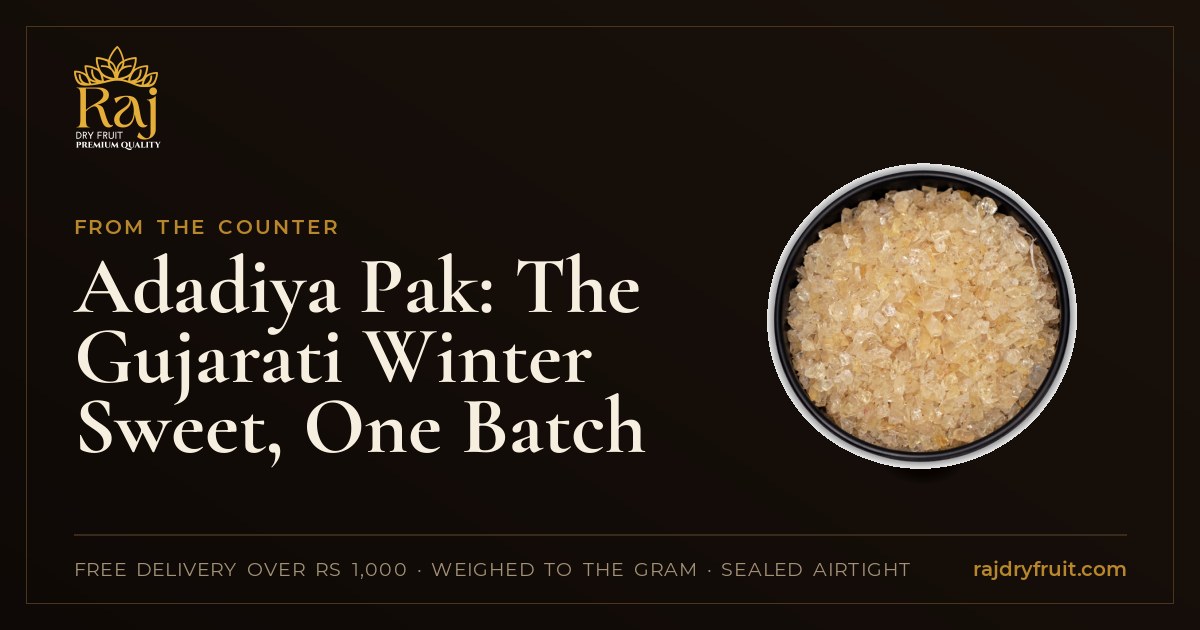
Three items are the hardest to find in a good grade in a regular grocery: gond, piplamool and saunth. Gond barik, the small-crystal gond, fries evenly and puffs well; our gond guide explains the grades. Piplamool should be dry, aromatic and free of dust. Saunth should be pale and pungent.
Gond Barik pack sizes are at today's shop rate, Piplamool is at today's shop rate, and Saunth is at today's shop rate. Badam for the batch works out to at today's shop rate today.
What other Gujarati winter sweets use the same pantry?
Once you have gond, saunth and piplamool in the kitchen, a few other winter recipes open up: methi pak, gundar pak (gond pak), and saalam pak. Each uses the same base of ghee, jaggery or sugar, dry fruits and a variation of the same masala. Gujarati households often follow a meal with mukhwas; our post on Gujarati mukhwas covers that side of the table, and our winter dry fruits page gathers everything for the season.
How to order for a winter batch
For one batch you need 50 g gond, a small pack each of piplamool and saunth, and about 100 g of nuts. Most families make two or three winter sweets, so a practical order is 250 g gond barik, a pack each of piplamool and saunth, 500 g badam, 500 g kaju and 250 g pista; orders start at ₹1,000 and every order ships free. If you are in Ahmedabad, our page on ordering online in Ahmedabad has local details.

Questions people ask
What is the adadiya pak recipe in short?
Rub ghee and milk into coarse urad flour, roast it slowly in ghee until golden, add mawa if you like, then mix in sugar, fried gond, chopped nuts and adadiya masala. Set in a tray and cut into squares.
What are some Gujarati winter sweets?
Adadiya pak, methi pak, gundar pak, saalam pak and sukhdi are the best known. Most use ghee, jaggery or sugar, gond and dry fruits with warming spices, and are made in large batches in December.
What is vasanu for winter?
Vasanu is the Gujarati name for winter preparations made with spices, gond, dry fruits and ghee, eaten in small amounts through the cold months. Adadiya pak is one of the most popular.
Can adadiya pak be made with jaggery?
Yes. Many families use grated jaggery in place of sugar, added off the heat once the flour has cooled a little. The pak turns darker and has a deeper, caramel taste.
Written at our counter, where these questions get asked every week.


