In this guide
Quick answer
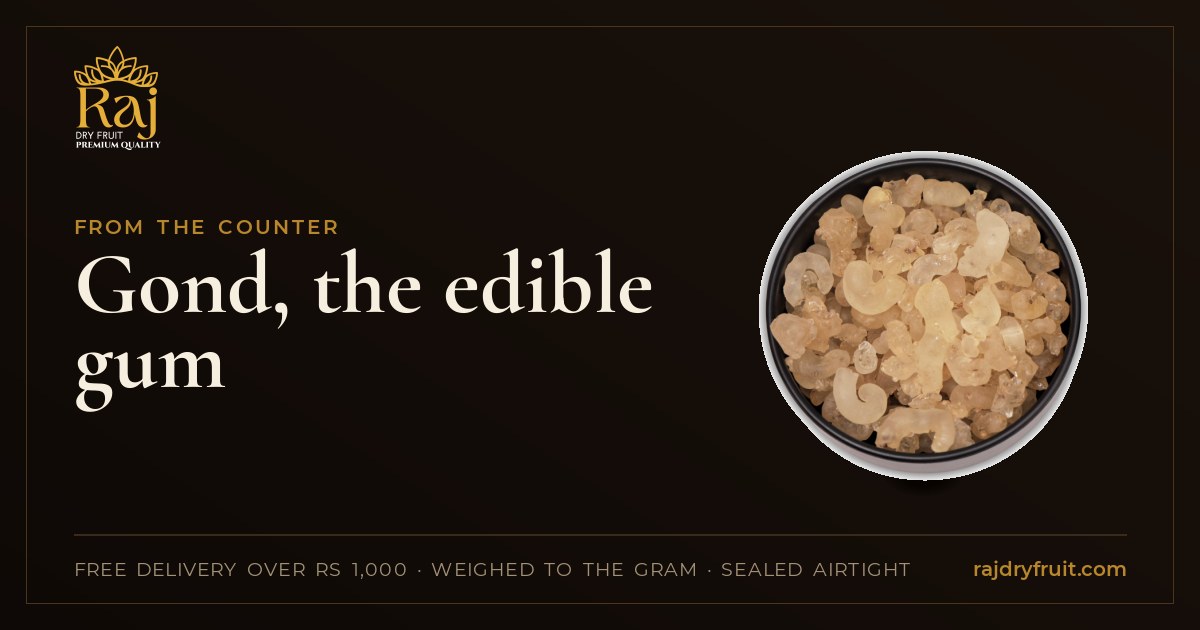
Gond is edible gum: the dried resin that oozes from the bark of acacia trees, mainly babool, and sets into hard, pale yellow to amber crystals. In Indian kitchens it is fried in ghee until it puffs up light and crunchy, then crushed into winter sweets such as gond laddoo and panjiri. It is not the same thing as gond katira.
That last point matters more than anything else in this guide. Gond and gond katira look similar in a jar, have similar names, and are used in completely opposite ways. Gond goes into hot ghee. Gond katira goes into cold water. Swap one for the other and the recipe fails.
What is gond called in English and other languages?
In English, gond is called edible gum, or acacia gum. The spelling varies: gond, gondh, goond. In Maharashtra it is called dink, which is why the same sweet is gond laddoo in the north and dinkache ladoo in Maharashtra.
We sell it in two forms, Goond Whole and Goond Barik. Both are the same gum; the difference is only the size of the pieces.
Is gond the same as gond katira?
No. Gond is acacia gum and is fried; gond katira is tragacanth gum, from a different plant, and is soaked. Put a piece of each in water overnight and the difference is obvious: gond katira swells into a soft, clear jelly many times its size, while gond does not swell that way; it slowly softens and turns sticky.
| Gond | Gond katira | |
|---|---|---|
| Comes from | Acacia (babool) tree | Tragacanth (astragalus) plant |
| Looks like | Hard, glassy, yellow to amber lumps | Thin, white, flaky or ribbon-like pieces |
| How it is used | Fried in ghee until it puffs | Soaked in water until it turns to jelly |
| Season | Winter sweets: laddoo, panjiri | Summer drinks and sherbets |
| Typical dishes | Gond laddoo, panjiri, dinkache ladoo | Sherbet, falooda-style drinks |
We keep gond, not gond katira. If you are making a summer sherbet, gond from our shelf is the wrong thing to buy.
Gond whole or gond barik: which should you buy?
Buy barik if you want less work; buy whole if you want to control the size of the pieces yourself. Barik means fine, and gond barik is the gum already broken into small, even granules. Whole gond comes as larger lumps and crystals.
- Gond barik fries quickly and evenly, because every piece is about the same size. It is the easier choice for a first batch of laddoo and for panjiri.
- Whole gond needs breaking before frying. Put the lumps in a cloth or a thick bag and tap them with a rolling pin or pestle into pieces roughly the size of a chana dal. Big lumps puff on the outside and stay hard and chewy in the middle.
- Whole gond is easier to judge. Clean, glassy, light-coloured lumps are easy to see. With fine granules, dust and bits of bark are harder to spot.
How do you fry gond for laddoo?
Fry gond in hot ghee on medium-low heat, a little at a time, until each piece puffs up, turns opaque and pale, and floats. It takes well under a minute per batch. The steps:
- Break whole gond into small, even pieces first. Barik can go in as it is.
- Heat the ghee in a kadhai, deep enough for the pieces to float. Drop in one piece as a test: it should rise and swell within a few seconds.
- Fry a small handful at a time. Gond puffs to several times its size, and a crowded pan cools the ghee and leaves pieces unpuffed.
- Stir gently and lift out as soon as the pieces are puffed and creamy white. If they brown, the ghee is too hot.
- Drain and cool, then crush lightly with the back of a bowl or a rolling pin. Fried gond crumbles easily.
The test of a good batch is simple. Bite a cooled piece. It should crunch and dissolve, like a light puffed snack. If it sticks to your teeth, it was not fried long enough or the ghee was not hot enough, and those pieces can go back in the pan.
Gond laddoo usually brings the fried gond together with roasted wheat flour, ghee, jaggery or sugar and a generous amount of dry fruit. Common additions are chopped badam, kaju, grated chuara, dry coconut, makhana and a little saunth (dry ginger powder). Every household has its own proportions.
Why is gond eaten in winter?
Gond is eaten in winter by tradition. In much of North and West India, gond laddoo and panjiri are made when the weather turns cold, rich with ghee and dry fruit, and eaten a piece at a time with morning tea or milk. Gond laddoo is also traditionally made for new mothers in many families. These are customs, not medicine; anyone who is pregnant, recently delivered, diabetic or managing a health condition should check with their doctor, because these sweets are heavy on ghee and sugar.
If you are stocking up for the season, our winter dry fruits page gathers the things that usually go into these sweets in one place.
How to store gond
Raw gond keeps well. Store it in an airtight jar in a dry cupboard, away from steam and damp, and it lasts for many months. If it absorbs moisture, it turns sticky and the pieces clump together; that gond still fries, but less evenly.
Fried gond is different. Once it has been through ghee, treat it like any fried food: use it within a few days, or fold it straight into laddoo. The finished laddoo, made with roasted flour and plenty of ghee, keeps for a few weeks in an airtight tin in cold weather.
We send gond and the rest of the dry fruits shelf across India; orders start at ₹1,000 and every order ships free. See today’s price on the Goond Whole page.
Questions people ask
Can I use gond katira instead of gond in laddoo?
No. Gond katira is meant to be soaked, not fried, and it will not give laddoo the light crunch that fried gond does. For laddoo and panjiri you need gond, the acacia gum.
Why did my gond not puff up?
Usually the ghee was not hot enough, or the pieces were too large. Break the gum smaller, test one piece first, and fry in small batches.
Do you need to soak gond before frying?
No. Gond goes into the ghee dry. Soaking is how gond katira is used, not gond.
Is gond barik lower quality than whole gond?
Not by itself. Barik is the same gum in smaller pieces, which saves you the breaking. Judge either by colour and cleanliness: light, glassy and free of bark.
Can children eat gond laddoo?
Many families give them to children, but they are rich and sweet, and the chopped nuts in them are a choking risk for small children. For children under 5, check with your doctor first.
We deliver across India See 87 city pages
Written at our counter, where these questions get asked every week.