In this guide
Quick answer
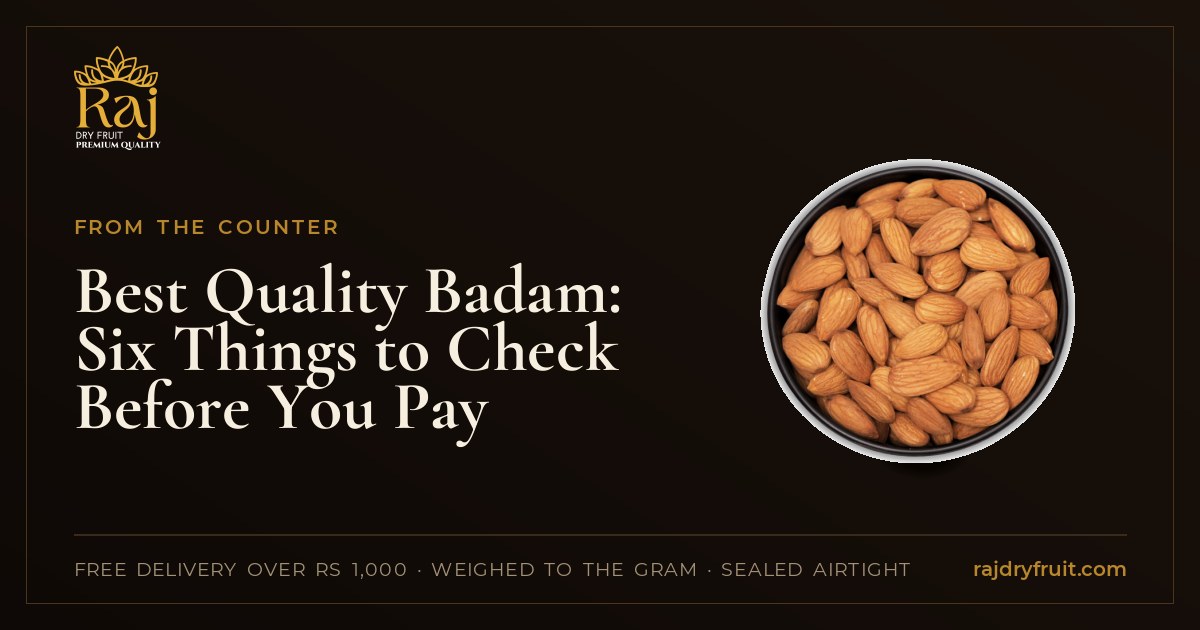
Search for almonds and every listing says best quality. It is the most common phrase on any dry fruit price list and the least useful, because no shop has ever described its own stock as middling. These are the checks that actually separate one kilo from another.
What does best quality mean on a price list?
Usually nothing. There is no grading body behind the phrase and no definition it has to meet. What does mean something is the count — how many almonds make up a given weight — and the origin. A shop that names both is telling you something; a shop that says best quality and nothing else is telling you it would rather not.
Our own range runs at today's shop rate across the grades we keep, with the count and the pack weight printed beside each figure on the badam price page, so there is nothing left to take on trust.
The six checks, in order
| Check | Good | Poor |
|---|---|---|
| Evenness | Kernels look like each other | A mix of sizes in one pack |
| Surface | Matt, dry, lightly wrinkled | Shiny, oily, or dusty |
| Colour | Even mid brown | Patchy, pale or very dark ones among them |
| Snap | Breaks cleanly with a crack | Bends or crumbles |
| Smell | Faintly sweet, nutty | Sharp, bitter, of old oil |
| Inside | Pale cream, solid | Yellowed, hollow or shrivelled |
Do them in that order and you will usually stop at the second or third. Evenness is the quickest tell of all: a properly graded lot looks monotonous, and a bag that looks interesting has been mixed.
Does a higher count number mean a better almond?
No, and this is where most of the confusion lives. The count tells you size, not quality. A large almond and a small one from the same orchard, the same season and the same grading line are the same almond; one of them simply grew bigger and the larger grade is scarcer, so it costs more.
What that means in practice is that paying for the biggest grade makes sense when size is visible and not when it is not.
- Gift box or tray: buy the large grade. Size reads across a table and that is the entire job.
- Soaking overnight: buy the everyday grade. You peel it and eat it, and nobody measures.
- Milk, cooking, badam powder: the smallest grade, every time. It is ground or blended within a minute.
- A jar on the counter for the family: everyday grade, and spend the difference on buying it fresher.
Is mamra a better quality almond?
It is a different almond rather than a higher grade of the same one. Mamra is rounder, oilier and grown mainly in Iran and Afghanistan, and it costs considerably more — at today's shop rate at our counter today. People who like it describe it as sweeter and less papery; people who do not say it is not worth the gap.
What it is definitely not is a quality upgrade on a californian almond that will make your morning soak better. If you have never deliberately tasted the two side by side, buy a small pack of mamra once and decide for yourself before committing to it. The comparison of the two sets out what actually differs.
How do you keep good almonds good?
The best kilo in the market will be ordinary in six weeks if it is kept badly, and almonds are kept badly in most Indian kitchens. They carry oil, oil turns with heat and light, and the shelf above the stove is the worst place in the house.
Decant into glass with a tight lid, keep it away from the cooker and out of the sun, and refrigerate in summer or in any humid city. Buy a month at a time rather than six, which is the single habit that does most for how your almonds taste. Our orders start at ₹1,000 and every order ships free, so a month-sized order is not a penalty. The whole nut shelf with today’s figures is on the nuts page.
Questions people ask
What does the count number on almonds mean?
How many kernels make up a given weight. A lower count means bigger almonds. It describes size and scarcity, not how good the almond is to eat.
Should almonds be shiny?
No. A natural almond is matt. Shine usually means it has been polished or oiled, which makes an older nut look fresher than it is.
How can I tell if almonds have gone bad?
Smell and taste. A turned almond smells faintly of paint and tastes bitter at the back of the tongue. It does not look different, so the nose is the only reliable test.
Is imported almond better than Indian?
Most almonds sold in India are imported, so the question is usually really about mamra against californian. Neither is better; they are different almonds at different rates. Today’s figures for both are on the mamra badam price page.
We deliver across India See 87 city pages
Written at our counter, where these questions get asked every week.