In this guide
Quick answer
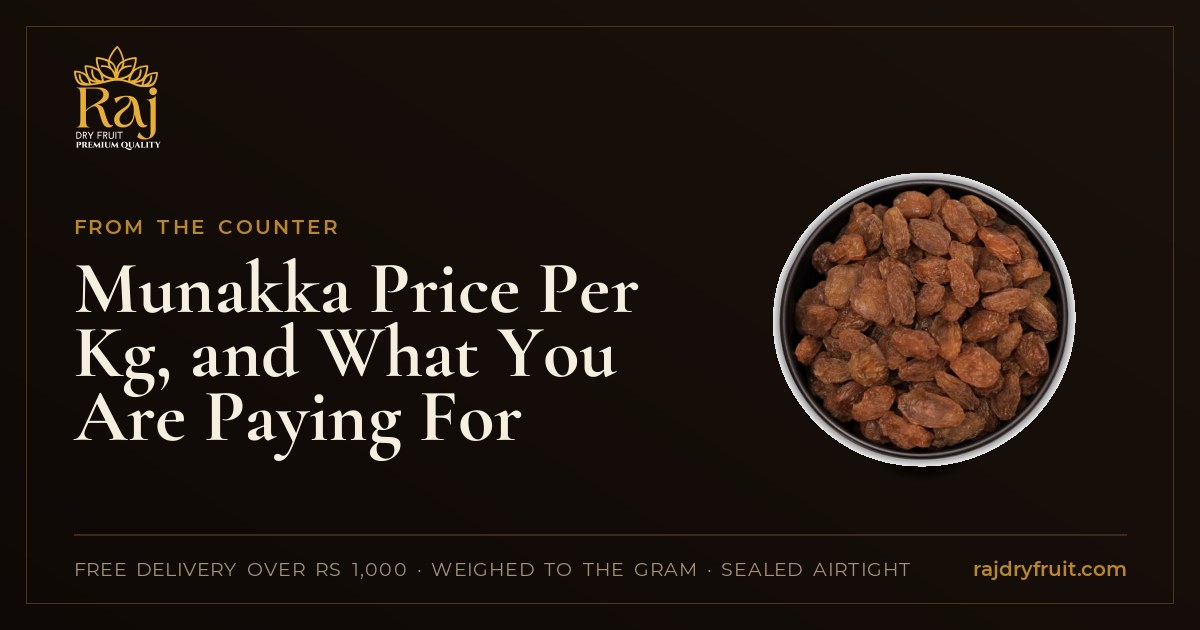
Munakka gets asked about by phone more than almost anything else on the shelf, and the question is always the same: why does one shop say one figure and the next shop say nearly double. The answer is size, and once you can see it the price stops being a mystery.
What does munakka cost per kilo?
At our counter today munakka works out to at today's shop rate, and that figure is read off the shop as the page loads rather than typed in once and left to go stale. The jumbo grade, which is the one most people picture when they say munakka, is at today's shop rate a pack.
Regular munakka is the same fruit, smaller, and costs considerably less. It is not a worse grape and it has not been stored badly. It is simply a smaller berry, and smaller berries are what is left after the big ones have been picked out.
Why is jumbo munakka so much dearer?
| Grade | What you see | What it suits |
|---|---|---|
| Jumbo abjosh | Large, plump, seeds inside, soft to press | Soaking overnight, eating as it is, gifting |
| Regular abjosh | Smaller, firmer, same colour | Kheer, cooking, daily use |
| Kishmish | Small, seedless, golden or green | Poha, sweets, children |
Only so much of a crop grows to the top size, so the jumbo grade is the scarce part of the same harvest. The rest is good fruit at a lower rate. Whether the gap is worth it depends entirely on what you are doing with it: for soaking overnight and eating two with the water, the big one is noticeably better. Chopped into kheer, nobody can tell.
How do you tell good munakka from poor?
- Press one. It should give, not crumble. A munakka that crackles has been sitting too long.
- Look at the colour. An even brown-black across the lot is right; patchy pale ones mean a mixed pack.
- Check for stickiness. A faint tackiness is normal. A wet, sugary stickiness means it has sweated in storage.
- Count the seeds. Munakka has them, and that is correct. If there are none, you have been sold kishmish.
That last point costs people money every week. Munakka and kishmish are priced quite differently, and a seedless raisin sold as munakka is the oldest substitution in the trade. The guide to the difference between kishmish, munakka and dakh sets them out side by side.
Is munakka worth buying over ordinary kishmish?
For most kitchen use, no. Kishmish is cheaper, keeps as well and disappears into cooking just the same, and its rate is on the kishmish price page. Where munakka earns its figure is when it is eaten deliberately rather than cooked into something — soaked overnight in water, eaten in the morning with the water it soaked in, which is the way most households here use it.
The other place it earns it is a gift tray, where size reads from across a table and a small raisin does not. Our orders start at ₹1,000 and every order ships free, so a jar of the jumbo grade for the house and a jar of regular for the kitchen is one order rather than a decision between them.
One more thing worth knowing before you compare two quotes: munakka is sold both with the stalk on and off, and the stalk is weight you are paying for. It is a small difference on a quarter kilo and a real one on a full one. Ask, and if the answer is vague, assume the stalks are in.
How should it be stored?
Cool, dark and sealed. Munakka carries more moisture than a seedless raisin, so it is the one that sugars and sticks first if the jar is left in a warm kitchen. In a humid month, or in a coastal city at any time of year, keep it in the fridge and take out a week at a time.
Bought well and kept properly it will hold for two to three months without hardening. There is more on how it is eaten in the munakka guide, and the rest of the shelf with today’s figures is on the dry fruits page.
Questions people ask
Is munakka the same as abjosh?
Yes. Abjosh is the trade name and munakka the household one, for the large seeded raisin. Both are quoted against the same grades.
Why does munakka have seeds?
Because it is dried from a seeded grape rather than a seedless one. The seeds are normal and most people eat them with the fruit after soaking.
How many munakka should be soaked at a time?
Four to six overnight in half a glass of water is what most households here settle on, eaten in the morning with the water.
Is the jumbo grade worth the extra money?
For eating and for gifting, yes. For cooking, no — the smaller grade behaves identically once it is in the pot and costs a good deal less per kilo.
We deliver across India See 87 city pages
Written at our counter, where these questions get asked every week.