In this guide
Quick answer
Kishmish and munakka are both dried grapes, but not the same thing. Kishmish is small, golden or green and seedless, used in kheer, halwa and pulao. Munakka is a large, dark, sticky raisin from a different grape with its seeds still in, and it is the one people soak overnight.
All of them are grapes that have been dried. That is where the simplicity ends, and it is why people stand in front of the shelf for a while.
Dakh is the family name
Dakh — draksh in older usage — is the general word. Everything on this shelf is dakh. It is not a grade or a type, and a shop writing dakh on a bag has not told you very much yet.
Kishmish is the small seedless one
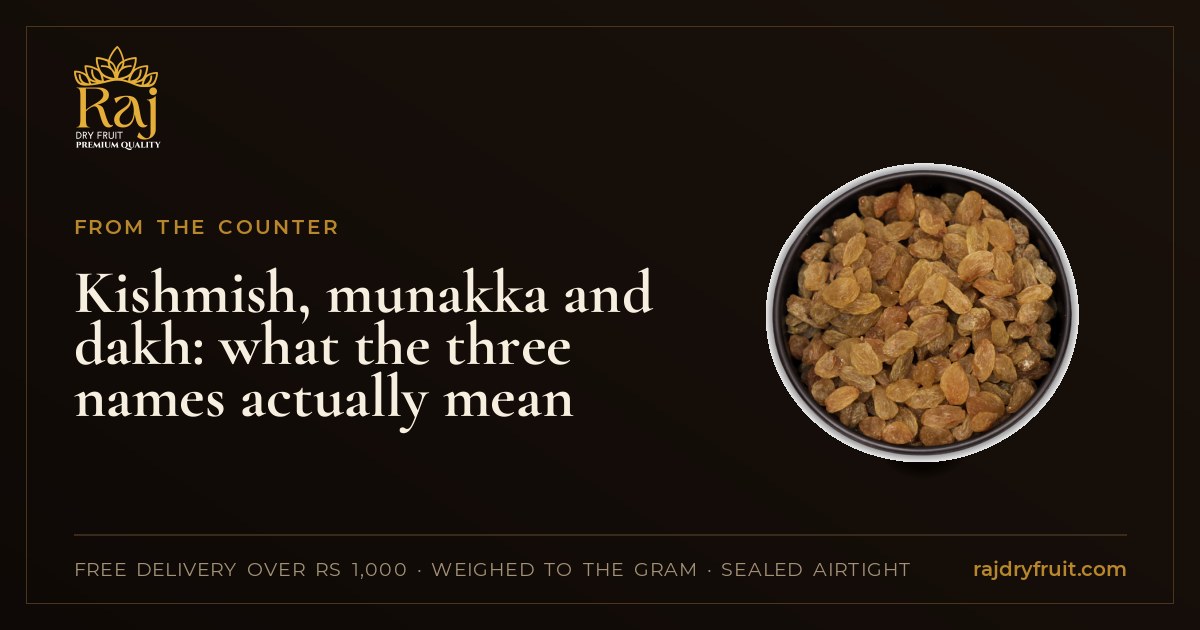
What most kitchens keep is kishmish: small, golden or pale green, no seed, sweet without much sourness. It goes into kheer, into pulao, into halwa, and it is the one children eat by the handful.
Regular Dakh is the everyday version of this. Kishmis Lambi is the long one, which is a different grape rather than a different process — noticeably sweeter and less sharp, and it holds its shape better in anything cooked.
Kali Dakh is the black seedless. It is more acidic than the golden kinds and considerably more assertive; people who find ordinary kishmish cloying usually prefer it.
Munakka is the big one, and it has seeds
This is the distinction that matters, because it is the one recipes rely on and packaging rarely explains.
Munakka — also sold as abjosh — is a large, dark, wrinkled, sticky raisin dried from a different grape, and the seeds are still in it. That is not a defect. It is the point. When a recipe or a vaidya says munakka, the seed is part of what is being asked for, and swapping in seedless kishmish is not the same thing.
We keep it in two sizes: Munakka Jumbo and Munakka Regular. The difference between those two is size alone — same fruit, same drying, larger berries.
So which one does your recipe mean?
- Kheer, sewai, halwa, pulao: kishmish. Small, seedless, dissolves into sweetness.
- Anything soaked overnight and eaten in the morning: munakka, almost always. That practice is specifically about the large seeded raisin.
- Chutney, or anything that needs sourness as well as sweetness: kali dakh.
- Eating from a bowl: whichever you like. Buy a hundred grams of two and find out.
How to tell a good one
- It should be soft but not wet. Squeeze one. It should give and spring back. A raisin that stays squashed has too much moisture in it and will ferment.
- Sugar crystals on the surface are not a good sign. They mean it has been through a temperature swing, usually from sitting somewhere warm and then somewhere cold.
- Uniform, glossy, identical golden colour is worth being suspicious of. Naturally dried fruit varies. Absolute uniformity usually means heavy treatment.
- Taste for the aftertaste. Good kishmish finishes clean. A chemical or bitter finish is treatment, and washing does not remove it.
Everything here is weighed to order, so a hundred grams of three kinds costs less than a bad kilo of one.
Wondering what it costs today? Kishmish prices are on their own page, read off the shop as the page loads.
Questions people ask
Are munakka and kishmish the same?
No. Kishmish is a small seedless raisin. Munakka, also sold as abjosh, is a large dark raisin with seeds, dried from a different grape. A recipe that asks for munakka means the seeded one, so seedless kishmish is not a straight swap.
What is the difference between black kishmish and normal kishmish?
Kali dakh, the black seedless raisin, is more acidic and less sweet than golden kishmish, so it suits chutneys and anyone who finds ordinary kishmish too sweet. Golden kishmish is the everyday choice for sweets and pulao.
How do I tell good raisins from bad ones?
Squeeze one: it should give and spring back, not stay squashed. Avoid sugar crystals on the surface, a perfectly uniform glossy colour, and any bitter or chemical aftertaste, which washing does not remove.
Which raisin should be soaked overnight?
Munakka is the raisin traditionally soaked overnight and eaten in the morning. Kishmish can be soaked too, but that practice is specifically about the large seeded raisin.
We deliver across India See 87 city pages
Written at our counter, where these questions get asked every week.