
In this guide
Quick answer
The kaju ka ped is a spreading evergreen tree, usually 6 to 12 metres tall, with broad leathery leaves. Each cashew grows outside the fruit: a yellow or red cashew apple swells from the stalk, and a single kidney-shaped nut hangs below it. One apple gives one nut, which has to be roasted and shelled by hand.
What does a cashew tree look like?
The cashew tree, Anacardium occidentale, is low and wide rather than tall, with a dense, rounded crown that often touches the ground. Its leaves are thick, glossy and oval, up to 20 cm long, and new leaves come out a coppery red. Small pinkish flowers appear in clusters at the branch tips in the cool months, from about December to February in most of India.
The tree is native to north-east Brazil. Portuguese traders brought it to the Goa and Malabar coast in the sixteenth century, partly to hold coastal soil against erosion, and it took so well that India became one of the world’s great cashew countries. The history of the cashew is a good read on how a Brazilian tree became a staple of Indian kitchens.
How does the nut actually grow?
This is the part that surprises people. The cashew nut is the true fruit of the tree, and it forms first: a small grey-green kidney shape at the end of the flower stalk. Then the stalk above it swells into a soft, juicy “apple”, yellow, orange or red, the size of a small pear. The nut stays attached underneath, outside the apple.
- One apple, one nut: every cashew apple carries exactly one nut. There is no pod or cluster.
- The apple is edible: it is juicy and astringent, and in Goa it is fermented and distilled into feni. Most apples are left in the orchard because they spoil within a day.
- The nut is in a hard shell: inside the grey shell is a layer of caustic oil that burns the skin, so nobody cracks a raw cashew by hand.
- Harvest is from the ground: farmers collect fallen apples from about February to May, twist off the nuts, and dry them in the sun.
How is a raw cashew turned into kaju?
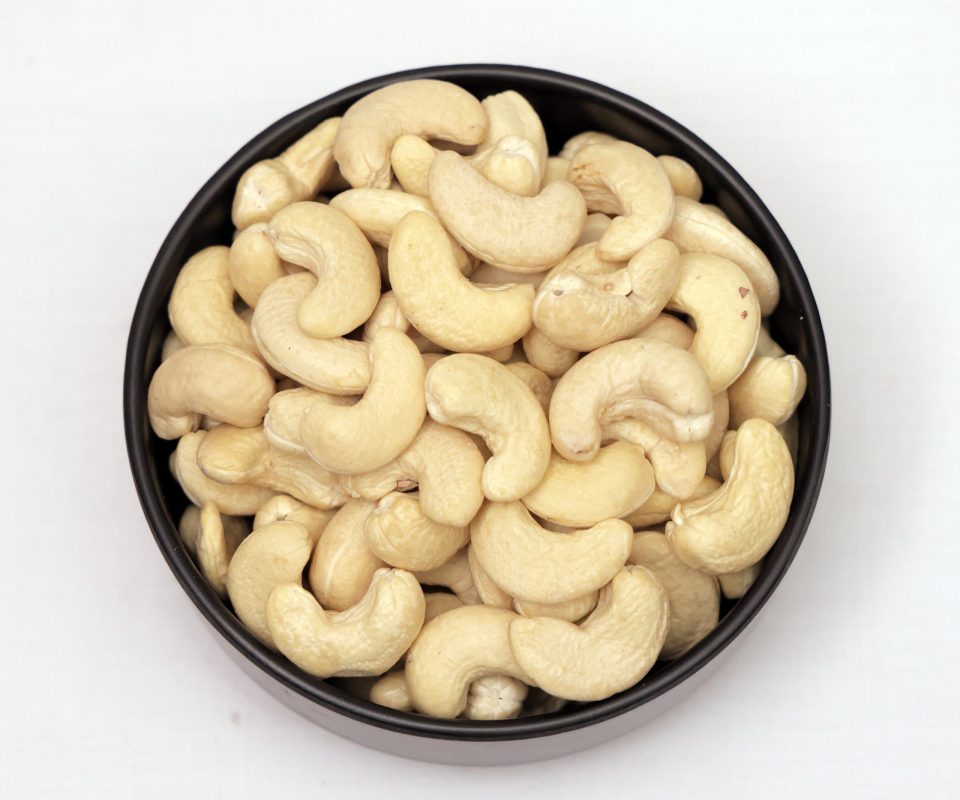
Between the orchard and your jar, every cashew goes through several careful steps, and most of them still involve hands.
- Drying: raw nuts in the shell are sun-dried for a few days so they can be stored.
- Roasting or steaming: the shells are heated so the caustic shell oil is driven off or set, making shelling safe.
- Shelling: each nut is cracked open, mostly with hand or foot-operated cutters, one at a time, to free the kernel without breaking it.
- Drying again: kernels are dried to loosen the thin brown skin, the testa.
- Peeling: the testa is scraped off, again largely by hand.
- Grading: kernels are sorted by size, colour and whether they are whole, halves or pieces.
Kerala’s Kollam is famous for this work, and coastal Maharashtra, Goa, Karnataka, Andhra Pradesh, Odisha and Tamil Nadu all grow and process cashew.
Why does this make kaju a dear nut?
Because the numbers work against the buyer at every step. A cashew apple gives one nut, and only around a quarter of the raw nut’s weight ends up as edible kernel. Roughly 4 kg of raw cashew in the shell yields about 1 kg of kaju. Then every kernel is shelled and peeled with care, and whole kernels fetch more than broken ones, so careful hands are worth paying for.
| Step | What is lost or added | Effect on price |
|---|---|---|
| Orchard | One nut per apple, seasonal harvest | Limited supply |
| Shelling | About three quarters of the weight is shell and skin | Kernel costs far more than raw nut |
| Hand labour | Each nut shelled and peeled individually | High processing cost |
| Grading | Whole, large kernels are a small share | Jumbo and whole grades cost most |
| Breakage | Halves and pieces separated out | Kaju faad and tukda cost less |
That last row is the useful one for a kitchen. Broken kaju is the same nut that cracked in the shelling, sold for less because it is not whole. Our guide to kaju grades explains every size and count.
What does kaju cost today, by grade?
Today kaju works out to at today's shop rate across our grades. The largest whole kernels, Jumbo Cashew, are at today's shop rate. The mid grade most homes keep in the jar, Super Cashew, is at today's shop rate. Kaju faad, the halves that split in shelling, is at today's shop rate and is the sensible choice for gravies, kheer and kaju katli. The full list is on the kaju price page.
If you want to know more about the coastal kaju that started it all in India, read our piece on Goa kaju. All our cashew grades are in the cashew collection.
At Raj Dry Fruit, orders start at ₹1,000 and every order ships free. A sensible household basket is 500 g Super Cashew for the jar, 250 g kaju faad for cooking, 500 g badam and 250 g pista, which covers a month of snacking and cooking.
How long does a cashew tree take to bear?
Grafted cashew trees start bearing in their third year and reach full yield at around seven to ten years. A mature tree in a well-run Indian orchard gives roughly 8 to 10 kg of raw nuts a season, which works out to only about 2 to 2.5 kg of kaju. Trees go on bearing for decades. Dwarf and grafted varieties developed in India are smaller, easier to harvest, and bear sooner.


Questions people ask
Kaju ka ped kaisa hota hai?
It is a low, wide evergreen tree with large, glossy, oval leaves and a dense crown. It flowers in winter, and in spring each flower stalk swells into a red or yellow cashew apple with a single nut hanging below it. Trees are usually 6 to 12 metres tall.
How does cashew grow on the tree?
The nut forms first at the end of the flower stalk, and then the stalk above swells into the cashew apple. The nut stays outside the apple, attached at the bottom. Each apple has exactly one nut.
Where are cashew trees grown in India?
Cashew trees grow mainly along the coasts: Maharashtra’s Konkan, Goa, Karnataka, Kerala, Tamil Nadu, Andhra Pradesh and Odisha. They need warm weather and well-drained soil. Kerala’s Kollam is a major processing centre.
Why can’t you eat a raw cashew from the tree?
The shell contains a caustic oil that irritates and burns the skin and mouth. Nuts are roasted or steamed before shelling to deal with it. The kaju you buy has already been shelled and cleaned, so it is safe to eat.
Written at our counter, where these questions get asked every week.


