
In this guide
Quick answer
Akhrot halwa is made by coarsely grinding walnut kernels, roasting them slowly in ghee until fragrant, then cooking them with milk and sugar until the mixture thickens and leaves the pan. For four people you need about 200 g walnut kernels, 3 tablespoons of ghee, 400 ml milk and 100 g sugar. Fresh kernels keep it sweet, never bitter.
What is akhrot halwa?
Akhrot ka halwa is a rich winter sweet from North India and Kashmir, where walnuts are harvested every autumn. It is made like badam halwa or moong dal halwa: the nut is ground, roasted in ghee, and cooked down with milk and sugar. The result is a dense, nutty, gently sweet halwa, darker than badam halwa, with a toasty walnut taste.
Halwa in its many forms is found from the Middle East to South Asia; the Wikipedia page on halva traces the family. Walnut halwa is one of the less common versions, which is why it feels special when it appears on a winter table.
What do you need for walnut halwa for four?
| Ingredient | Amount | Note |
|---|---|---|
| Walnut kernels | 200 g | Four-piece kernels are ideal |
| Ghee | 3 to 4 tbsp | Walnuts are oily; they need less ghee than badam |
| Full-cream milk | 400 ml | Or 150 g mawa for a richer halwa |
| Sugar | 100 to 120 g | Adjust to taste |
| Green cardamom | 4 pods, powdered | Added at the end |
| Saffron | A pinch, optional | Soaked in a spoon of warm milk |
| Badam slivers | 1 to 2 tbsp | Garnish |


How is akhrot halwa made, step by step?
- Taste a kernel first. If it is bitter, the halwa will be bitter. Use fresh kernels only.
- Soak (optional). Soak the walnuts in hot water for 30 minutes, then drain. This softens the skin’s tannin and makes a smoother halwa.
- Grind coarsely. Pulse in a mixer to a coarse crumb, like semolina. Do not make a paste; walnuts turn oily if ground too long.
- Roast in ghee. Heat the ghee in a heavy kadai, add the walnuts, and roast on low heat, stirring constantly, for 8 to 10 minutes until fragrant and a shade darker. Walnuts burn faster than badam, so stay at the stove.
- Add milk. Pour in the milk and keep stirring. It will bubble and then slowly thicken, 10 to 12 minutes.
- Add sugar. Once most of the milk is absorbed, add sugar and saffron. The halwa loosens, then thickens again.
- Finish. Cook until it leaves the sides of the pan and the ghee starts to show at the edges. Stir in cardamom.
- Serve warm, topped with badam slivers.
Why do fresh kernels matter so much?
Walnuts are among the oiliest nuts, and their oil goes stale faster than that of badam or kaju. A walnut that has sat through a warm summer can taste sharp and bitter, and roasting only makes that bitterness stronger. A badam halwa forgives an older nut; an akhrot halwa does not.
That is why this is a winter dish. The new walnut crop arrives from Kashmir in October and November, and kernels from the new season are sweet and mild. Our post on why walnuts turn bitter explains what heat and humidity do to them, and how to store them.
Why are four-piece kernels the right buy?
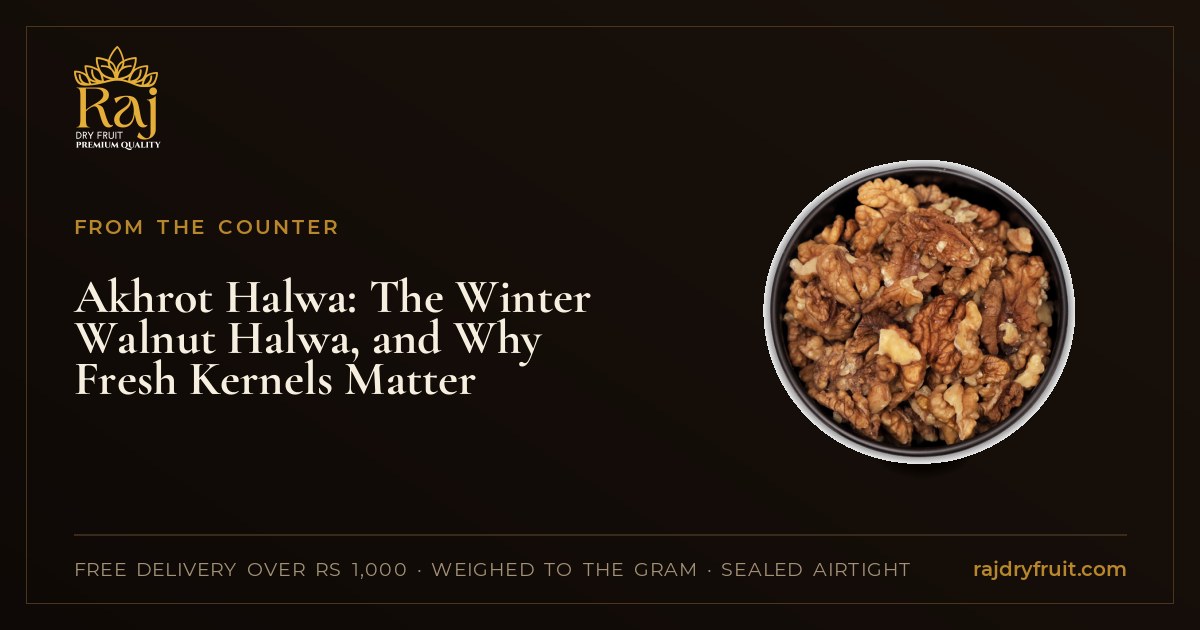
Because the walnuts are ground anyway. Walnut halves look beautiful in a bowl, and that look costs money. Four-piece kernels are the same nut, broken into quarters during shelling, and they cost less. In a halwa, a brownie, a laddoo or a chutney, nobody can tell the difference.
- Four pieces: halwa, laddoo, baking, chutney.
- Two pieces (halves): snacking, salads, garnish, gift jars.
- In shell: the table, cracking by the fire, long storage.
Akhrot today works out to at today's shop rate. Walnut Kernels Four Pieces come in at today's shop rate, and the halves are at today's shop rate. Badam for the garnish is at today's shop rate. Every grade is on the akhrot price page.
Can you make it with less sugar or no milk?
Yes. Two common variations:
- Jaggery: replace sugar with grated jaggery, added off the heat once the milk is absorbed, then cooked briefly. It turns darker and deeper.
- Mawa instead of milk: crumble 150 g mawa into the roasted walnuts and cook five minutes. Quicker, richer, and closer to a barfi texture.
- Dates: some cooks blend 6 to 8 soft dates into the milk and cut the sugar by half.
Walnut halwa keeps three to four days in the fridge. Warm it with a spoon of milk before serving.
How much to buy for the season?
One batch for four uses 200 g of kernels. Most families make it two or three times a winter, alongside gajar halwa and laddoos. A practical winter basket is 500 g four-piece walnut kernels, 500 g badam, 500 g kaju and 250 g pista; orders start at ₹1,000 and every order ships free. Our winter dry fruits page gathers everything for the season, and every walnut grade is in the walnut collection.

Questions people ask
What is the walnut halwa recipe in short?
Coarsely grind 200 g walnuts, roast in 3 tablespoons of ghee on low heat for 8 to 10 minutes, add 400 ml milk and cook until absorbed, then add 100 g sugar and cook until it leaves the pan. Finish with cardamom and badam slivers.
Why is my akhrot ka halwa bitter?
Usually because the walnuts were old or the halwa was roasted too hot. Stale walnut oil turns bitter, and walnuts scorch quickly. Use fresh kernels, taste one first, and roast on low heat.
Should walnuts be soaked for halwa?
It is optional. A 30-minute soak in hot water softens the skin and gives a smoother, slightly milder halwa. Drain well before grinding.
Can akhrot halwa be made with mawa?
Yes. Use about 150 g mawa in place of the milk, added after roasting the walnuts. It is quicker and richer, with a texture close to barfi.
Written at our counter, where these questions get asked every week.


