
In this guide
- Which grapes become kishmish?
- How does a grape turn into a raisin, step by step?
- Why are some raisins green, some golden and some black?
- What does the drying method mean for the pack you buy?
- How do you tell a well-made kishmish from a poor one?
- How much kishmish does a home use, and how to order it?
- FAQs
Quick answer
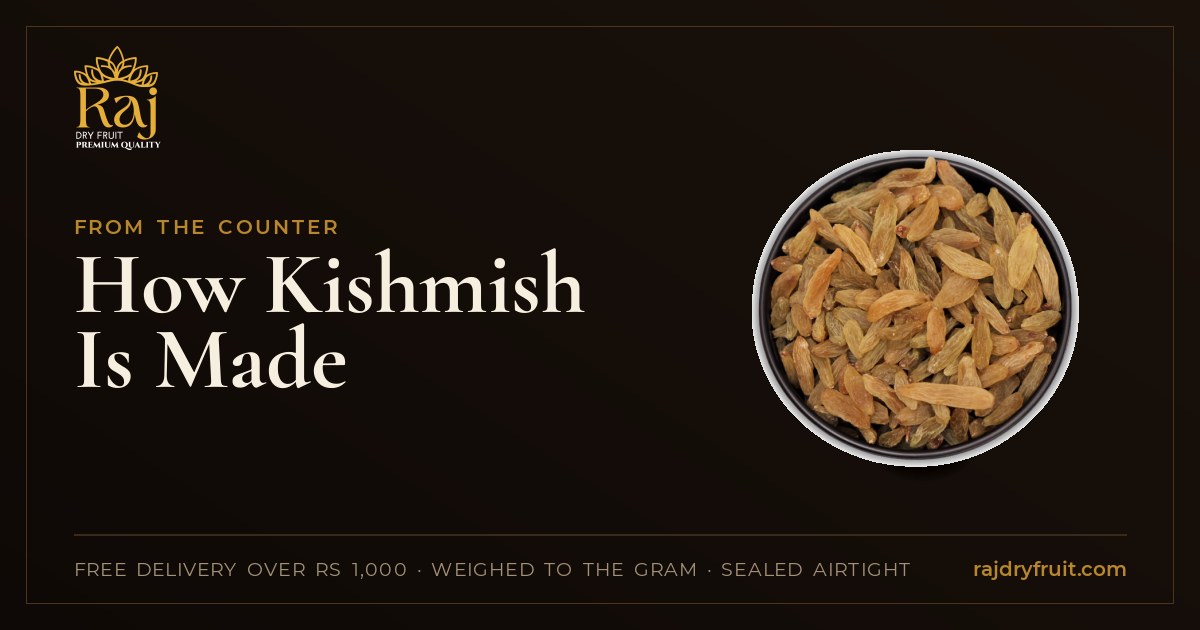
Kishmish kaise banta hai: seedless grapes are picked ripe, dipped briefly in a food-grade drying oil solution that loosens the waxy skin, then spread on racks in shaded, airy sheds for roughly two weeks until they lose about three quarters of their weight. Shade drying keeps them green; drying in open sun turns them dark.
Which grapes become kishmish?
Almost all Indian kishmish starts as a seedless table grape, mainly Thompson Seedless and its local selections such as Sonaka and Manik Chaman. These grapes are thin skinned, sweet and seedless, which is exactly what a raisin needs. Black kishmish comes from black seedless varieties such as Sharad Seedless and Krishna Seedless, grown in the same belts.
The heart of Indian raisin making is the Nashik, Sangli and Solapur belt of Maharashtra and the Vijayapura (Bijapur) district of Karnataka. The grapes are harvested between February and April, when the weather is dry and hot, which is the only reason open-air drying works at all.
How does a grape turn into a raisin, step by step?
The steps below are the ones followed in most drying sheds in the Sangli and Nashik belt.
- Harvest and sort. Bunches are cut when sugar is high, usually above 20 to 22 degrees Brix. Damaged and unripe berries are picked out.
- Dip. The grapes are dipped for a few minutes in a solution of potassium carbonate and a food-grade drying oil (ethyl oleate). This cracks the waxy bloom on the skin, so moisture can leave quickly. Without the dip, drying takes far longer and the colour goes muddy.
- Spread on racks. The dipped bunches go onto wire or bamboo racks stacked in tall sheds with shade-net walls. Air moves through; direct sun does not.
- Dry for 12 to 15 days. The grape goes from about 80 percent water to around 15 percent. Roughly four kilos of fresh grapes give one kilo of kishmish.
- Clean and grade. Stalks are shaken off, the raisins are washed, sorted by size and colour, and lightly coated with a little edible oil so they stay loose rather than clumping.
Nothing is added for sweetness. All of the sugar in a kishmish was already in the grape, simply concentrated.


Why are some raisins green, some golden and some black?
The colour comes from how the grape was dried, and from which grape it was. That is the one fact that explains every pack on the shelf.
| Raisin | Grape | How it is dried | Taste and use |
|---|---|---|---|
| Green kishmish (lambi dakh) | Green seedless, long berry | Shade dried in sheds, after the dip | Tangy-sweet, firm; snacking, sheera, pulao |
| Golden kishmish | Green seedless | Dried indoors, often with sulphur dioxide to hold the light colour | Mild, soft; cakes, fruit bread, garnish |
| Brown, sun dried | Green seedless | Open sun, no shade | Deeper, caramel sweetness; everyday cooking |
| Black kishmish (kali dakh) | Black seedless | Shade or sun dried | Rich, slightly winey; soaking, kheer, halwa |
| Munakka | Large seeded grape | Sun dried, slower | Very sweet, soft, with seeds; soaking, winter use |
Green raisins vs golden raisins is mostly a question of sun and sulphur. Shade-dried green kishmish keeps the grape’s own colour and a bit of tartness. Golden raisins have been dried without browning, which is why they look almost translucent. Sun-dried raisins brown naturally as the sugar darkens, the same way onions brown in a pan. If you want the difference between kishmish, munakka and dakh laid out by size and seed, our guide to the kishmish, munakka and dakh difference goes through it pack by pack.
What does the drying method mean for the pack you buy?
It tells you what the kishmish will do in your kitchen.
- Lambi dakh (long green kishmish) is the one to keep in a jar for eating. It has bite and a clean, tangy finish.
- Regular dakh is a smaller, everyday kishmish, the sensible buy for sheera, sooji halwa, biryani and poha, where it softens anyway.
- Black kishmish is the soaking raisin. Ten to fifteen soaked overnight is a common morning habit, and it colours kheer a pleasant dusky shade. More on that in our black raisins guide.
Today green kishmish works out to at today's shop rate, and munakka, the large seeded raisin, comes to at today's shop rate. Black kishmish pack sizes are at today's shop rate. Every grade and size sits together on the kishmish price page.
How do you tell a well-made kishmish from a poor one?
A well-dried kishmish is even in colour, loose in the pack, slightly firm when pressed, and smells of grape rather than of anything sour. Check four things when the pack arrives:
- Stickiness. Raisins that clump into a ball have been stored warm or were under-dried.
- Stalks and grit. A few stalks are normal; sand is not. Good cleaning removes nearly all of both.
- Sugar crystals. White specks on the surface are the raisin’s own sugar coming out with age. Harmless, but a sign the lot is old.
- Smell. A fermented, vinegar smell means moisture got in. Do not eat it.
Washing kishmish in a sieve under running water before use is a good habit with any brand. Keep it airtight, away from the stove, and in summer in the fridge. Stored this way it holds well for six to nine months.
How much kishmish does a home use, and how to order it?
A family of four that adds kishmish to sheera, poha and the odd pulao, and snacks on a handful now and then, gets through about 250 g a month. Add a daily soaking habit and it rises to 400 to 500 g. Winter laddoos and Diwali sweets push it higher.
Kishmish rarely goes into an order alone. A sensible household basket is 500 g kaju, 500 g badam, 250 g pista and 250 g lambi dakh, which keeps the kitchen covered for a month. Our kishmish and raisin collection has all three colours side by side, orders start at ₹1,000 and every order ships free.

For background on how drying methods differ around the world, the Wikipedia entry on raisins covers sun drying, dipping and mechanical dehydration.
Questions people ask
How are raisins made at home?
Wash seedless grapes, dip them for a minute in hot water to crack the skin, and dry them on a tray in a warm, airy, shaded spot for one to two weeks, turning daily. An oven at its lowest setting with the door ajar works in about 24 to 36 hours. Home raisins come out darker and less even than shed-dried ones.
How is kishmish made in India?
Mostly in drying sheds in the Nashik, Sangli and Vijayapura belts. Ripe seedless grapes are dipped in a potassium carbonate and drying-oil solution, then shade dried on racks for about two weeks, cleaned, graded by size and colour, and packed.
Is green kishmish better than golden kishmish?
Neither is better; they suit different uses. Green kishmish is firmer and tangier and is the better snacking raisin. Golden raisins are softer and milder, and suit baking. Their nutrition per gram is very similar.
Is oil added to kishmish?
A very light coat of edible oil is applied after cleaning so the raisins stay separate. It is a thin film, not frying. Rinsing kishmish in water before eating removes most of it along with any dust.
Written at our counter, where these questions get asked every week.