
In this guide
Quick answer
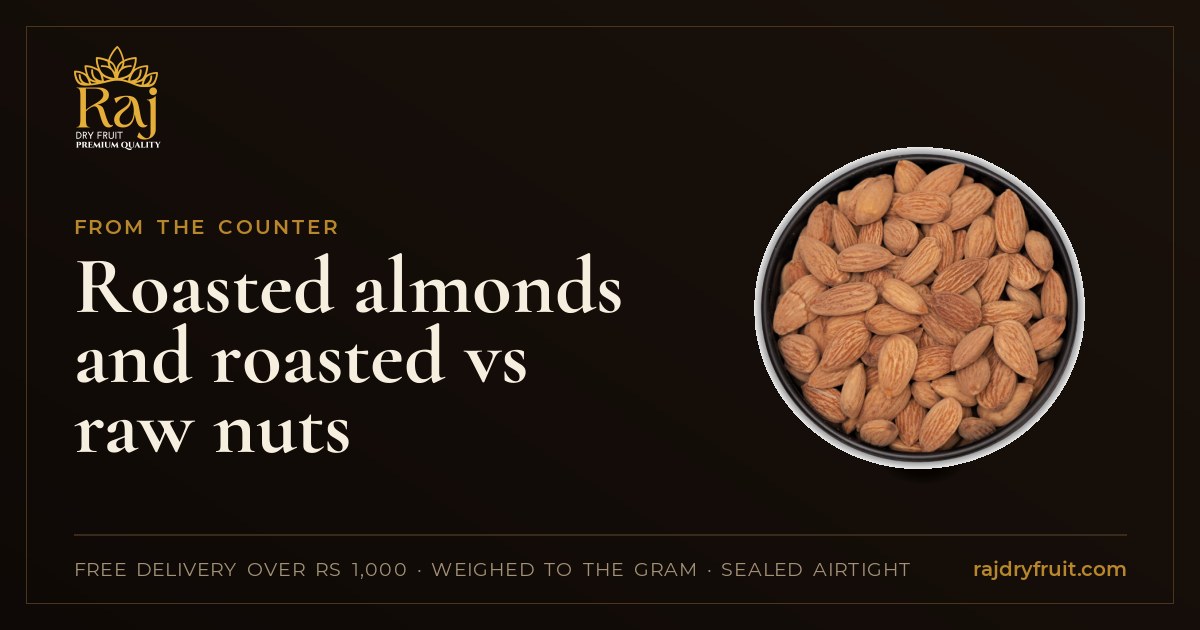
Roasted almonds are raw almonds heated, usually without oil, until they turn crunchy, lightly golden inside and toasty in flavour. Roasting changes the taste and texture far more than the nutrition: a roasted almond has nearly the same protein, fat and fibre as a raw one. The main trade-off is that roasted nuts go stale sooner.
So the choice between roasted and raw is mostly about how you will eat them. Raw almonds suit soaking, grinding and cooking. Roasted almonds suit snacking straight from the jar, and they are what most people mean when they say a nut “tastes like a nut”.
What is the difference between roasted and raw nuts?
Roasting drives out moisture and browns the nut, which makes it crunchier and gives it a deeper, toasty flavour. Raw nuts are softer, milder and keep longer.
| Point | Raw | Dry-roasted | Roasted and salted |
|---|---|---|---|
| Texture | Firm, slightly waxy | Crisp, crunchy | Crisp, crunchy |
| Flavour | Mild, milky | Toasty, nutty | Toasty, savoury |
| Keeps (sealed, cool) | Several months | A few weeks once open | A few weeks once open |
| Best for | Soaking, cooking, sweets | Snacking, garnish | Snacking with tea |
| Salt | None | None | Added |
On nutrition, the difference is small. Per 100 g, almonds provide about 580 kcal, about 21 g of protein, about 50 g of fat, mostly unsaturated, about 12 g of fibre and a good amount of vitamin E. Dry roasting removes a little water, so the figures per 100 g creep up slightly, and a little of the vitamin E is lost to heat. For everyday eating these differences do not matter much. What matters more is whether oil or salt has been added.
Are roasted almonds better than soaked or raw almonds?
Neither is better; they do different jobs. Soaked almonds are the traditional morning habit in many Indian homes, peeled and eaten soft. Raw almonds are what you grind for badam milk or halwa. Roasted almonds are the snack.
If you want to soak and peel, buy raw, such as Regular Badam or Mamra Badam Regular. Our guide on Mamra or Californian almonds explains the difference between the two. If you want a ready snack, Roasted Almonds (Badam) saves you the work.
How do you roast almonds at home in a pan?
Dry-roast almonds in a heavy pan on low to medium heat for about 8 to 12 minutes, stirring constantly, until they smell toasty and the inside turns light golden. Cut one open to check, because the skin hides the colour.
- Heat a thick kadhai or tawa on medium, then lower the heat.
- Add the almonds in a single layer. Roast in batches if needed.
- Stir every 30 seconds. Almonds brown from the outside in and scorch easily on one side.
- After about eight minutes, cut one in half. You want a pale golden inside, not white and not brown.
- Tip them onto a plate straight away. They keep cooking in a hot pan.
- Cool completely before storing. They turn crisper as they cool.
How do you roast almonds and kaju in an oven?
Spread the nuts in one layer on a tray and roast at about 160 to 170°C. Almonds take roughly 10 to 15 minutes and cashews about 8 to 12 minutes; stir halfway and check early, because ovens vary.
- Almonds: ready when fragrant and light golden inside.
- Kaju: ready when evenly pale gold. Cashews colour faster than almonds and go from golden to burnt quickly, so watch the last few minutes.
- Pan-roasting kaju: use low heat and stir all the time; five to eight minutes is usually enough.
- A small microwave batch: possible in short bursts with stirring in between, but it is easy to burn the centre, so a pan is more forgiving.
For roasting, Regular Cashew is the sensible choice. There is no need to roast the largest grade, as our kaju grades guide explains.
Should you buy salted or unsalted roasted nuts?
Unsalted is the better everyday choice, and salted is fine as an occasional snack. Salted nuts are easy to overeat, and the salt adds up if you are already watching how much you have.
If you have high blood pressure, a kidney condition or have been told to limit salt, ask your doctor and stick with unsalted. To salt nuts lightly at home, sprinkle the hot roasted nuts with a few drops of salted water and toss them in the warm pan until dry, so the salt sticks without any oil.
For flavoured options, we keep Kaju Roasted and Roasted Pistachio, and our roasted and salted nuts page shows the full range.
How long do roasted almonds last?
Home-roasted almonds are best within two to three weeks in an airtight jar. Raw almonds, kept sealed in a cool, dark place, last several months.
- Roasting brings oil to the surface, and that oil meets air, which is why roasted nuts go stale faster.
- Keep roasted nuts in small, full jars rather than one big half-empty one.
- In hot or humid weather, the fridge extends their life.
- Stale roasted nuts taste flat or bitter and smell sharp. No amount of re-roasting fixes rancid oil.
We send roasted and raw nuts across India; orders start at ₹1,000 and every order ships free. See today’s price on the Roasted Almonds (Badam) page, or browse our almonds shelf.
Questions people ask
Do roasted almonds have more calories than raw?
Almost the same. Dry-roasted almonds lose a little water, so the figure per 100 g is slightly higher, and oil-roasted nuts add a little more.
How many roasted almonds can you eat a day?
A small handful, about 20 to 30 g, is a common everyday serving for an adult. Whole nuts are a choking risk for children under five, so crush or grind them for small children.
Can you roast soaked almonds?
Yes, but pat them completely dry first and roast longer on low heat. They will be crunchy but slightly denser than roasted dry almonds.
Should roasted almonds be kept in the fridge?
If you will not finish them within a couple of weeks, or the weather is hot and humid, yes. Keep them in an airtight jar so they do not pick up smells.
Is roasting almonds with ghee a good idea?
A few drops of ghee help seasoning stick and add flavour. It also adds fat, so dry roasting is the lighter option for daily snacking.
We deliver across India See 87 city pages
Written at our counter, where these questions get asked every week.


