
In this guide
Quick answer
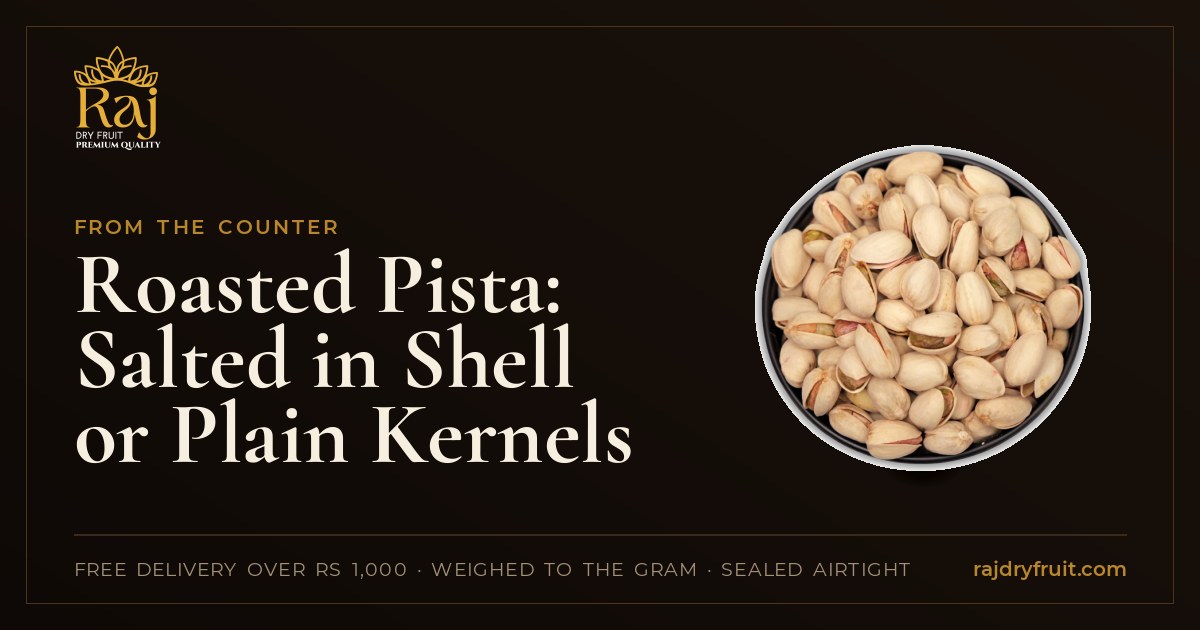
Roasted pista in shell is better for snacking and guest bowls, because cracking the shell slows people down and the salt roast brings out the flavour. Plain pista kernels are better for cooking, sweets, soaking and children, because they are ready to use and carry no added salt. Neither is better nutritionally; they simply suit different jobs.
What is the difference between roasted pista and pista kernels?
Both come from the same nut. Roasted pista is sold in its naturally split shell, dry-roasted and usually salted, so you crack it open as you eat. Pista kernels are shelled, unroasted and unsalted, the green nut ready for sweets or a handful at breakfast.
| Roasted salted pista in shell | Plain pista kernels | |
|---|---|---|
| How it is sold | In the split shell, roasted with salt | Shelled, raw, unsalted |
| Taste | Toasty, savoury, moreish | Mild, sweet, fresh green |
| Best for | Guest bowls, tea time, drinks, travel | Mithai, kheer, kulfi, badam milk, children |
| Edible share of the weight | Roughly half, the rest is shell | All of it |
| Keeps after opening | 3 to 4 weeks crisp in a jar | 2 to 3 months, longer in the fridge |
Which is better value per gram of nut?
Compare by the nut you actually eat, not by the pack weight. A kilo of pista in shell gives roughly half a kilo of kernel once the shells are off, so in-shell pista that looks cheaper per kilo is often close to kernels per gram of nut. You pay for the roasting, the salt and the pleasure of cracking them open.
Across our pista grades, the rate works out to at today's shop rate today. Roasted Pistachio packs are at today's shop rate, and Pista Kernels come to at today's shop rate. The pista price page lists every pack and grade side by side.


How do you tell a fresh roast?
Roasted pista goes stale faster than raw kernels, and a tired batch is easy to spot once you know what to look for:
- Shells split open. Most nuts should be naturally gaping. A bag with many closed shells is a poorer grade, and the closed ones are hard to open.
- Kernel colour. Green to green-gold under a thin purple-brown skin. Very pale or dull brown kernels suggest an old or over-roasted lot.
- Crunch. A fresh roast snaps. A chewy or bendy kernel has absorbed moisture.
- Smell. Toasty and clean. A paint-like or bitter smell means rancid oil.
- Salt. Lightly salty on the shell and the lips. A thick white crust often covers a stale nut.
Our best quality pista post goes deeper into grading, and the roasted vs raw nuts post covers how roasting changes taste and shelf life.
How much salt and energy is in roasted pista?
Pistachios are rich in energy whichever way you buy them. USDA FoodData Central lists dry-roasted salted pistachio kernels at roughly 570 kcal and about 21 g of protein per 100 g, with most of the remainder as fat and fibre. The salt adds sodium that unsalted kernels do not have. For anyone watching salt or blood pressure, plain kernels are the sensible choice, and a doctor can advise on portions. A small handful of 25 to 30 kernels is a typical serving.
How much roasted pista for Diwali guests?
Roasted pista is a Diwali guest-bowl staple, partly because the shells keep anyone from finishing the bowl too quickly. As a guide:
- A bowl for six to eight guests over an evening: 150 to 200 g in shell.
- Open house over the five festival days: 500 g to 1 kg in shell.
- Pista for sweets and kulfi through the season: 250 g kernels.
Put out a small empty bowl for shells beside the pista. It keeps the table tidy and guests take that as a cue to help themselves.
Roasted pista also mixes well with other roasted nuts. A three-part bowl of roasted pista, roasted kaju and roasted badam gives guests a choice, and the pista, being the slowest to eat, lasts longest. If you are building a Diwali gift as well, a jar of roasted pista in shell sits well beside a jar of plain kernels for the recipient who likes to cook.
How should you store it, and what should you order?
Move roasted pista into an airtight glass jar as soon as the pack is opened. Keep it away from the stove and sunlight. In humid cities, keep most of it in the fridge and a small serving jar outside. Kernels keep longer, and in the fridge they stay fresh for three to four months.
Our orders start at ₹1,000 and every order ships free. A practical Diwali basket clears it easily: 500 g roasted pista in shell for the guest bowl, 250 g pista kernels for sweets, and 500 g roasted kaju or 500 g badam. Every salted and roasted option is on the roasted salted nuts page, and every pista grade is in the pistachio collection.

Questions people ask
What is the roasted pistachio price for 1kg?
It moves with the market, so the live figure is on the product page and the pista price page. Remember that about half of in-shell weight is shell when you compare it with kernels.
Is salted pista in shell healthy?
The nut is the same as an unsalted one, but the salt adds sodium. If you are watching salt, choose plain kernels and keep salted pista for occasional guest bowls.
Why are some pista shells closed?
The shell splits naturally as the nut ripens. Closed shells usually hold less mature nuts, which is why better grades have few of them.
Can I use roasted salted pista in sweets?
It is better not to, as the salt shows in mithai and kheer. Use plain pista kernels or pista katran for sweets and keep the roasted pista for snacking.
Written at our counter, where these questions get asked every week.