In this guide
Quick answer
A classic mohanthal recipe for one 9-inch tray uses 500 g coarse besan, about 300 g ghee and a one-string sugar syrup, and is topped with roughly 25 g badam katran, 25 g pista katran and 15 g charoli pressed into the surface. The grainy texture comes from rubbing the besan with ghee and milk first.
What is mohanthal?
Mohanthal is a dense, fudge-like Gujarati and Rajasthani sweet made from roasted gram flour, ghee and sugar, cut into squares or diamonds. It is a fixture of the Diwali thali in Gujarati homes, especially in Ahmedabad, Surat and Rajkot, and is also offered at Shrinathji temples in Nathdwara. Its name is linked to Krishna, Mohan, as the Wikipedia entry on mohanthal notes. A good mohanthal is grainy, not smooth, and rich with ghee without being greasy.
Every family has its own version. Some add mawa for a softer, richer bite; some use only ghee and besan for a firmer, longer-keeping sweet. Kathiawadi homes often make it darker, roasting the besan longer, while Surat homes tend to keep it lighter and generously topped. Whichever style you follow, the toppings are the same three dry fruits, and they are what make a tray look festive on the Diwali table. Families in Surat can find delivery details on our buy dry fruits in Surat page.
Which dry fruits go on mohanthal, and how much for one tray?
Three dry fruits are traditional on top, and they are cut fine so they sit flat on the surface.
| Topping | For one 9-inch tray | What it adds |
|---|---|---|
| Badam katran (thin slivers) | 25 g, about 3 tbsp | Pale flakes, mild crunch |
| Pista katran (green slivers) | 25 g, about 3 tbsp | Colour and a fresh nutty taste |
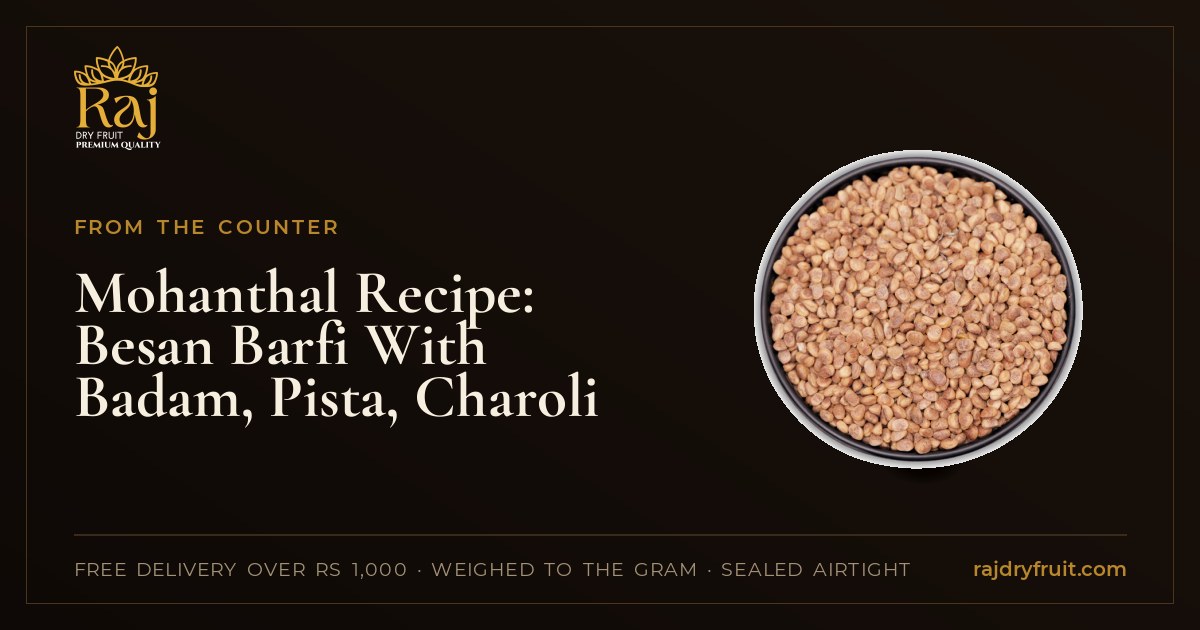
| Charoli (chironji) | 15 g, about 2 tbsp | Tiny, lentil-like, soft almond flavour |
| Kesar strands, optional | 10 to 12 strands | Colour and aroma |
Some families also mix a spoon of chopped pista and charoli into the batter itself. For two trays, which most Gujarati households make before Diwali, double the toppings. Ready-cut katran saves an hour of slicing, and evenly cut slivers look better than hand-chopped ones.


How do you make mohanthal at home?
You need 500 g coarse besan (ladoo besan), 300 g ghee, 3 tbsp milk, 400 g sugar, 200 ml water, half a teaspoon of elaichi powder, a pinch of nutmeg and 100 g mawa if you like it richer.
- Dhabo: rub 3 tbsp warm ghee and 3 tbsp warm milk into the besan with your fingertips. Rest it 30 minutes, then pass it through a coarse sieve. This step gives mohanthal its signature grain.
- Roast: heat the rest of the ghee in a heavy kadhai, add the besan and roast on low heat for 25 to 30 minutes, stirring constantly, until golden brown and nutty.
- Mawa: if using, crumble it in during the last 5 minutes.
- Syrup: in a separate pan, boil sugar and water to a one-string consistency with the kesar.
- Combine: switch off the heat under the besan, add elaichi and nutmeg, then pour in the syrup and stir quickly. It will bubble and thicken.
- Set: pour into a greased tray, level it, and immediately scatter badam katran, pista katran and charoli over the top. Press them in gently with a flat katori.
- Cut: rest 3 to 4 hours, then cut into 25 to 30 pieces.
Why does mohanthal go wrong, and how do you fix it?
- Hard as a brick: the syrup was cooked beyond one string. Next time take it off sooner.
- Soft and will not set: syrup undercooked or besan under-roasted. Rewarm gently and stir for a few minutes more.
- Toppings fall off: they were added after the surface set. Scatter them within a minute of pouring.
- Raw taste: the besan needed more roasting. The colour should be a deep gold, and the smell nutty.
What do the toppings cost?
The garnish is a small share of the tray’s cost, but it is the part guests see first. Charoli works out to at today's shop rate today, and because a tray uses only 15 g, a 100 g pack covers several batches. Pista katran packs come to at today's shop rate, and badam katran packs are at today's shop rate. The charoli price page lists every pack, and our pista kernels, katran and pishori post explains which pista cut to use where.
Our orders start at ₹1,000 and every order ships free. A Gujarati Diwali kitchen making mohanthal, ghughra and mathiya usually needs 100 g charoli, 100 g pista katran, 100 g badam katran, plus 500 g kaju and 500 g badam for the rest of the sweets and the guest bowl, which clears the minimum comfortably.

Where do Ahmedabad and Surat homes buy for Diwali?
Most Gujarati households now buy their Diwali dry fruit online in the last two weeks of October. Diwali falls on Sunday 8 November this year, so ordering by the end of October leaves time to make mohanthal a few days ahead. Our Raj Dry Fruit online in Ahmedabad page has delivery details for the city, and all pista cuts are in the pistachio collection.
Questions people ask
Why is mohanthal grainy?
Because of the dhabo step, where besan is rubbed with ghee and milk and sieved before roasting. It creates small clusters that stay as soft grains in the finished sweet.
What are the main Gujarati Diwali sweets?
Mohanthal, ghughra, magas, sukhdi, mathiya and chorafali are the usual set. Many of them use badam, pista, charoli or kishmish.
What is charoli used for in sweets?
Charoli is sprinkled on mohanthal, shrikhand, kheer and halwa, and mixed into ghughra filling. It gives a soft crunch and a mild, almond-like taste.
How long does mohanthal keep?
About two weeks at room temperature in an airtight tin, and a little longer in the fridge. Bring it to room temperature before serving so the ghee softens.
Written at our counter, where these questions get asked every week.