In this guide
Quick answer
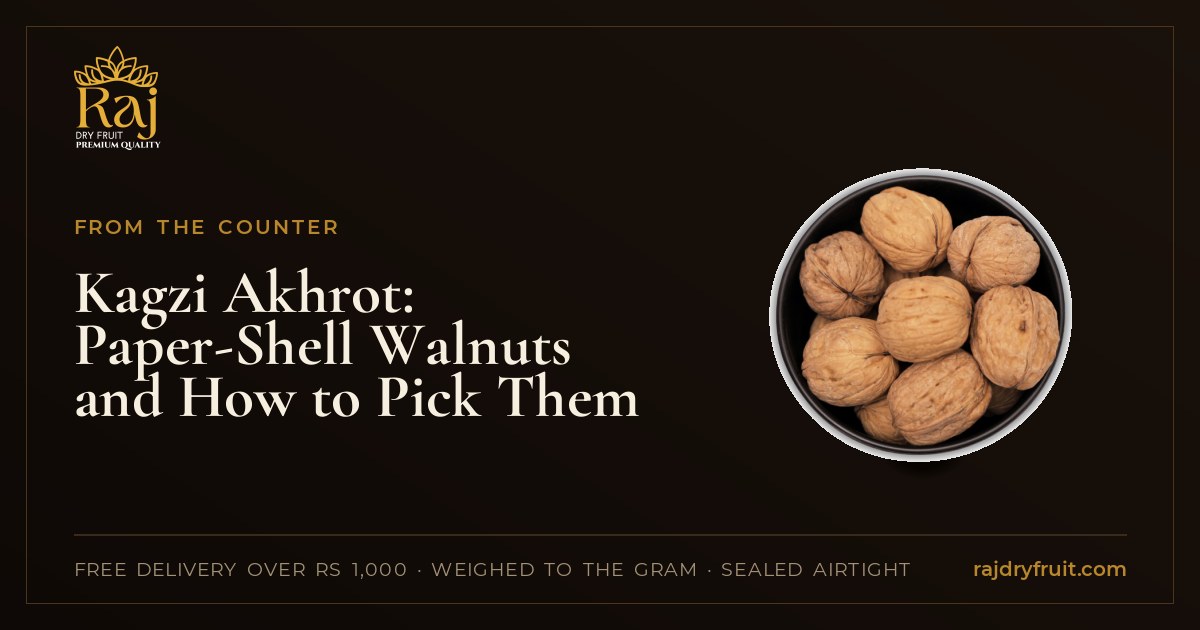
Kagzi akhrot is a walnut with a shell so thin, “kagaz” or paper-like, that you can crack it between two walnuts or with your palm, no nutcracker needed. Most kagzi walnuts in India come from Kashmir and Himachal. The thin shell means more kernel per kilo, and the new crop reaches shops in October and November.
What makes a walnut “kagzi”?
Kagzi describes the shell, not the kernel. Walnut trees in Kashmir are mostly grown from seed rather than grafted, so every orchard holds trees with different shells. Traders sort the crop into three broad types:
- Kagzi: paper-thin shell, cracks by hand, kernel usually comes out in two clean halves.
- Medium shell: needs a firm squeeze or a light tap; still easy at home.
- Wonth or hard shell: thick and woody, needs a hammer, and the kernel tends to break into small pieces as you dig it out.
Kagzi is the type people want for the dining table and for gifting, because the cracking is part of the pleasure and the kernel comes out whole. The tree is Juglans regia, the Persian or English walnut; the Wikipedia page on Juglans regia covers its spread from Central Asia to the Kashmir valley.
Is Kashmiri kagzi akhrot different from other walnuts?
Kashmir grows most of India’s walnuts, and its kagzi nuts are known for a light kernel and a mild, sweet taste. Imported walnuts from California and Chile are usually larger, very even, and sold mostly as kernels. Here is how they compare:
| What to compare | Kashmiri kagzi in shell | Hard-shell Indian walnut | Imported kernels |
|---|---|---|---|
| Shell | Very thin, cracks by hand | Thick, needs a tool | Already shelled |
| Kernel colour | Light to light amber | Light amber to amber | Extra light, very even |
| Taste | Mild, sweet, a little buttery | Stronger, can be slightly bitter | Mild, uniform |
| Shelf life | Longest, the shell protects it | Long | Shortest, needs cool storage |
| Kernel yield | About 45 to 50 percent of weight | About 30 to 40 percent | All kernel |
| Best for | Table, guests, gifting | Cooking, if you have patience | Baking, halwa, daily use |
Those yield figures matter when comparing price. A kilo of kagzi in shell gives you roughly 450 to 500 g of kernel; a kilo of hard-shell walnuts can give much less.


Why is this the right month to buy?
Kashmir harvests walnuts from September, and after drying and sorting, the new crop reaches the rest of India in October and November. Walnuts are oily, and old-crop nuts that have sat through a summer often taste bitter. A new-crop kagzi akhrot cracked in November tastes noticeably sweeter than the same nut in May. Our post on new-crop walnuts goes into the timing in more detail.
How do you pick a good lot of kagzi akhrot?
Crack three or four before you judge, because walnuts vary from nut to nut. A good lot passes these checks:
- Weight in the hand. A good nut feels heavy for its size. A very light one is often empty or shrivelled.
- Shell surface. Clean, dry and light brown. Dark patches or a damp feel point to poor drying.
- The rattle. Shake one near your ear. A loud rattle means the kernel has shrunk inside, which comes with age.
- Kernel colour. Light cream to light amber is fresh. Dark brown kernels are older or from a lower grade.
- Taste. Mildly sweet with a slight tannin on the skin. Sharp, bitter or paint-like means rancid.
The full guide to akhrot types and grades has photos of light and amber kernels side by side.
What is the kagzi akhrot price for 1 kg?
Akhrot today works out to at today's shop rate, depending on whether you buy in shell or as kernels. Our in-shell walnut packs are at today's shop rate, and two-piece kernels (halves) are at today's shop rate. The full list of grades is on the akhrot price page.
When you compare, remember the yield. In-shell looks cheaper per kilo, but you are paying for shell too. If you want kernels for cooking, buying kernels is often the better deal; if you want the cracking, the freshness and the longest storage, buy in shell.
Should you buy in shell or kernels?
It comes down to how you eat them.
- In shell for the table, for children who enjoy cracking, for gifting and for storing through winter. Kept in a cool, dry place, in-shell walnuts last six months or more.
- Halves for the daily jar, salads and topping, where you want the walnut to look whole.
- Four-piece kernels for akhrot halwa, brownies, laddoos and chutney, where the nut is chopped anyway. They cost less than halves.
Once shelled, keep walnut kernels in an airtight jar in the fridge. They pick up smells easily, so keep them away from onions and spices.
What should a winter order look like?
A family that eats two or three walnuts a day each goes through about a kilo in shell a month in winter. A sensible basket for the season is 1 kg walnuts in shell, 500 g kaju and 500 g badam, with 250 g four-piece kernels for a batch of halwa. It is one delivery, and orders start at ₹1,000 and every order ships free. The whole range sits in our walnut collection.

Questions people ask
What is a paper shell walnut?
A paper shell walnut is a walnut whose shell is thin enough to crack by hand. In India it is called kagzi akhrot. The thin shell also means a higher share of kernel per kilo and an easier, cleaner crack.
Is kagzi akhrot from Kashmir better?
For eating in shell, Kashmiri kagzi akhrot is very well liked for its light, sweet kernel. Freshness matters more than origin, though. A new-crop kagzi beats an old one from any region.
How many walnuts in shell are in a kilo?
Usually between 70 and 110, depending on size. Larger kagzi nuts sit at the lower end. Each nut gives roughly 5 to 7 g of kernel.
Why do some walnuts taste bitter?
Bitterness usually comes from oil that has started to go stale, or from a thick, dark skin on an older kernel. Fresh, light kernels stored cool are mild. If the taste is sharp or sour, the nut has gone rancid and should be thrown away.
Written at our counter, where these questions get asked every week.