In this guide
Quick answer
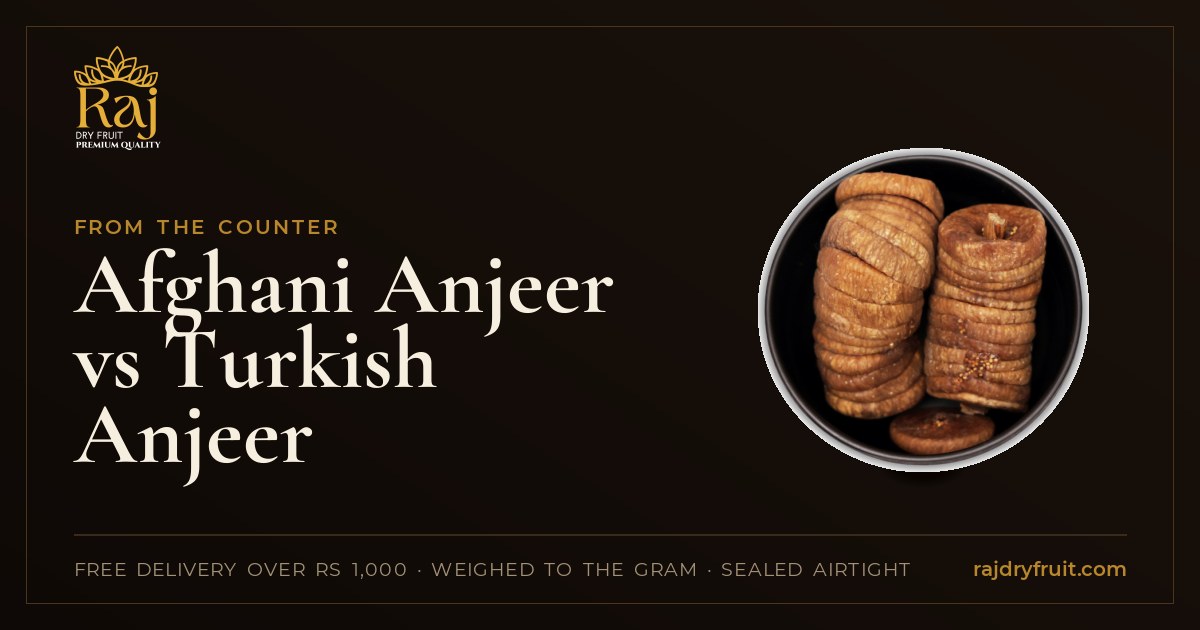
Afghani anjeer is usually smaller, darker and chewier, with a dense, honeyed sweetness, while Turkish anjeer is larger, paler golden, softer and more uniform. Neither is simply better: Afghani suits daily soaking and cooking, Turkish suits gifting and eating whole. The best anjeer for you is the size and softness your use needs.
Where do Afghani and Turkish anjeer come from?
Turkey is the largest producer of dried figs in the world, and most of its crop comes from the Aydin and Izmir region on the Aegean coast. The main variety there is Sarilop, the same fig that California calls Calimyrna. It is a big, light-skinned fig that dries on the tree and is then sun dried and graded by size.
Afghan figs come from smaller orchards and older, more varied trees. They tend to be dried harder, sometimes strung on thread in the traditional way, which is where the “mala anjeer” you see in older markets comes from. India also grows some fresh figs near Pune and in Karnataka, but very little of that crop is dried for sale. The common fig entry on Wikipedia lists the main producing countries if you want the wider picture.
How do you tell Afghani and Turkish anjeer apart?
Hold one of each and the difference is plain within a minute. This is the comparison we go by:
| What to check | Afghani anjeer | Turkish anjeer |
|---|---|---|
| Size | Small to medium, uneven | Medium to very large, even |
| Colour | Light brown to dark brown | Pale gold to light honey |
| Skin | Thicker, a little leathery | Thin, smooth, slightly glossy |
| Inside | Dense, seeds tightly packed | Soft, jammy, seeds loose |
| Sweetness | Deep, almost caramel | Clean and mild |
| Shape | Often flattened or pressed | Rounder, often pressed into a neat button |
| Best for | Soaking, halwa, milk, cooking | Eating whole, gift boxes, guests |
Some sellers call any pale, soft fig “Turkish” and any dark, hard one “Afghani”. That is a shortcut, not a rule. A Turkish fig stored badly darkens and hardens too, and a well-kept Afghan fig stays supple.


Which anjeer is best for soaking?
For soaking, a medium, slightly firmer fig is the better buy. It holds its shape overnight in water and the water itself turns sweet. Two to three anjeer soaked in half a cup of water and eaten in the morning is a common habit; our post on soaked anjeer covers how long to soak and what to do with the water.
A very large, very soft fig turns almost to pulp after a night in water. That is no loss in a halwa or a milkshake, but for eating whole after soaking, the medium grade is easier.
Which anjeer is best for gifting and guests?
For a gift box or a guest bowl, size and colour matter more than anything else. Large, even, golden figs look generous in a box and are soft enough to eat straight away. Our Jumbo Anjeer is the grade for this. It is the one most families choose for Diwali boxes, wedding trays and the plate that goes out with tea.
Regular Anjeer is smaller and less even, and it is the sensible choice for the daily soaking jar, for anjeer barfi and for milk. The taste is close; what you pay for in Jumbo is size and looks.
What do the two grades cost today?
Across both grades, anjeer works out to at today's shop rate today. Jumbo Anjeer pack sizes are at today's shop rate, and Regular Anjeer is at today's shop rate. The full list, with every grade side by side, is on the anjeer price page.
Origin moves the price less than people expect. Size moves it more. A kilo of large, even figs costs noticeably more than a kilo of mixed small ones from the same orchard, simply because fewer of the big ones grow.
How to check anjeer when it arrives
Whichever origin you prefer, these checks tell you whether the lot is good:
- Press one. It should give a little and spring back. Rock hard means old or over-dried.
- Look at the base. The small opening at the bottom should be clean, with no dark powder or webbing.
- Break one open. The inside should be pink-amber with seeds, never grey or dusty.
- Smell it. Sweet and fruity is right. Sour or musty means moisture has been in.
- White bloom. A fine white coat on the skin is often the fig’s own sugar, not mould, and it wipes off. Fuzzy patches are mould.
Our step-by-step guide on how to buy anjeer has pictures of each of these. Keep anjeer in an airtight jar in the fridge after opening; it holds well for four to six months that way.
What should a home order look like?
Two adults eating two soaked anjeer a day get through roughly 400 to 500 g a month. Add a few for guests and a batch of anjeer barfi and a kilo goes in six weeks.
Most homes buy anjeer alongside the other jars. A balanced month’s basket is 500 g Regular Anjeer for soaking, 500 g kaju and 500 g badam, with 250 g Turkish apricot if anyone likes something tangy. A basket like that crosses the minimum easily: orders start at ₹1,000 and every order ships free, so the house and the delivery are covered in one go.

Questions people ask
Which anjeer is best in India?
For eating whole and gifting, large, soft, golden figs of the Turkish type are the most popular. For soaking and cooking, a medium, firmer fig does the job just as well and costs less. Check freshness before origin; a fresh fig of either kind beats an old one.
Is Turkish anjeer better than Afghani anjeer?
Turkish anjeer is bigger, softer and more even, so it looks better in a box. Afghani anjeer is denser and deeper in taste, and many people prefer it for soaking. The nutrition per 100 g is very similar.
Why is some anjeer dark and some golden?
Variety, drying and age. Pale varieties such as Sarilop dry to a golden colour, while other varieties dry darker. Any fig also darkens with time and warm storage, so a dark fig that was once golden is usually an old one.
How many anjeer are in a kilo?
It depends on size. Large Jumbo figs run to roughly 40 to 60 a kilo, while a smaller regular grade can be 80 to 120. That is why two kilos of anjeer can look so different in the jar.
Written at our counter, where these questions get asked every week.