
In this guide
Quick answer
Badam katran is almond cut into thin slivers or slices for garnishing sweets, kheer and badam milk. It saves the slow job of slicing soaked almonds by hand. A tray of barfi needs about 20 to 30 g, a litre of kheer 15 to 20 g, and a 250 g pack covers most Diwali kitchens.
What exactly is badam katran?
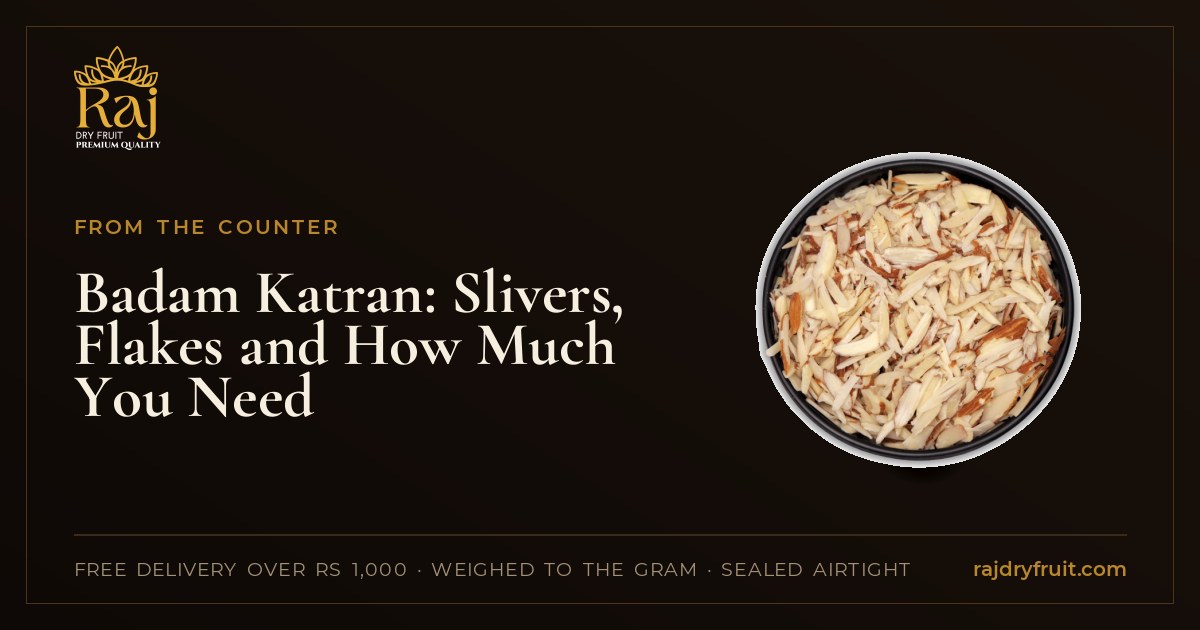
Katran simply means cuttings. In a dry fruit shop, badam katran is whole almond cut into thin pieces, ready to scatter. Halwais buy it by the kilo because slicing almonds by hand is slow work, and home cooks buy it for the same reason in festival weeks. There are three common cuts, and the names get used loosely:
| Cut | What it looks like | Best for |
|---|---|---|
| Slivers (lambi katran) | Long thin sticks, cut along the length of the nut | Kheer, sheer khurma, biryani and pulao, badam milk |
| Slices (gol katran) | Thin cross-section slices, oval and flat | Barfi, kaju katli, cakes, the top of a halwa tray |
| Flakes | Very thin, wide slices, often blanched | Baking, muesli, desserts where a delicate look is wanted |
| Pista katran | The same idea with pista; green slivers | Colour on top of almost every Indian sweet |
Our Badam Katran is cut for sweets, so it covers the barfi tray and the kheer pot equally well, and its pack prices are at today's shop rate.
How much badam katran does each sweet need?
Garnish quantities are small, which is why one pack goes a long way. These are working figures from home kitchens:
- A 1 kg tray of barfi or kaju katli: 20 to 30 g on top.
- A litre of kheer or payasam: 15 to 20 g stirred in, a little more on top.
- A litre of badam milk: 20 g, plus soaked whole almonds if you grind them in.
- A family pot of sheer khurma: 40 to 50 g, along with pista and charoli.
- A tray of gajar halwa for ten: 30 g, mixed with pista katran.
- Biryani or pulao for six: 20 g, fried golden in ghee with kaju and kishmish.
For a typical Diwali, with two or three sweets, a pot of kheer and the guests’ badam milk, a family uses 150 to 250 g of badam katran and 50 to 100 g of pista katran.

Why buy katran rather than slicing almonds yourself?
Time, mostly. Slicing whole almonds evenly means soaking them, sometimes peeling them, and then cutting each one with a sharp knife; for 250 g that is well over an hour. Katran arrives ready, evenly cut, and dry enough to stay crisp on top of a sweet.
Cost is the other question. Whole Californian badam comes to at today's shop rate today, and katran is the same nut with the cutting already done; compare its pack price above. If you are already buying whole almonds for soaking, and have time, slicing is fine. If it is the week before Diwali and you are making four sweets, buy the katran. Our badam price page shows every almond we stock.
What about pista katran?
Pista katran is the green that finishes a sweet. A few slivers on barfi, rasmalai or kulfi change how it looks more than any other garnish. It is priced at at today's shop rate by pack, and because a little goes a long way, 100 g covers several trays. Our guide to pista kernels, katran and pishori explains the difference between the cuts.
Most cooks use badam and pista katran together, roughly three parts badam to one part pista, which gives a cream-and-green finish without the cost of a pista-only garnish.
How should badam katran be stored?
Cut almonds have more surface open to the air than whole ones, so they go stale faster. Keep katran in an airtight glass jar, away from the stove, and use it within six to eight weeks. In humid months or hot kitchens, keep it in the fridge. If it smells sharp or tastes bitter, the oil has turned and it is time for a fresh pack. Toasting it for two minutes in a dry pan before scattering brings back the aroma of a pack that has been open for a while.
Nutritionally it is simply almond. USDA FoodData Central lists slivered almonds at about 580 kcal and 21 g of protein per 100 g, though at garnish quantities that is a few grams per serving.
What is a sensible order for a festival kitchen?
Our orders start at ₹1,000 and every order ships free. A good festival kitchen order is 250 g of Badam Katran, 100 g of Pista Katran and 500 g of Regular Badam for soaking and badam milk; add 500 g of kaju for the katli and you are set for Diwali. With Diwali on Sunday 8 November, ordering by the last week of October leaves time for the sweets. Everything is in the almond collection, and our recipe for a badam pista milk masala uses the katran too.


Questions people ask
What is dry fruit katran?
Dry fruit katran means dry fruit cut into thin slivers or slices for garnishing, usually badam and pista. It saves time and gives an even finish on sweets and kheer.
Are almond slices for sweets the same as badam katran?
Yes, in everyday use. Katran covers slivers and slices; the cut changes the look, not the taste. Slices sit flat on barfi, slivers suit kheer.
What are badam flakes?
Very thin, wide slices, often blanched, used mostly in baking and desserts. For Indian sweets, regular badam katran does the same job.
Can badam katran be used in biryani?
Yes. Fry it golden in ghee with kaju and kishmish and scatter it over the top just before serving.
We deliver across India See 87 city pages
Written at our counter, where these questions get asked every week.


