
In this guide
Quick answer
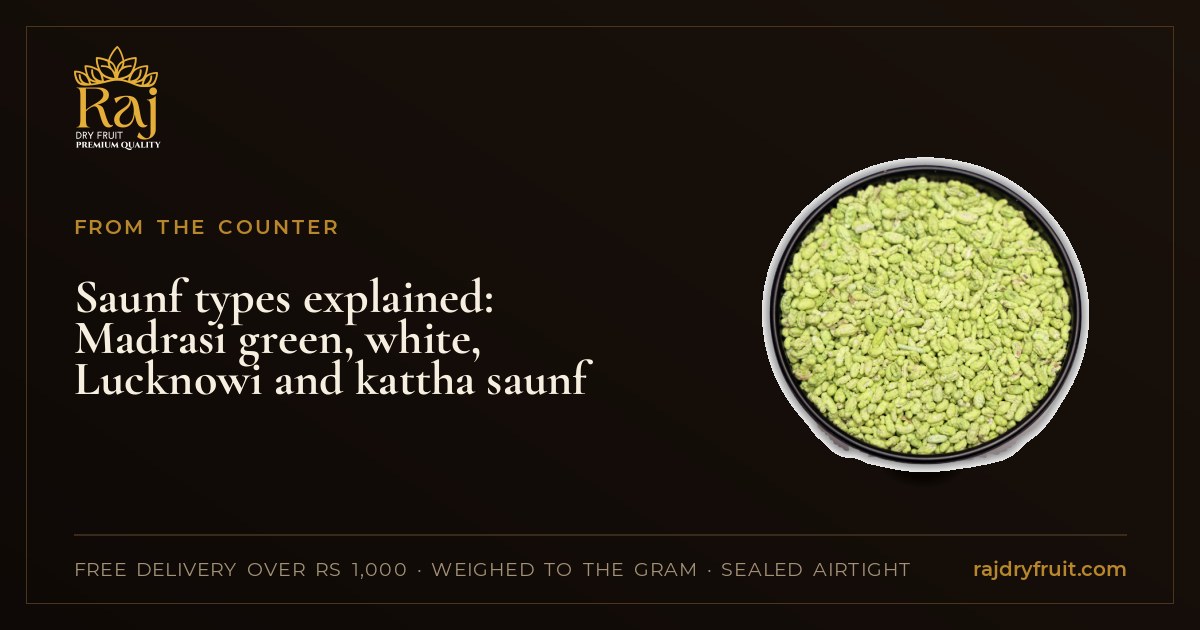
Saunf is fennel seed, the dried seed of the fennel plant, with a sweet, cooling, liquorice-like taste. In India it is sold in a few distinct kinds: Madrasi green saunf, the fuller everyday seed; white saunf, a paler seed; Lucknowi saunf, a small, thin, bright green seed; and kattha saunf, which is saunf coated for chewing after meals.
They all come from the same plant. What changes is when the seed was picked, how it was dried, and what, if anything, was done to it afterwards. That decides the colour, the size and what each one is best for.
What is saunf called in English and other languages?
Saunf is fennel seed in English. It is not aniseed, although the two taste similar and are often confused; aniseed comes from a different plant and is smaller and greyer. It is also not star anise, which is badian, a woody, star-shaped pod from a tree.
| Language | Name |
|---|---|
| Hindi | Saunf, sonf |
| Gujarati | Variyali |
| Marathi | Badishep |
| Bengali | Mouri |
| Tamil | Perunjeeragam |
| English | Fennel seed |
What is the difference between green saunf and white saunf?
The difference is colour and look, not the plant: green saunf is fuller and greener, white saunf is paler, closer to straw in colour. Fennel seed is green while it is on the plant and fades towards yellow-brown as it ripens and dries, so colour mostly reflects the stage it was picked at and how carefully it was dried out of direct sun.
| Type | Looks like | Taste | Best for |
|---|---|---|---|
| Madrasi Saunf Green | Plump, long, green seed | Sweet, fresh, full | Chewing after meals, mukhwas, cooking |
| Madrasi Saunf White | Paler, straw-coloured seed | Sweet, much like the green | Cooking, grinding, masalas |
| Lucknowi saunf | Small, thin, bright green | Very sweet, delicate | Chewing on its own |
| Kattha Saunf | Saunf with a dark, coated surface | Sweet with a paan-like edge | Mukhwas after meals |
Madrasi Saunf Green is the one most homes keep: good enough to chew straight from the jar, and sturdy enough to go into a tadka or a pickle. Madrasi Saunf White is what people tend to pick when the seed is going into a masala, a gravy or a spice powder, where its colour will not show.
Lucknowi saunf is worth a mention because people ask for it by name. It is the smallest and greenest kind, prized for chewing, and it usually costs more than the Madrasi seed. We do not keep it at the moment.
What is kattha saunf?
Kattha saunf is fennel seed coated with kattha, the catechu extract that is also used in paan, usually with some sweetening. It is a mukhwas: eaten a pinch at a time after a meal, the way people once chewed paan. The coating gives the seed a darker colour and a slightly astringent, paan-like finish over the sweetness of the saunf.
We keep Kattha Saunf on our mukhwas and herbs shelf, alongside the ready-mixed mukhwas. If you want to know how all these blends are put together, our guide to what mukhwas actually is goes through it.
How do you roast saunf for mukhwas at home?
Dry-roast saunf in a heavy pan on low heat, stirring all the time, for a few minutes until it smells toasted and darkens very slightly. Then cool it completely before it goes into a jar. The steps most homes follow:
- Start with clean seed. Pick out stalks and any stones. Green saunf gives the best-looking result.
- Optional salt water: sprinkle a little salted water, or a few drops of lemon juice with salt, over the seeds and rub them so each one is lightly coated.
- Roast on low heat, stirring constantly. High heat browns the outside before the inside dries, and burnt saunf tastes bitter.
- Stop when the smell changes from raw and grassy to warm and sweet, and the seeds feel dry and crisp.
- Cool fully on a plate, then store airtight. Warm seeds sweat in a jar and go soft.
Roasted saunf is good on its own. Many families mix it with roasted dhana dal, a little roasted sesame and a few pieces of sweet supari or misri to make a simple house mukhwas.
How is saunf used in cooking?
Saunf is one of the quiet workhorses of Indian cooking. It goes into the tempering for Rajasthani and Gujarati dishes, into North Indian pickles, into Kashmiri cooking where ground fennel is used in many gravies, into Bengali panch phoron, and into garam masala and biryani masala in many households. In sweets, a pinch of ground saunf is common in malpua, and it is one of the flavours in thandai.
For cooking, crush or grind saunf just before use. The oils that carry its smell fade quickly once it is ground.
How to buy and store saunf
- Smell a pinch. Rub a few seeds between your fingers. Fresh saunf smells sweet and strong straight away.
- Look at the colour evenly across the bag. A mix of green, brown and grey seeds usually means old or mixed lots.
- Check for dust and stalks. A few stalks are normal; a lot of husk and grit is not.
- Store airtight, away from light. Green saunf fades towards brown in sunlight, and loses aroma with it.
We send all our saunf across India in 100 g packs; orders start at ₹1,000 and every order ships free. See today’s price on the Madrasi Saunf Green page.
Questions people ask
Is saunf the same as fennel?
Yes. Saunf is the Hindi name for fennel seed. The bulb vegetable sold as fennel in some markets is a cultivated form of the same plant.
Which saunf is best for eating after meals?
Green saunf, either plain or roasted, is the usual choice. Lucknowi saunf is sweeter and finer, and kattha saunf suits people who liked the taste of paan.
Is saunf the same as jeera?
No. Jeera is cumin, which is smaller, browner and savoury. Saunf is fennel, which is larger, greener and sweet. They look alike from a distance; the Tamil name for saunf, perunjeeragam, literally means big cumin.
Can children eat saunf?
Many families give children a little saunf after meals. Whole seeds are small and hard, so for young children, and for anyone pregnant or on medication, check with your doctor about amounts.
Does saunf go bad?
It does not spoil quickly if kept dry, but it loses its smell. Whole seed kept airtight holds up for many months; ground saunf fades within weeks.
We deliver across India See 87 city pages
Written at our counter, where these questions get asked every week.


