In this guide
Quick answer
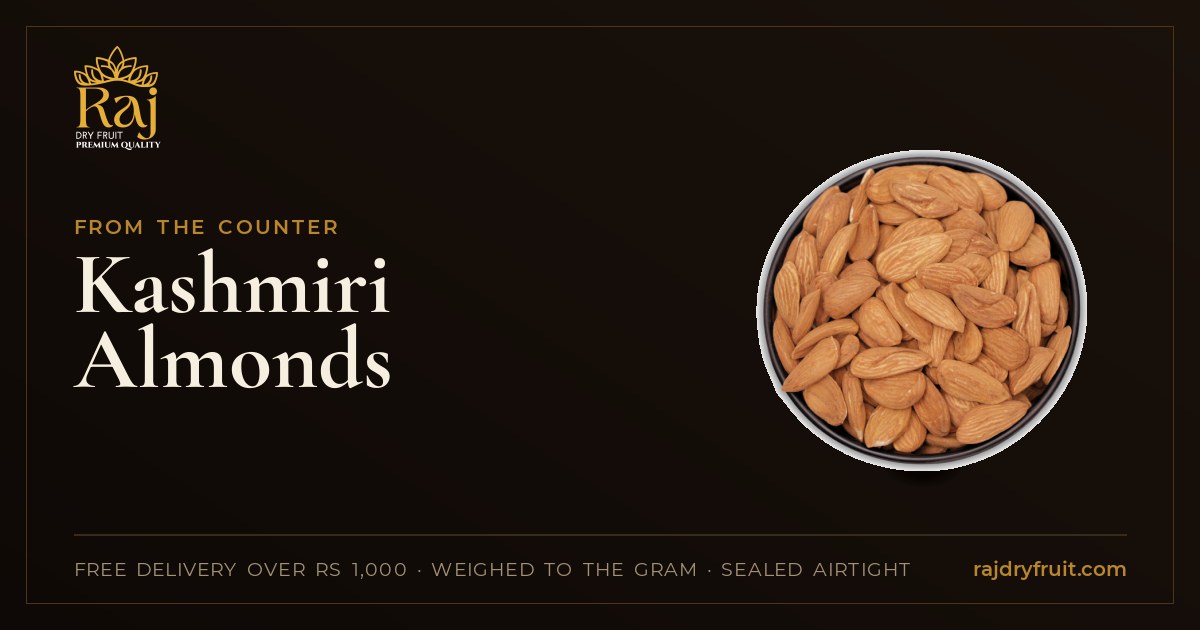
Kashmiri almonds are usually smaller, flatter and paler than Iranian Mamra, often sold in a thin papery shell, with a sweet, mild taste. Iranian and Afghan Mamra badam is darker, deeply wrinkled, boat-shaped and visibly oily when cut. Both are traditional Indian favourites for soaking; Mamra is richer, while Kashmiri is lighter and harder to find in volume.
What makes an almond Kashmiri?
Kashmiri badam comes from orchards in the Kashmir valley, mainly around Pulwama and Budgam, where almond trees flower in early spring. The crop is small compared with India’s demand, which is one reason genuine Kashmiri almonds are scarce outside the valley and are often sold in their thin shells. The Wikipedia article on almonds notes that most of the world’s crop comes from California, with smaller traditional growing areas in Iran, Afghanistan and Kashmir.
Mamra is a type rather than a place. The word is used for the oil-rich, concave almond grown mainly in Iran and Afghanistan. Some traders also call good Kashmiri kernels Kashmiri Mamra, which is where the confusion starts.
How can you tell Kashmiri almonds from Iranian Mamra?
Lay a few of each side by side and the differences are easy to see.
| Check | Kashmiri almonds | Iranian or Afghan Mamra | Californian badam |
|---|---|---|---|
| Shape | Small to medium, flatter, pointed | Small, curved like a boat, concave on one side | Larger, flat, even |
| Colour | Light brown, pale skin | Darker brown, deeply wrinkled | Uniform light brown, smoother |
| Oil | Moderate | High, shines when cut | Lower |
| Taste | Sweet, mild, delicate | Rich, full, nutty | Mild, crunchy |
| Usually sold | Often in thin paper shell, sometimes as kernels | As kernels, graded by size | As kernels |
Two quick home tests help. Press a kernel on white paper and leave it for ten minutes: Mamra leaves a clear oil mark. Then soak five overnight: Mamra swells and its skin slips off easily, while Californian stays firmer. Our Mamra or Californian almonds post covers that comparison in detail.


Which Mamra badam is best?
For soaking every morning, a good Iranian or Afghan Mamra is the benchmark most Indian families use: rich, oily and soft after a night in water. Kashmiri almonds are lovely to eat and a regional favourite, but supply is small and quality varies from lot to lot. Some lots carry an occasional bitter kernel, so taste one or two before serving.
Within Mamra, size is the main grade. Jumbo Mamra is larger and more even, and looks better in a gift box or on a guest plate. Regular Mamra tastes the same at a lower rate and is the sensible choice for daily soaking. Our types of almonds in India post walks through every name you will see on a label.
What do Mamra and Kashmiri-style almonds cost?
Mamra costs several times as much as Californian badam because it is scarce and oil-rich. Today Mamra works out to at today's shop rate, against at today's shop rate for everyday Californian badam. Our jumbo Mamra packs are at today's shop rate. Every Mamra lot we stock is on the Mamra badam price page.
Be careful with very low prices for anything called Kashmiri or Mamra. The most common trick in the market is Californian almonds sold under a Mamra label, and the second is mixing a few Mamra kernels into a cheaper lot. The shape and oil tests above catch both.
When is each one worth it?
- Mamra: for the daily soak, for children and elders, and for a premium gift. Five to seven a day goes a long way, so a 250 g pack lasts a person over a month.
- Kashmiri: if you come across a fresh lot from the valley, it is a pleasure to eat as a snack. Buy small amounts and check for bitter kernels.
- Californian: for cooking, badam milk, halwa, barfi and everyday snacking, where the extra oil of Mamra is lost.
Many homes do both: Mamra in the soaking bowl, Californian in the kitchen.
How should you store expensive almonds?
Mamra’s oil is what makes it valuable, and oil is what turns rancid. Keep Mamra in an airtight glass jar in a cool cupboard for up to three months, or in the fridge for six. Soak only what you will eat the next morning. Never keep Mamra near the stove or in a steel tin on a sunny shelf.
Our orders start at ₹1,000 and every order ships free, and a family almond order usually crosses that comfortably: 250 g Mamra for soaking, 500 g regular badam for cooking and 500 g kaju for the guest bowl. Every grade is in the almonds collection.

Questions people ask
Is Kashmiri mamra badam the same as Iranian Mamra?
Not quite. Mamra originally refers to the oil-rich almond from Iran and Afghanistan, while Kashmiri almonds are a separate regional crop. Some traders use Kashmiri Mamra for both, so check shape and oil rather than the label.
What is the Kashmiri badam price?
It varies with the season and the small size of the crop. Genuine Kashmiri lots are scarce outside the valley, so prices are usually close to Mamra.
Why are Mamra almonds so expensive?
They are grown in small quantities in Iran and Afghanistan, they are richer in oil, and much of the crop is hand-sorted. Demand in India is far larger than supply.
How many Mamra almonds should I eat a day?
Most families soak five to seven a day for an adult and three to five for a child. If you have a specific health condition, check portions with your doctor.
Written at our counter, where these questions get asked every week.