
In this guide
Quick answer
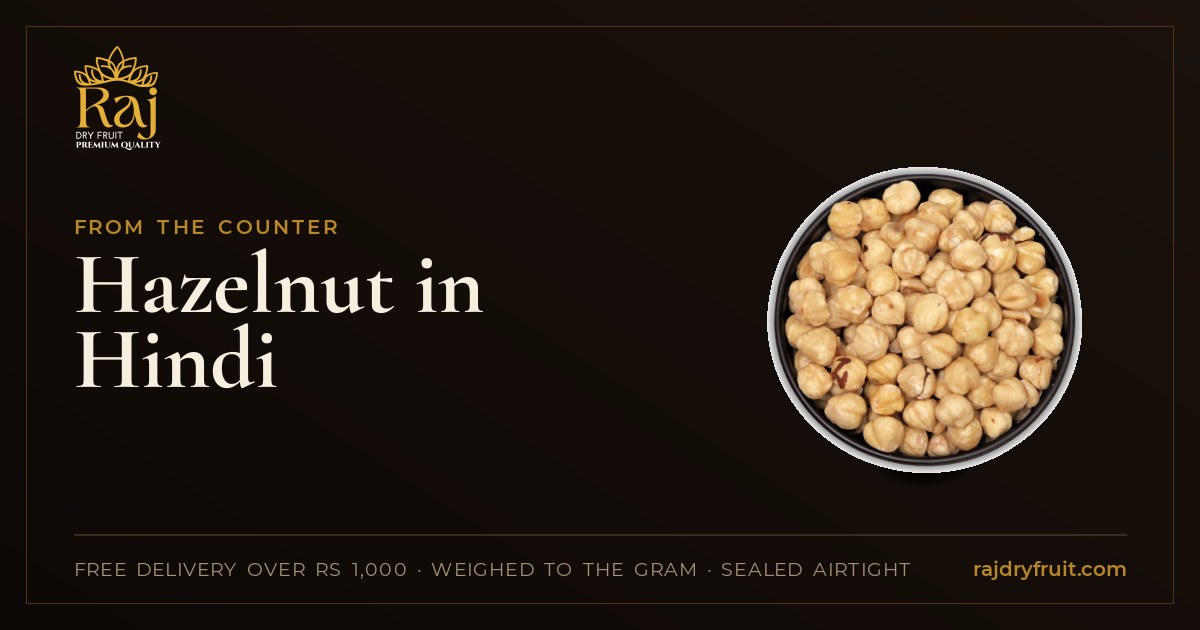
Hazelnut has no traditional Hindi name, so in Hindi it is simply called hazelnut, written हेज़लनट. It is the small, round, brown-skinned nut of the hazel tree (Corylus), grown mostly in Turkey and other cooler countries, and best known in India as the nut in chocolate spreads, pralines and hazelnut coffee.
In English it has two other names you may see on labels and in older recipes: filbert and cobnut. All three mean the same nut. Raw hazelnuts taste mild and slightly sweet; roasting turns them deep, toasty and far more fragrant, which is why most recipes ask for them roasted.
What is hazelnut called in Hindi and other Indian languages?
In Hindi, hazelnut is called hazelnut (हेज़लनट); there is no separate older Hindi word in everyday use. The same goes for most Indian languages, where shops and families use the English name, because hazelnuts came to India as an imported nut rather than a local crop.
You may come across websites giving a “Hindi name” for hazelnut. Be careful with those: we have not found one that Indian shoppers actually use at the counter, and asking for “hazelnut” is what gets you the right thing. For the Hindi and English names of the nuts that do have them, see our list of dry fruit names in English and Hindi.
Where do hazelnuts come from?
Most of the world’s hazelnuts come from Turkey, especially the Black Sea coast, with Italy, the United States and a few other countries growing much smaller crops. The nut grows in a hard shell inside a leafy husk, and is sold in India mostly shelled, with its thin brown skin still on.
That skin is edible but slightly bitter and papery. Whether you remove it depends on what you are making, which we come to below.
Hazelnut nutrition per 100 g
Hazelnuts are rich in fat, mostly the monounsaturated kind, and are one of the better nut sources of vitamin E. The approximate values below are per 100 g of raw kernel, from standard food composition tables. A normal serving is a small handful, about 25–30 g, so divide by roughly four for one portion.
| Nutrient | Per 100 g (about) | What it means |
|---|---|---|
| Energy | 628 kcal | Energy-dense, eat by the handful |
| Fat | 61 g | Mostly monounsaturated |
| Protein | 15 g | Similar to walnuts |
| Fibre | 10 g | Higher than many nuts |
| Vitamin E | 15 mg | A good source among nuts |
Tree nut allergy includes hazelnut for many people, so check with a doctor if anyone in the family has a nut allergy. Whole nuts are also a choking risk for children under five; grind or chop them for small children.
How do you roast and skin hazelnuts?
Roast hazelnuts in a hot oven or a heavy pan until the skins crack and the kernels turn golden, then rub them in a kitchen towel while warm and most of the skin flakes off. It takes about fifteen minutes from start to finish.
- Heat the oven to about 175°C, or put a heavy kadhai on low-medium heat.
- Spread the nuts in one layer. Crowded nuts steam instead of roasting.
- Roast for 10–15 minutes in the oven, or 8–10 minutes in the pan, stirring often, until the skins crack and the nuts smell toasty. Cut one open: it should be light gold inside, not brown.
- Tip them straight into a clean kitchen towel, fold it over and leave for a minute to steam.
- Rub hard through the towel. Most of the skin will come away. Some will always stay stuck, and that is fine.
- Cool completely before chopping, grinding or storing, or they turn oily.
For snacking, you can skip the skinning entirely. Skinning matters most for smooth spreads, pralines and cakes where bits of skin would show or taste bitter.
How are hazelnuts used?
Hazelnuts are used as a snack, in chocolate and in baking, and they pair with chocolate and coffee better than almost any other nut. Most of what they do best starts with roasting.
- Snack: roasted, with or without a pinch of salt, or mixed with badam and cashews.
- Homemade chocolate spread: roasted, skinned hazelnuts ground until they turn to butter, then blended with melted chocolate, a little sugar and a pinch of salt.
- Praline: roasted nuts set in caramel, then crushed over ice cream or cake.
- Baking: chopped into brownies and cookies, or ground and used with flour in cakes.
- Breakfast: chopped over oats, muesli or yoghurt with dried berries.
- Indian sweets: as a change from pista or badam on top of kheer or a dry fruit barfi.
For a gift, a few roasted hazelnuts with pecans, Brazil nuts and good dates makes a box that looks different from the usual kaju-badam tray. Our premium dry fruits page has more ideas.
How should you store hazelnuts?
Store hazelnuts in an airtight jar in a cool, dark place for a few weeks, or in the fridge for several months. Like all oily nuts, they go rancid in heat, and a rancid hazelnut tastes stale and sharp. Roasted hazelnuts lose their crunch and aroma faster than raw, so roast only what you will use within a week or two.
Our Hazel Nuts come in a 100 g pack and sit on the Imported Nuts shelf. See today’s price on the product page.
Questions people ask
What is hazelnut called in Hindi?
Hazelnut is simply called hazelnut (हेज़लनट) in Hindi. There is no older Hindi name in common use, as it is an imported nut.
Is hazelnut the same as filbert?
Yes. Filbert and cobnut are other English names for the hazelnut. They all refer to nuts of the hazel tree.
Do you have to remove hazelnut skin?
No, the skin is edible. Remove it for smooth spreads and delicate cakes, where it can taste bitter; leave it on for snacking.
Can hazelnuts be eaten raw?
Yes, raw hazelnuts are safe and mild-tasting. Roasting simply makes them crunchier and much more fragrant.
How many hazelnuts can I eat in a day?
A small handful, about 25–30 g, is a common serving. They are energy-dense, so they are best eaten in place of another snack rather than on top of one.
We send imported nuts across India; orders start at ₹1,000 and every order ships free. Add hazelnuts to your next order of dry fruits.
We deliver across India See 87 city pages
Written at our counter, where these questions get asked every week.


