In this guide
Quick answer
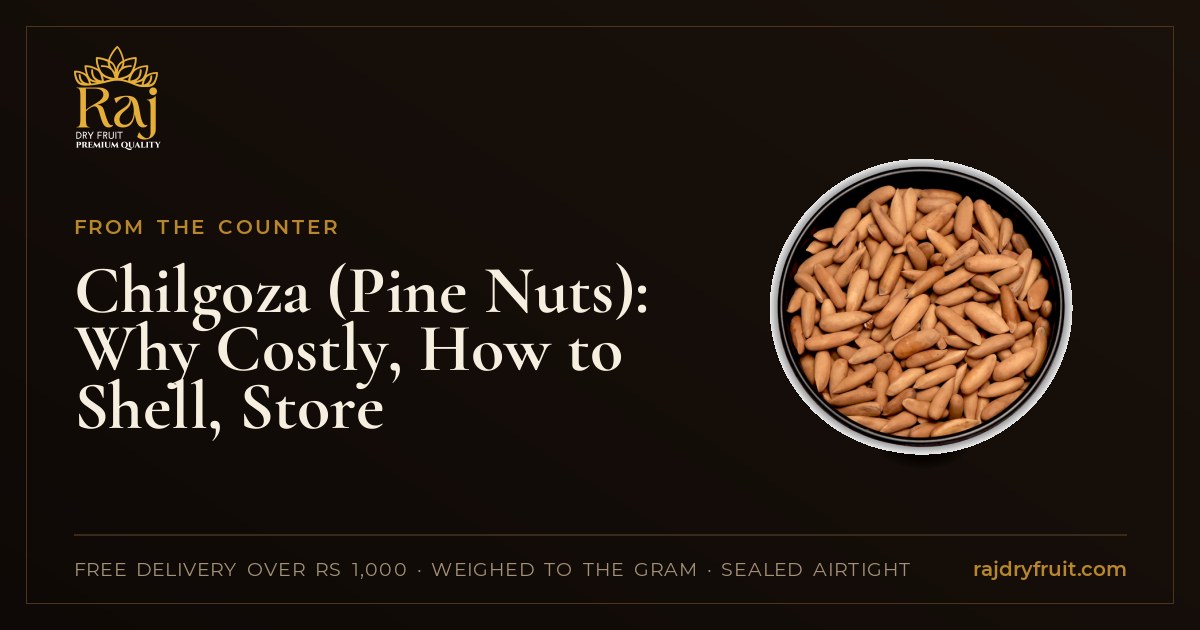
Chilgoza is the pine nut: the edible seed of the chilgoza pine, a tree that grows wild on dry, high mountain slopes in Kinnaur in Himachal Pradesh, and in Afghanistan and Pakistan. The long, slim nut comes in a thin dark-brown shell, and the soft ivory kernel inside tastes sweet, buttery and faintly of pine.
It is one of the most expensive nuts sold in India, and it is mostly eaten in winter, often lightly roasted in the shell and cracked open one at a time. This guide covers the name, why the price is what it is, how to shell chilgoza without crushing it, and how to keep it from going stale.
What are pine nuts called in Hindi?
Pine nuts are called chilgoza in Hindi and Urdu. Strictly, chilgoza is one particular pine nut, from the tree Pinus gerardiana; in Kinnaur the same nut is known locally as neoza.
The pine nuts in Western recipes such as pesto usually come from other pine species. They are shorter, rounder and sold shelled. Chilgoza is longer and slimmer, and in India it is usually sold in its shell. The two can stand in for each other in cooking, though chilgoza’s flavour is more delicate. For other nut and seed names, see our list of dry fruit names in English and Hindi.
Why is chilgoza so expensive?
Chilgoza is expensive because it comes from wild trees in a small mountain area, and every step of the harvest is done by hand. Nobody grows it in orchards; the supply is whatever the forests give in a year.
- A small growing area. The chilgoza pine grows only in a narrow belt of the dry north-western Himalaya and the mountains to its west.
- Wild trees, hard terrain. The trees stand on steep, high slopes, and the cones are picked by climbing or with long poles.
- Slow extraction. The cones are dried or heated until their scales open, and the nuts are then shaken and picked out by hand.
- Once a year. The harvest comes in autumn, and a poor season simply means less chilgoza.
- You pay for the shell too. When you buy chilgoza with its shell, part of what you pay for is shell, so the kernel costs more than the per-pack price suggests.
That is why a small pack is the usual buy, and why chilgoza is often given as a winter gift rather than eaten by the handful. For today’s price, see the Chilgoza – Pine Nuts (With Shell) page.
How do you shell chilgoza?
To shell chilgoza, press the nut lengthwise along its seam until the thin shell splits, then slide the kernel out. The shell is thin and brittle, so gentle pressure works better than force; hitting it crushes the kernel along with the shell.
- Warm them first (optional). Toss the nuts in a dry pan on low heat for two or three minutes. Warm shells split more easily, and the kernel tastes nuttier.
- Hold the nut on its side. Find the flatter edge, where the two halves of the shell meet.
- Press along the length. Squeeze between thumb and forefinger, or place it on a board and press with the back of a spoon until you hear it crack.
- For many at once, lay them in a single row inside a folded kitchen towel and roll a rolling pin over them lightly. Check, and roll again if needed.
- Slide out the kernel. Rub off any thin papery skin if you like; it is edible.
Many people simply crack chilgoza between their front teeth, the way it has been eaten for generations. It works, but go gently; the shell is thin, but not that thin.
Chilgoza with shell or kernels: which should you buy?
Buy chilgoza with shell if you want it to stay fresh longer and enjoy cracking it; buy kernels only if you need them ready for cooking and will use them quickly. The shell protects the oily kernel from air and light.
| Point | With shell | Shelled kernels |
|---|---|---|
| Freshness | Keeps much longer | Goes stale faster |
| Best for | Winter snacking, gifting | Cooking, garnish, pesto |
| Effort | Needs shelling | Ready to use |
| Flavour | Best roasted in shell | Best toasted briefly |
| Storage | Cool, airtight | Fridge, airtight |
Our chilgoza comes with its shell, which is how most people in India buy it.
How to eat chilgoza
The classic way to eat chilgoza is roasted in the shell and cracked open by hand, a few at a time, on a winter evening. Other ways:
- Toasted kernels on top of a dish, such as a pulao, a salad or a bowl of kheer. Toast them for a minute only; they burn fast.
- In a winter nut mix, with almonds, walnuts and dates, the kind of mix on our winter dry fruits page.
- Ground into a sauce, in place of other pine nuts.
- In a gift box, next to other rare nuts such as Brazil Nuts, Hazel Nuts and Pecan Nuts.
A small handful of shelled kernels, about 20 to 30 grams, is a sensible amount for a day. Pine nuts in general carry about 670 kcal per 100 g, mostly from fat, with about 14 g of protein per 100 g; these are widely published values for pine nuts as a group, and chilgoza itself can vary. Anyone with a nut allergy should avoid them, and whole nuts are a choking risk for children under five.
How to store chilgoza so it stays fresh
Chilgoza is rich in oil, and oil goes rancid with heat, light and time. Stored well, chilgoza in its shell keeps for months; badly stored, it turns bitter in weeks.
- Airtight container, glass or steel, filled close to the top.
- Cool and dark, away from the stove and sunlight.
- Fridge in summer and monsoon, and always for shelled kernels.
- Shell only what you will eat that day or that week.
- Taste one before using a batch. A sharp or bitter, paint-like taste means the oil has turned.
Chilgoza sits with other hard-to-find nuts on our Imported Nuts shelf. We send it across India; orders start at ₹1,000 and every order ships free, and today’s price is on the Chilgoza page.
Questions people ask
Is chilgoza the same as pine nuts?
Chilgoza is a pine nut, the seed of one particular pine tree. Pine nuts sold abroad often come from other pine species and look shorter and rounder.
Can chilgoza be eaten raw?
Yes. Chilgoza is safe to eat raw once shelled. Many people prefer it lightly roasted, which deepens the flavour and makes the shell easier to crack.
Why do my chilgoza taste bitter?
A bitter or paint-like taste usually means the oil has gone rancid from age, heat or light. Those nuts are best thrown away.
Is the thin skin on chilgoza edible?
Yes. The papery skin on the kernel is edible. Rub it off if you prefer a cleaner look for garnishing.
When is chilgoza season?
Chilgoza is harvested once a year, in autumn, and fresh stock tends to reach shops in the colder months. That is also when people buy it most.
We deliver across India See 87 city pages
Written at our counter, where these questions get asked every week.


