
In this guide
Quick answer
For a pot of sakkarai pongal made with one cup of raw rice, fry about 12–15 cashews and a level tablespoon of raisins in two or three tablespoons of ghee, and pour the lot over the pongal at the end. Broken cashew pieces do this job exactly as well as whole ones, and cost noticeably less.
That is the short answer. The rest of this is for the Chennai kitchen that makes pongal more than once a year: every Margazhi morning, on Thai Pongal in January, and whenever there is a payasam to finish for a function.
Why the cashews go in last, and in ghee
Sakkarai pongal is rice and moong dal cooked soft, then stirred into melted jaggery with ghee and cardamom. The cashews and raisins are not cooked in the pot. They are fried separately in ghee, and that ghee, now smelling of roasted cashew, is poured in with them.
This is the temple-style finish most Tamil homes aim for: the pongal glossy with ghee, the kaju golden and still crisp on top, the raisins puffed round. Payasam gets the same treatment, whether it is semiya payasam, paal payasam or paruppu payasam made with moong dal and jaggery. The tempering of kaju and dakh is poured in at the end, just before serving, so the cashews do not go soft sitting in the milk.
How much to use: a quick table
These are the amounts we would reach for. Add more if the house likes a cashew in every spoon.
| Dish | Base quantity | Cashews | Raisins | Cardamom |
|---|---|---|---|---|
| Sakkarai pongal | 1 cup rice, 1/4 cup moong dal | 12–15 whole, or about 20 g broken | 1 tbsp (about 10–12 g) | 3–4 pods, powdered |
| Semiya payasam | 1/2 cup vermicelli, 1 litre milk | 10–12, or about 15 g broken | 1 tbsp | 3 pods |
| Paruppu payasam | 1/2 cup moong dal | 10–12, or about 15 g broken | 1 tbsp | 3 pods |
| Temple-size pot (5 cups rice) | For a function or a Margazhi offering | about 100 g | about 50–60 g | 12–15 pods |
A household that makes pongal through Margazhi and again for Pongal will get through a 500 g bag of cashews and a 250 g bag of raisins without trying.
Which kaju grade to buy
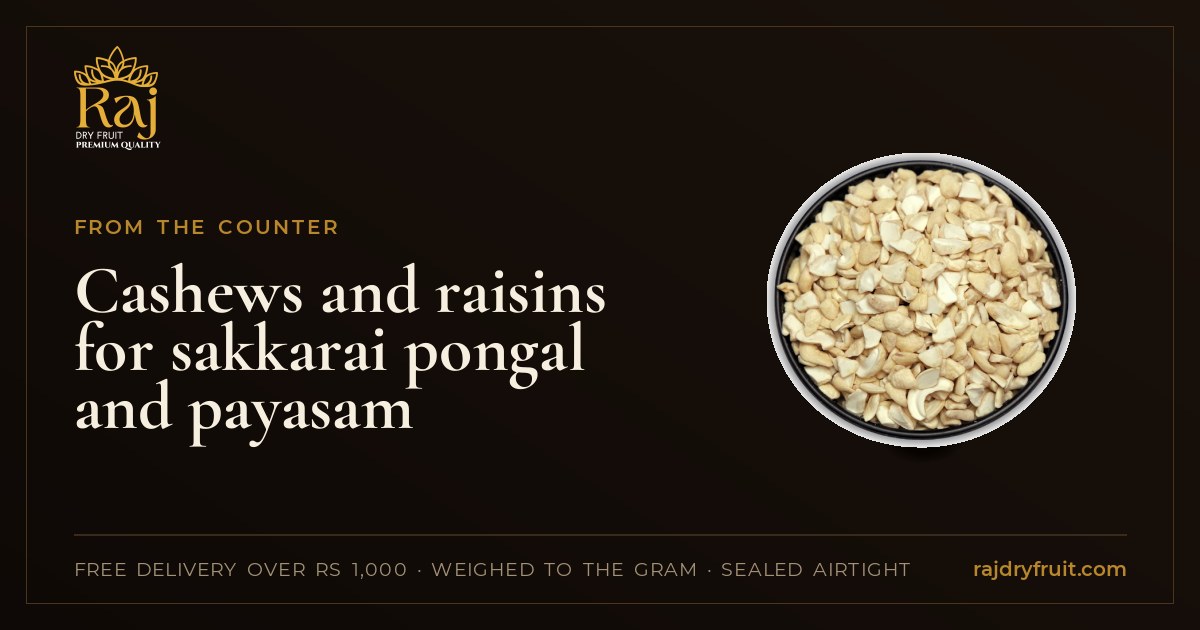
For pongal and payasam, buy Broken Cashew (Kaju Tukda). It is the same kernel as the whole grades, split during shelling, and it tastes exactly the same once fried. Nobody looking into a bowl of pongal can tell a quarter-piece from a whole cashew that has been stirred through.
Keep Regular Cashew for the times the cashew has to be seen: the neyvedyam plate at a function, or the top of a payasam served in a glass. Whole cashews also fry a little more evenly, which matters when you are frying a large batch for a crowd.
Kaju runs around at today's shop rate a kilo depending on grade, and tukda sits at the lower end. Our guide to what Super, Jumbo, faad and tukda mean explains why, and the whole cashew shelf is there to compare.
How to fry cashews and raisins in ghee without burning them
- Use a small, heavy pan. A small kadai or tadka pan keeps the ghee deep enough to cover the nuts.
- Keep the flame low to medium. Ghee burns faster than oil, and cashew goes from golden to bitter in seconds.
- Cashews first. Stir constantly. Whole cashews take about a minute. Broken pieces take less, so watch them closely and take the pan off the heat as they turn light gold; they keep colouring in the hot ghee.
- Raisins last. Drop them in when the cashews are nearly done. They puff up in a few seconds. Leave them longer and they turn dark and hard.
- Pour at once. Tip nuts and ghee straight over the pongal or payasam. If you leave them in the pan they will carry on cooking.
A tip for broken kaju: shake off the fine powder at the bottom of the bag before frying. The powder burns long before the pieces are ready, and it darkens the ghee.
Raisins, cardamom and the rest of the tempering
The usual raisin for pongal is the small golden-green kishmish, what many Chennai homes call ular thiratchai. Our Regular Dakh is that everyday raisin. It swells well in ghee and holds its shape in hot jaggery.
For cardamom, powder the seeds of fresh green elaichi just before you use it. Pre-ground cardamom loses its smell quickly, and in a dish this simple, the cardamom is half the flavour.
Many temple-style recipes also add a pinch of edible camphor (pachai karpooram) or nutmeg. We do not keep edible camphor. Use it very sparingly if you do; a pinch is plenty for a whole pot.
Storing nuts through a humid Chennai winter
Chennai’s air is damp for much of the year, and cashews pick up moisture quickly. A cashew that bends instead of snapping has already started going stale. Keep them in an airtight steel or glass jar, take out what you need with a dry spoon, and keep the jar away from the stove. Raisins do fine in a closed jar at room temperature for a few months.
If Pongal is on the calendar, order a week or so ahead. Delivery to Chennai takes 4–6 days, and it is free: orders start at ₹1,000. You can see today’s dry fruit prices in Chennai before you order.
Questions people ask
Can I use broken cashews for sakkarai pongal?
Yes. Broken kaju is the same nut as whole kaju and tastes the same once fried in ghee. It costs less, and in pongal nobody can tell the difference.
Why do my raisins turn black when I fry them?
The ghee is too hot or they stayed in too long. Add raisins at the very end, on low heat, and take them off as soon as they puff up.
How many cashews go into one cup of rice for pongal?
About 12–15 whole cashews, or around 20 g of broken pieces, with a tablespoon of raisins. Temple-style pongal often uses more.
Should I soak cashews before adding them to payasam?
Not for the fried garnish, which should stay crisp. Soak cashews only if you are grinding them into a paste to thicken the payasam.
We deliver across India See 87 city pages
Written at our counter, where these questions get asked every week.