
In this guide
Quick answer
Dagad phool is a dried lichen that grows on rocks and tree bark, used as a spice in Indian masalas. It is called pathar phool in Hindi, stone flower in English and kalpasi in Tamil. It tastes of very little raw, but warmed in oil or dry-roasted it gives a deep, woody, earthy smell that goda masala and Chettinad cooking depend on.
The most useful thing to know is that it is a background spice. You use a small pinch, you roast or fry it, and you grind it in with everything else. Nobody should be able to pick it out in the finished dish, but most people notice when it is missing.
What is dagad phool called in English and other languages?
In English, dagad phool is called stone flower, or simply black stone flower. The name comes from where it grows: “dagad” is stone in Marathi and “pathar” is stone in Hindi. It is not a flower at all. A lichen is a partnership between a fungus and an alga, and the dried, papery flakes you buy are that growth, scraped off and dried.
| Language | Name | Where you will hear it |
|---|---|---|
| Hindi | Pathar phool, chharila | North Indian spice shops |
| Marathi | Dagad phool | Goda and kala masala |
| Tamil | Kalpasi | Chettinad masala |
| Kannada | Kallu hoovu | Karnataka masala powders |
| English | Stone flower, black stone flower | Recipe books and labels |
If a recipe asks for any of these names, it is asking for the same thing. We sell it as Pathar Phool (Stone Flower), because that is the name most of our customers know.
What does pathar phool look like and taste like?
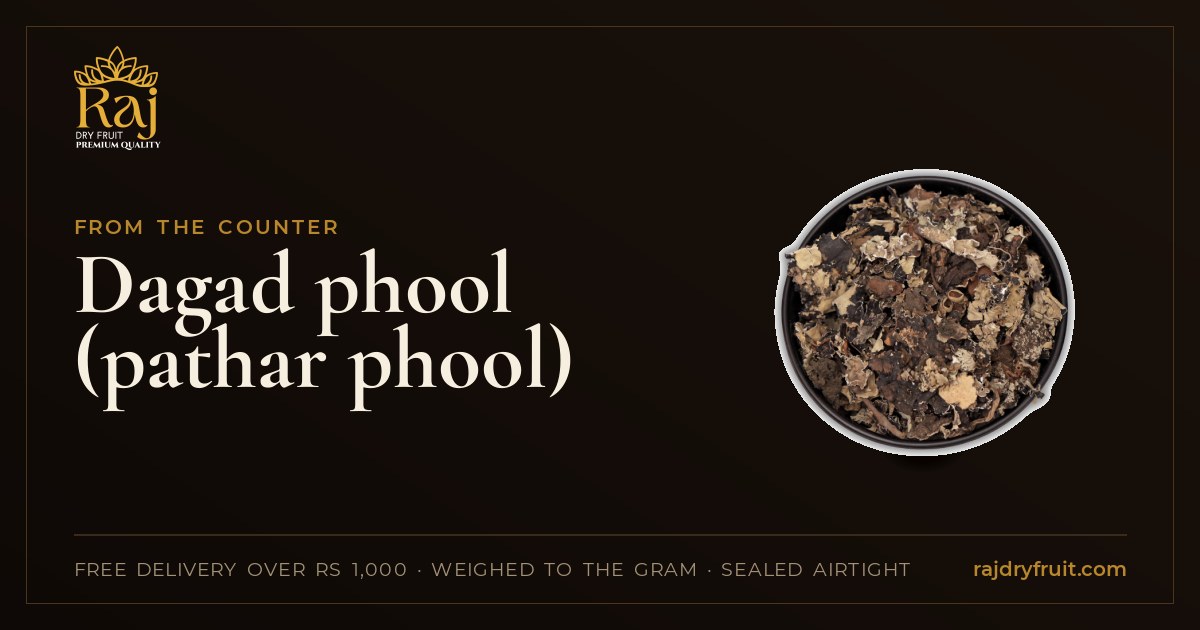
Pathar phool looks like thin, crinkled flakes, grey-black on one side and pale grey or off-white on the other, a little like dried leaves or torn paper. It is very light. A hundred grams is a surprisingly large bag.
Raw, it smells faintly of damp wood and not much else, and it has almost no taste on the tongue. The aroma only opens when it meets heat. Fried in a spoon of oil or ghee, or roasted in a dry pan, it gives off a smoky, earthy, almost forest-floor smell. That is the note it adds to a masala: depth rather than heat or sharpness.
How do you use dagad phool in goda masala?
In goda masala, dagad phool is dry-roasted with the other whole spices and ground in with them, and it is one of the spices that gives the masala its dark, rounded smell. Goda masala is the Maharashtrian household blend used in amti, masale bhaat and many vegetable dishes, and every family has its own version. The usual pattern looks like this:
- The base: coriander seeds and dried coconut, which make up most of the weight.
- The seeds: sesame and cumin, with some families adding shah jeera.
- The warm spices: cinnamon, cloves, black pepper and bay leaf.
- The background notes: dagad phool, and in many homes nagkesar and other spices in small amounts.
Roast each group separately on low heat, because coconut and sesame brown far faster than cinnamon or dagad phool. Dagad phool needs only a minute or so, until it smells toasted. Let everything cool fully before grinding, or the oil from the coconut and sesame turns the powder into a paste.
Most of those whole spices are on our spices shelf, including cinnamon, laung, kali mirch and tej patta, so the whole blend can come from one order.
How much stone flower should you use?
Use very little. As a working guide, a few flakes are enough for a single dish, and a small handful is enough for a jar of home-ground masala that will last a family several weeks. It is easy to overdo because the flakes are so light: a spoonful of pathar phool is a lot more flakes than a spoonful of coriander seeds.
Too much does not make a dish spicier. It makes it taste muddy and slightly bitter. If you are new to it, start small, taste the finished masala, and add more to the next batch.
Chettinad masala and biryani masala
In Tamil Nadu, kalpasi is a standard part of Chettinad cooking. It goes into the masala for Chettinad chicken and mutton, and into kuzhambu powders, alongside fennel, black pepper, dried red chillies, cinnamon, cloves and star anise. Here it is usually fried in oil at the start with the other whole spices, or roasted and ground into the paste.
For biryani, pathar phool is one of the whole spices that goes into many home biryani masala mixes, and into the spice bundle some cooks tie in muslin and drop into the rice or the stock. It sits with badian, badi elaichi, shah jeera, jaifal and javitri. If you are building your own biryani masala, our guide to jaifal and javitri covers the two spices that are easiest to get wrong in it.
A simple way to use it without a full masala: when you temper whole spices in ghee for a pulao or a mutton curry, add two or three flakes with the cloves and cinnamon. They crackle quietly, darken a little, and the smell tells you they are done.
How to buy and store pathar phool
- It should be dry and crisp. The flakes should crumble between your fingers, not bend. Limp or leathery flakes have picked up moisture.
- Smell it. A woody, earthy smell is right. A musty, mouldy smell is not.
- Some dust and small bits are normal. Lichen is fragile, and the bottom of any bag will have crumbs. They grind the same way.
- Look for loose grit. Because it grows on rock, a shake over a plate before use is a sensible habit.
Store it in an airtight jar away from light and steam, the same as any whole spice. Kept dry, it holds its aroma for months. Once ground into a masala, it fades faster, which is why many families grind goda masala in amounts that last a few weeks at a time.
We send pathar phool and the rest of our whole spices across India; orders start at ₹1,000 and every order ships free. You can see today’s price on the Pathar Phool product page.
Questions people ask
Is dagad phool the same as kalpasi?
Yes. Dagad phool is the Marathi name and kalpasi is the Tamil name for the same dried lichen, sold in English as stone flower. Hindi speakers usually call it pathar phool.
Can I skip pathar phool in a recipe?
You can, and the dish will still work, but a goda masala or Chettinad masala without it tastes flatter and less rounded. There is no real substitute that gives the same earthy note.
Do you need to wash stone flower before using it?
No, washing it makes it soggy and hard to roast. Shake it over a plate to remove any grit, then roast or fry it dry.
Why does my stone flower have no smell?
Raw pathar phool smells of very little. Warm a flake in a dry pan for a few seconds: if it gives off a woody, smoky smell, it is fine. If it still smells of nothing, it is old.
Is pathar phool used whole or ground?
Both. It is used whole when tempering in oil or ghee, or in a biryani spice bundle, and ground when making a dry masala such as goda or Chettinad masala.
We deliver across India See 87 city pages
Written at our counter, where these questions get asked every week.


