
In this guide
Quick answer
Kaju tukda is broken cashew, usually the four-piece grade, and it is used wherever the nut gets ground, cooked or hidden: gravies, cashew paste, kaju katli, pulao, upma, halwa and kheer. It tastes exactly like whole kaju because it comes from the same kernels, and for cooking it costs noticeably less per kilo.
What exactly is kaju tukda?
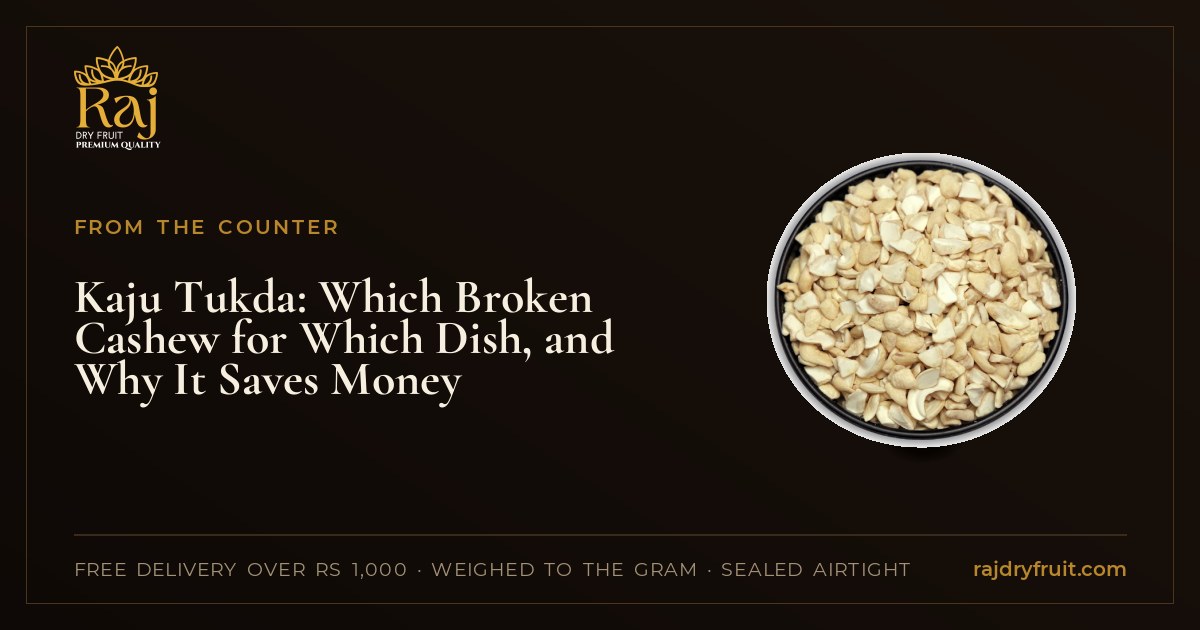
Kaju tukda is the part of a cashew lot that breaks during shelling and peeling. A raw cashew nut is roasted or steamed, cracked out of a hard shell, dried and peeled by hand or machine. Some kernels split along the natural line into two halves, and some break further into three or four pieces. Graders sort them by how they broke, not by how they taste.
The cashew trade has names for each stage. Whole kernels carry a W grade with a count (W240, W320). Halves split lengthwise are called splits, which most Indian shops sell as kaju faad or two-piece. Kernels broken crosswise are butts. Smaller pieces are large white pieces (LWP), small white pieces (SWP) and then baby bits. The Cashew Export Promotion Council of India lists these grades in its specifications, and what an Indian kitchen calls tukda sits around the LWP and SP end of that list.
Which broken cashew suits which dish?
Match the piece size to how visible the nut is on the plate. If it gets blended, buy the cheapest clean piece. If it shows, buy a bigger piece.
| Grade on the label | What it looks like | Best used for |
|---|---|---|
| Kaju faad (two-piece) | Clean halves, split lengthwise | Pulao, biryani garnish, upma, fried kaju for a halwa top |
| Kaju tukda (four-piece) | Quarters and chunky pieces | Cashew paste for gravies, kaju katli, kheer, laddu |
| Regular whole cashew | Whole, smaller count | The guest bowl, kaju roast, dishes where the shape matters |
A few kitchen rules of thumb:
- Shahi paneer, malai kofta or korma for four people needs about 50 g of tukda soaked for 20 minutes and ground smooth.
- A 500 g batch of kaju katli takes about 250 g of cashew, and tukda grinds just as well as whole.
- Vegetable pulao for six looks generous with 40 to 50 g of kaju faad fried golden in ghee.
- Semiya or chawal kheer for a family takes 30 g of chopped tukda added in the last ten minutes.
Our guide to cashew paste for gravy has the soaking times, and the kaju katli quantity guide works the sweet out by the kilo.


Is kaju tukda cheaper than whole kaju?
Yes, and the saving comes only from shape. Across all our grades, kaju works out to at today's shop rate today, and the broken grades sit at the lower end of that spread. Exact pack prices for the four-piece grade are at today's shop rate, and the two-piece kaju faad comes to at today's shop rate.
For a family that cooks with cashew three or four times a week, that gap adds up. Buying whole W320 for a gravy you will blend is paying for a shape nobody will see. The kaju price page lists every grade side by side if you want to compare, and the kaju grades explained post walks through the W numbers.
How do you check that broken cashew is fresh?
Broken kaju has more cut surface than whole kaju, so it shows age faster. Check four things when the pack arrives:
- Colour: ivory to pale cream. Grey, yellow patches or dark edges mean old stock or poor drying.
- Smell: faintly sweet and nutty. A paint-like or soapy note means the oil has turned rancid.
- Snap: a fresh piece breaks cleanly. A bendy, chewy piece has absorbed moisture.
- Powder: a little dust at the bottom is normal. A layer of fine powder means the pieces were handled roughly or are very old.
Store tukda in an airtight glass jar away from the stove. It keeps well for six to eight weeks at room temperature and three to four months in the fridge. In humid cities, the fridge is the safer place from the first day.
How much kaju tukda should a kitchen buy?
Most households that cook with cashew paste a few times a week get through 250 g in about a month. A kilo makes sense when Diwali sweets are on the plan, when you make kaju katli at home, or when the house is large. Before a festival, many cooks split the order: tukda for the kitchen and a smaller pack of whole kaju for the guest bowl.
Our orders start at ₹1,000 and every order ships free, and a sensible household basket clears that easily: 500 g kaju tukda for the kitchen, 500 g regular badam for soaking and 250 g pista kernels for sweets. Browse the whole cashew collection if you want to add a whole grade alongside.

Questions people ask
What is the tukda kaju rate per kg today?
It changes with the market, so the live figure is on the product page and the kaju price page. Broken grades are always below whole grades of the same lot because the only difference is shape.
Is broken cashew lower quality than whole cashew?
No. It comes from the same kernels and has the same taste and nutrition. It breaks during shelling and peeling, and is sorted out because whole nuts sell for more.
What does kaju 4 piece mean?
It means each kernel has broken into roughly four pieces. It is the standard cooking grade in Indian kitchens, larger than bits and smaller than the two-piece faad.
Can I use kaju tukda for kaju katli?
Yes. Katli needs ground cashew, so piece size does not matter. Pick clean, white pieces with no dark spots, because any discolouration shows in a pale sweet.
We deliver across India See 87 city pages
Written at our counter, where these questions get asked every week.