
In this guide
Quick answer
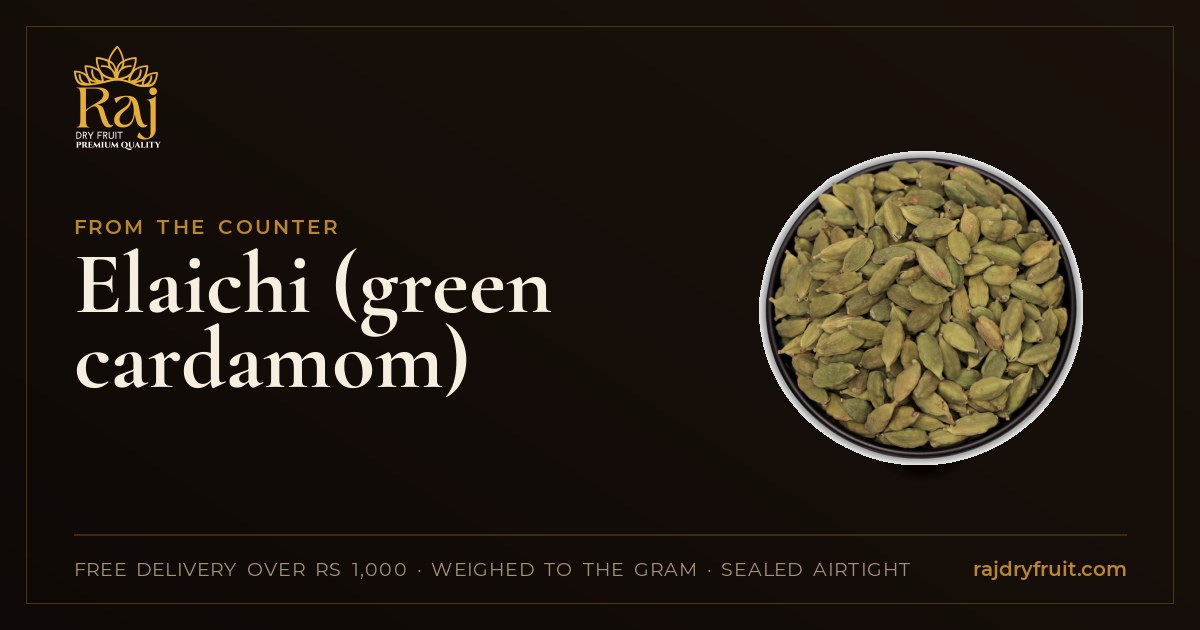
Elaichi is green cardamom, the small, pale-green pod of the Elettaria cardamomum plant, full of tiny black seeds with a sweet, cooling, slightly camphor-like smell. In Indian kitchens it flavours chai, kheer, halwa, biryani and almost every mithai. Its larger, smoky cousin, badi elaichi, is black cardamom, a different plant used mainly in savoury cooking.
The useful detail is that almost all of the flavour sits in the seeds, not the husk. A good pod is plump, evenly green and closed, and when you split it the seeds inside are dark, slightly sticky and strongly fragrant. That is what you are paying for, and it is what you should check.
What is elaichi called in English?
Elaichi is called cardamom in English, and the everyday green one is sometimes written “green cardamom” or “small cardamom” to separate it from black cardamom. In Hindi you will hear chhoti elaichi (small) and hari elaichi (green) for the same pod.
India grows green cardamom mainly in the hills of Kerala, Karnataka and Tamil Nadu, and it is one of the oldest traded spices in the world. Black cardamom, badi elaichi, is a different plant (Amomum subulatum) that grows in the eastern Himalayan hills, including Sikkim. The two are related but not interchangeable.
Green vs black cardamom: which one does the recipe want?
If the dish is sweet, or is chai, the recipe wants green. If it is a dark, heavy gravy, a pulao or a garam masala, it may want black, and many recipes use both. The table below is the quick way to tell them apart.
| Point | Green (chhoti elaichi) | Black (badi elaichi) |
|---|---|---|
| Look | Small, smooth, pale green pod | Large, wrinkled, dark brown pod |
| Smell | Sweet, floral, cooling | Smoky, earthy, resinous |
| Why it tastes that way | Dried gently to keep the colour | Traditionally dried over open fire |
| Best in | Chai, kheer, halwa, mithai, biryani | Garam masala, chole, rajma, pulao |
| How much to use | 1–3 pods for a pot of chai | Usually one pod is enough |
Do not swap one for the other in a sweet. Black cardamom in kheer tastes like smoke. For the savoury pot, we keep Black Cardamom (Badi Elaichi) alongside the green.
How do you judge good elaichi by size, colour and aroma?
Judge good elaichi by opening a pod: dark, sticky seeds and a strong smell matter more than anything on the outside. Size and colour are useful signs, but the seeds are the proof. In the trade, green cardamom is graded by size in millimetres, and the bolder pods are sold as the premium grades.
- Size. Bigger, bolder pods usually hold more seeds, and look better in a gift box or on top of a dish. For grinding into a masala, a medium pod does the same job.
- Colour. An even, fresh green means the pods were dried with care. Pale, yellowish or straw-coloured pods are usually older or were dried in harsh sun, and the aroma fades with the colour.
- Shape. Plump and closed is good. Split, flat or empty-feeling pods have lost oil and seeds.
- Seeds. Crack one open. The seeds should be black or dark brown and cling together. Light brown, dry seeds that rattle loose mean an old pod.
- Smell. Rub a pod between your palms. Good elaichi smells sweet straight away. If you have to put your nose into the bag to find it, it is tired.
Our Cardamom (Elaichi) Green & Super is the green elaichi we keep for chai and sweets. See today’s price on the product page, as spice rates move with each crop.
Whole elaichi or elaichi powder?
Buy whole pods and grind small amounts yourself. The aroma of cardamom comes from volatile oils in the seeds, and once the seeds are ground those oils start escaping within days. Ready powder also hides what went into it, and you cannot tell whether husk was ground in with the seeds.
To make fresh elaichi powder at home:
- Split the pods and tip out the seeds. Keep the husks for chai.
- Warm the seeds in a dry pan for under a minute, only until you can smell them.
- Cool, then grind in a small mixer jar or a mortar. A spoon of sugar in the jar helps the seeds grind finer, which is handy when the powder is going into a sweet.
- Store in a small airtight jar and use within a few weeks.
For a pot of chai, you do not need powder at all. Crush one or two pods lightly with the back of a spoon, husk and all, and boil them with the tea leaves.
How should you store elaichi?
Store elaichi whole, in an airtight glass jar, away from light, heat and the stove. Kept that way, whole pods hold their smell for many months. Moisture is the main enemy: damp pods lose colour and can turn musty, so always use a dry spoon and close the lid straight after.
Do not keep elaichi in the same open dabba as strong spices like hing, which will pass their smell into the pods. If you buy a larger pack for the festive season, keep a small working jar in the kitchen and the rest sealed in a cupboard.
How is elaichi used in chai and sweets?
In chai, elaichi goes in whole and crushed. In sweets, it goes in as fresh powder, added near the end so the smell stays bright. A pinch goes a long way, and too much turns a sweet bitter and medicinal.
- Chai: one or two crushed pods per two cups, often with ginger or Saunth (dry ginger) in winter.
- Kheer and seviyan: powder stirred in once the milk has thickened, with almonds and pista on top.
- Halwa and laddoo: powder mixed into the ghee and sugar at the end.
- Thandai: ground with almonds, saunf and black pepper. Our thandai ingredients page lists the full set.
- Biryani and pulao: whole green pods in the ghee with cloves and cinnamon, and black cardamom if you want a smokier rice.
- After meals: many people simply chew one pod, the way others take mukhwas.
Elaichi sits naturally with the other whole spices on our Spices shelf, such as Clove (Laung) and cinnamon.
Questions people ask
Is chhoti elaichi the same as green cardamom?
Yes. Chhoti elaichi, hari elaichi and green cardamom are all names for the same small green pod. Badi elaichi is black cardamom, a different plant.
Can I use black cardamom instead of green?
Only in savoury dishes like chole, rajma or a garam masala, and use less. In chai or sweets, black cardamom’s smoky taste does not work.
Should elaichi be eaten with the peel?
In chai and biryani the husk is cooked whole and simply left on the side. For sweets and powder, most people use only the seeds, because the husk is fibrous and has little flavour.
Why is elaichi so expensive?
Green cardamom is hand-picked pod by pod as each one ripens, and it is carefully dried to keep the colour. Prices also swing with each crop, which is why we point to the product page for today’s rate.
How long does elaichi stay good?
Whole pods in an airtight jar keep their aroma for many months. Home-ground powder is best used within a few weeks.
We send whole spices across India; orders start at ₹1,000 and every order ships free. You can add green elaichi to a mixed order of dry fruits and other spices.
We deliver across India See 87 city pages
Written at our counter, where these questions get asked every week.


