In this guide
Quick answer
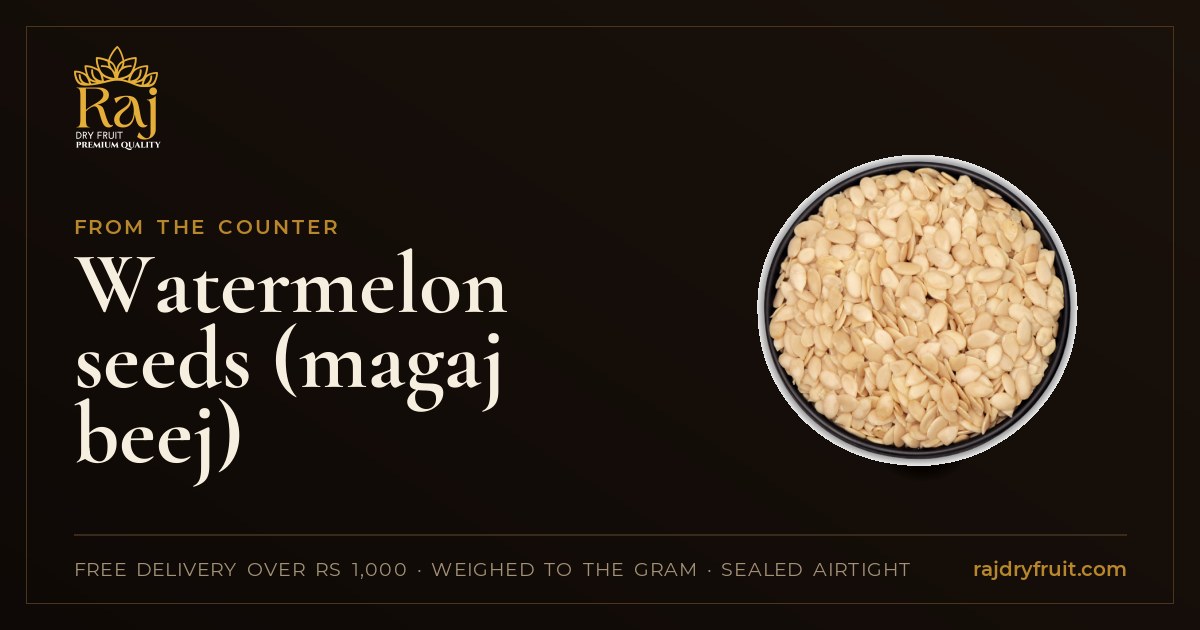
Magaj beej are peeled watermelon seed kernels: the small, flat, cream-coloured kernels that sit inside the hard black seed. Their benefit is as a food. Per 100 g they carry about 28 g of protein and a good amount of magnesium, iron and zinc, most of their calories come from fat, and Indian kitchens use them in thandai, laddoo, mukhwas and as a garnish on sweets.
Magaj is one of those things most people have eaten without knowing it. It is the pale speck on top of a barfi and the reason a good thandai tastes rounder than milk and nuts alone.
What magaj dry fruit actually is
A watermelon seed has a hard shell, black or brown depending on the melon. Crack it and inside is a soft kernel, a little like a very small, flat almond. That kernel is magaj.
Shelling them by hand is slow work, which is why peeled magaj costs far more than the whole seed. On our counter Watermelon Seeds (Magaj Beej) sit at around at today's shop rate a kilo; today’s figure is on our product pages.
The word magaj (or magaz) simply means kernel, and it is used a little loosely. Char magaz, a traditional blend used in many kitchens, is four such kernels together, and which four depends on the family: watermelon and muskmelon are almost always in it, with pumpkin, cucumber or bottle gourd kernels making up the rest. If you ask a shop for magaj on its own, you will usually be given watermelon kernels.
Watermelon seeds nutrition per 100 g
These are approximate figures for dried, shelled watermelon seed kernels. Every lot varies a little.
| Per 100 g (approx.) | Amount |
|---|---|
| Energy | about 550 kcal |
| Protein | about 28 g |
| Fat | about 47 g |
| Carbohydrate | about 15 g |
| Magnesium | about 500 mg |
| Iron | about 7 mg |
| Zinc | about 10 mg |
Two things follow from that table. First, for a seed, magaj is high in protein, which is part of why vegetarian kitchens have leaned on it for so long. Second, it is dense in calories, much like almonds. A level tablespoon, around 10 g, is roughly 55 calories, so it is an ingredient rather than something to eat by the bowl.
If you have diabetes, a kidney condition, are pregnant or are following a diet plan, ask your doctor how seeds fit into it.
How magaj is used in Indian cooking
Thandai
Thandai is the best-known use. Magaj is ground with almonds, saunf, black pepper, cardamom and a few other things into a paste or powder, then stirred into cold milk. It is the drink of Holi and Mahashivratri in much of North India, and many families think of magaj as a summer ingredient for that reason.
Laddoo and panjiri
Magaj goes into gond laddoo, dry fruit laddoo and panjiri alongside almonds and cashews. Roast it lightly in ghee first; it only takes a minute or two and turns faintly golden when it is ready.
Mukhwas
Lightly roasted magaj is a common part of after-meal mixes, where it softens the sharpness of saunf and dhana dal. We have explained how those mixes are built in what mukhwas actually is.
Garnish on sweets
A pinch of magaj on barfi, kalakand, halwa or kheer adds a small, soft crunch and a pale colour that sits well against pista green. It costs less than pista to use this way and many people prefer the milder taste.
Gravies
In rich, mild gravies, magaj paste is often used with or instead of cashew paste to thicken and smooth the sauce. Soak it for twenty minutes before grinding.
How to buy and store magaj
- Colour: even cream or off-white. A yellow or brownish cast usually means old stock.
- Smell: it should smell of almost nothing. Anything bitter or paint-like is rancid fat.
- Broken pieces: a few are normal. A bag that is mostly dust has been handled too much.
- Storage: an airtight jar, in the fridge in summer. Because it is so oily, magaj goes stale faster than most dry fruits.
If you want magaj together with other kernels, our Five Seeds Mix is ready to sprinkle, and the whole seeds shelf includes Muskmelon Seeds (Kharbuja Beej) and Pumpkin Seeds if you would rather mix your own char magaz.
Questions people ask
What is magaj called in English?
Magaj or magaz beej is sold in English as watermelon seed kernels, or peeled watermelon seeds.
Can I eat magaj raw?
Yes, it is edible straight from the packet. A light roast in a dry pan brings out more flavour.
How much magaj should I use in thandai?
Most home recipes use roughly one tablespoon of magaj for every two to three tablespoons of almonds, but it is a matter of taste.
Is magaj the same as char magaz?
Not quite. Magaj on its own is usually watermelon kernels, while char magaz is a blend of four melon and gourd kernels.
We deliver across India See 87 city pages
Written at our counter, where these questions get asked every week.