In this guide
Quick answer
The qubani ka meetha served at Hyderabadi weddings is made with small, brownish, dried apricots that still have their stones in, the kind often called Hunza-style. The bright orange Turkish apricots we sell are a different fruit to cook with: they make a good apricot dessert, but it will be lighter in colour and tangier than the deep, toffee-like qubani you remember from a dawat.
We would rather say that plainly than sell you the wrong thing for the dish. Here is what the difference is, how to get the best from each, and the almonds that go on top.
What qubani ka meetha actually is
Qubani is the Urdu word for apricot. Qubani ka meetha is dried apricots soaked overnight, stewed with sugar until they collapse into a thick, glossy, amber compote, and served chilled or warm, usually with fresh cream, malai or custard. At a Hyderabadi wedding feast it sits alongside double ka meetha as one of the two desserts people look for.
In the traditional version, the apricot stones are cracked open after cooking and the kernels inside are used as a garnish, alongside or instead of almonds.
Traditional dried apricots and Turkish apricots compared
| Traditional (Hunza-style) dried apricots | Turkish apricots | |
|---|---|---|
| Look | Small, round, pale to dark brown, wrinkled | Larger, flat, bright orange, soft |
| Stone | Usually still inside | Removed |
| Texture when dry | Hard, leathery | Soft and moist, ready to eat |
| Flavour | Deep, honeyed, caramel-like | Fresh, tart-sweet |
| Soaking | Overnight | 2–3 hours is enough |
| Qubani ka meetha result | Dark amber, thick, the classic taste | Golden-orange, lighter, tangier |
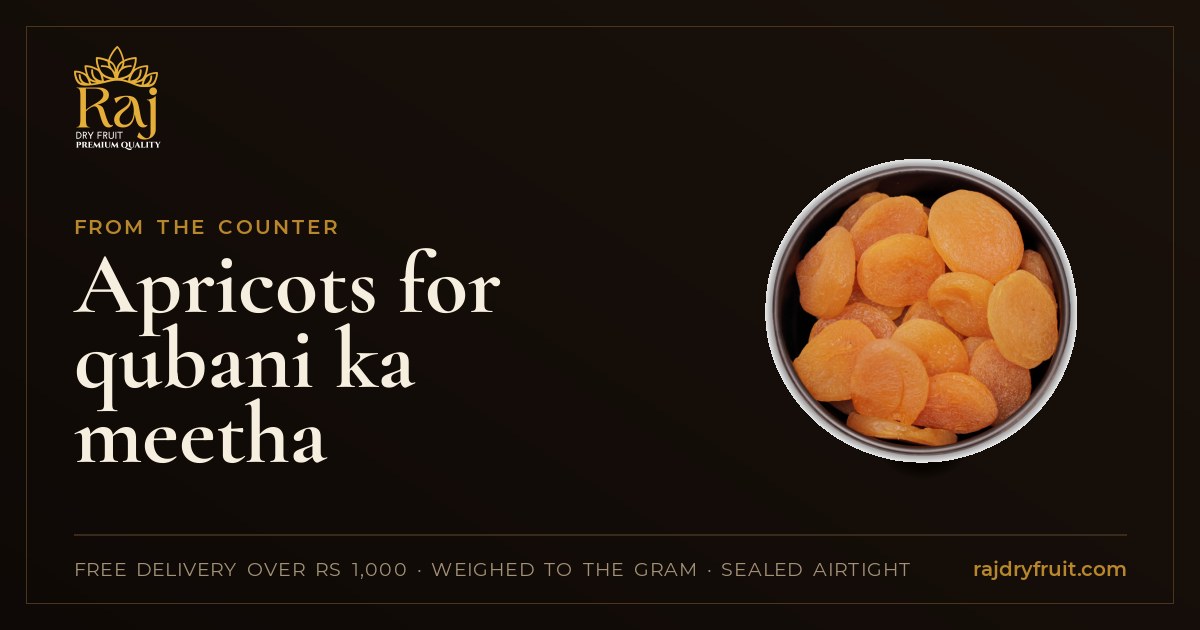
We keep Turkish Apricot, not the traditional variety. If you want the exact taste of a Hyderabadi wedding qubani, the stone-in brown apricots are what you need, and we do not stock them. If you want a qubani-style dessert that is easy, quick and genuinely good, Turkish apricots do the job well, and plenty of home cooks now use them.
Making qubani ka meetha with Turkish apricots
For 4–6 servings, use a 250 g pack of apricots.
- Soak. Cover the apricots with about two cups of water for 2–3 hours. Keep the soaking water; it carries flavour.
- Cook. Simmer the apricots in the soaking water until very soft, 15–20 minutes. Mash some and leave some in pieces.
- Sweeten carefully. Turkish apricots are sweeter than the traditional kind. Start with about 1/4 cup sugar and add more only after tasting. Traditional recipes use far more because the dried brown apricots are more tart and dense.
- Reduce. Cook on low heat, stirring, until thick and glossy. It thickens more as it cools.
- Deepen the colour, if you like. Cooking the sugar to a light caramel before adding the apricots brings the colour and flavour a step closer to the classic.
Serve chilled with cream or malai, or warm with vanilla ice cream, which is how many Hyderabad restaurants serve it now.
The almond garnish
Turkish apricots come without their stones, so there are no kernels to crack. Almonds are the usual stand-in, and the one most Hyderabadi homes use anyway.
- Badam Katran is almonds already sliced thin. Scatter them on top as they are, or toast lightly in a dry pan for a nuttier taste. A 100 g pack garnishes several batches.
- Blanched whole almonds look closest to the apricot kernels of the traditional dish. Soak Regular Badam in hot water for 20–30 minutes, slip off the skins, and split them in half.
For 4–6 servings, about 25–30 g of almonds is plenty, roughly 20–25 whole ones. Almonds cost around at today's shop rate a kilo for the everyday lot, so the garnish adds very little to the dish. The full almond shelf is there if you want larger kernels.
A word on apricot kernels: if you are using stone-in apricots, only use kernels that taste mild. Bitter apricot kernels should not be eaten in quantity. When in doubt, use almonds.
Buying and storing apricots for a function
For a family dawat of about 25 guests, plan on around 1–1.25 kg of Turkish apricots, or four or five 250 g packs. Qubani ka meetha keeps in the fridge for three to four days, so it can be made a day or two ahead of a function.
Store unopened apricots in a cool cupboard. Once opened, keep them in an airtight jar, and in the fridge during Hyderabad’s hot months from March to June, when soft dried fruit can turn sticky or start to ferment.
Delivery to Hyderabad takes 3–5 days, and it is free: orders start at ₹1,000. You can check today’s dry fruit prices in Hyderabad, and our guide to Mamra and Californian almonds if you are choosing almonds for the table as well.
Questions people ask
Can I make qubani ka meetha with Turkish apricots?
Yes. The dessert comes out lighter in colour and tangier than the traditional version made with brown, stone-in apricots, but it is quick and tastes good.
How long should I soak apricots for qubani ka meetha?
Traditional dried apricots need an overnight soak. Turkish apricots are already soft and need only 2–3 hours.
What garnish goes on qubani ka meetha?
Traditionally the kernels from the apricot stones, and blanched or sliced almonds. Cream or malai is served alongside.
How many apricots do I need for four people?
About 250 g of dried apricots makes 4–6 servings.
We deliver across India See 87 city pages
Written at our counter, where these questions get asked every week.