In this guide
Quick answer
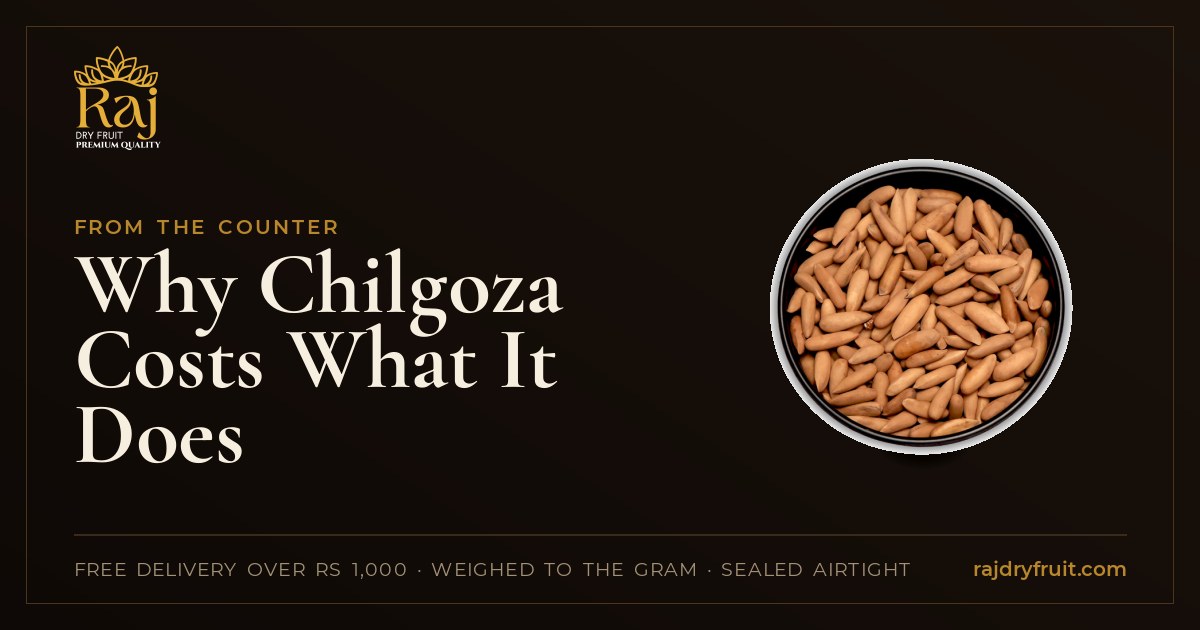
Every dry fruit shop gets the same phone call about chilgoza, and it is never really a question. It is somebody checking whether the figure they were quoted was a mistake. It was not. Pine nuts are the dearest thing on the shelf, by a distance, and the reason is in how they are gathered.
What does chilgoza cost per kilo?
At our counter, chilgoza with the shell on is at today's shop rate a pack, read off the shop as this page loads. Work that out per kilo and it sits far above kaju, badam or pista, and that gap holds in every shop in the country.
Shelled kernels cost more again, and the arithmetic is why. The shell is roughly half the weight you are carrying home, so a kilo of shelled chilgoza is about two kilos of the unshelled kind with the work already done.
Why is it so much dearer than every other nut?
| What happens | Why it costs |
|---|---|
| Grows wild, not farmed | No orchard, no planned yield, no scale |
| Cones picked by hand off tall trees | Dangerous, slow, a short season |
| Nuts extracted cone by cone | A day’s picking gives very little weight |
| Grows in a narrow belt | One bad season moves the whole year’s rate |
Compare that with an almond orchard, which is planted, irrigated, picked by machine and yields the same tonnage every year. The difference in the two rates is the difference between farming something and finding it.
It helps to see the gap against something familiar. Kaju, which nobody thinks of as a cheap nut, runs at today's shop rate at our counter today, and chilgoza sits several times above the top of that range. That is not a shop marking something up. It is what the kernel costs before anybody has touched it.
How do you buy chilgoza without wasting money?
- Buy small. A hundred grams is a real quantity of chilgoza, not a sample, because the kernels are tiny and a few go a long way.
- Buy with the shell if you will crack them yourself. They keep far better in the shell and you are not paying for somebody else’s labour.
- Buy kernels if they are going into food, where cracking a hundred shells is an evening nobody has.
- Keep them cold. Chilgoza carries more oil than almost any other nut, which is what makes it taste the way it does and also what makes it turn fastest.
That last one is where most of the money actually goes. A chilgoza left in a warm kitchen for two months is a chilgoza thrown away, and at this rate that is a painful jar to bin. The fridge is not optional with this one.
Is it worth buying at all?
For most households, in small quantities, yes — and for the reason people buy it rather than any other. It tastes of nothing else. The flavour is resinous and sweet and does not have a substitute, which is why it holds its place in kashmiri cooking and in winter sweets despite what it costs.
Where it is not worth it is as filler. Putting chilgoza into a mixed jar to be eaten by the handful is the most expensive way to eat nuts in India, and nobody notices it is there. If what you want is a daily nut, akhrot or badam does the job for a fraction of the figure — the akhrot price page and the badam price page have today’s rates for both.
How much should you buy at a time?
A hundred grams for a household that uses it occasionally, and that will last a season if it is kept cold. For a dish that calls for it specifically, work out what the recipe needs and buy that, rather than keeping a standing jar of something this expensive sitting about losing freshness.
Our orders start at ₹1,000 and every order ships free, so a small pack of chilgoza normally travels with the rest of the month’s order rather than on its own. There is more on where it comes from and how it is used in the chilgoza guide, and the full nut shelf is on the nuts page.
Questions people ask
Why is chilgoza more expensive than kaju and badam?
Because it is gathered from wild trees by hand rather than grown in an orchard, and a day’s work yields very little weight. Nothing about the supply can be scaled up.
Should I buy chilgoza with the shell or without?
With the shell if you will crack them yourself, as they keep longer and you pay for less labour. Without, if they are going straight into cooking.
How long does chilgoza keep?
A month or so at room temperature and several months in the fridge. It is the oiliest nut on the shelf, so it turns faster than any other if it is left warm.
Is there a cheaper substitute?
Not for the flavour. For the texture in a dish, broken cashew or pumpkin seed works, but it will taste like a different recipe rather than the same one made cheaply.
Written at our counter, where these questions get asked every week.