In this guide
Quick answer
Cheapest dry fruits is one of the most searched phrases in this trade, and it deserves a straight answer rather than a sales pitch. Some things here genuinely cost little because they are grown at scale. Others are cheap for reasons you would not accept if anybody told you them.
Which dry fruits actually cost the least?
The seeds, by a distance. Alsi, chia, magaj, sunflower and pumpkin are field crops, machine harvested and stored easily, and none of the things that make a nut expensive apply to them. Alsi runs at today's shop rate at our counter and is the least expensive thing we sell.
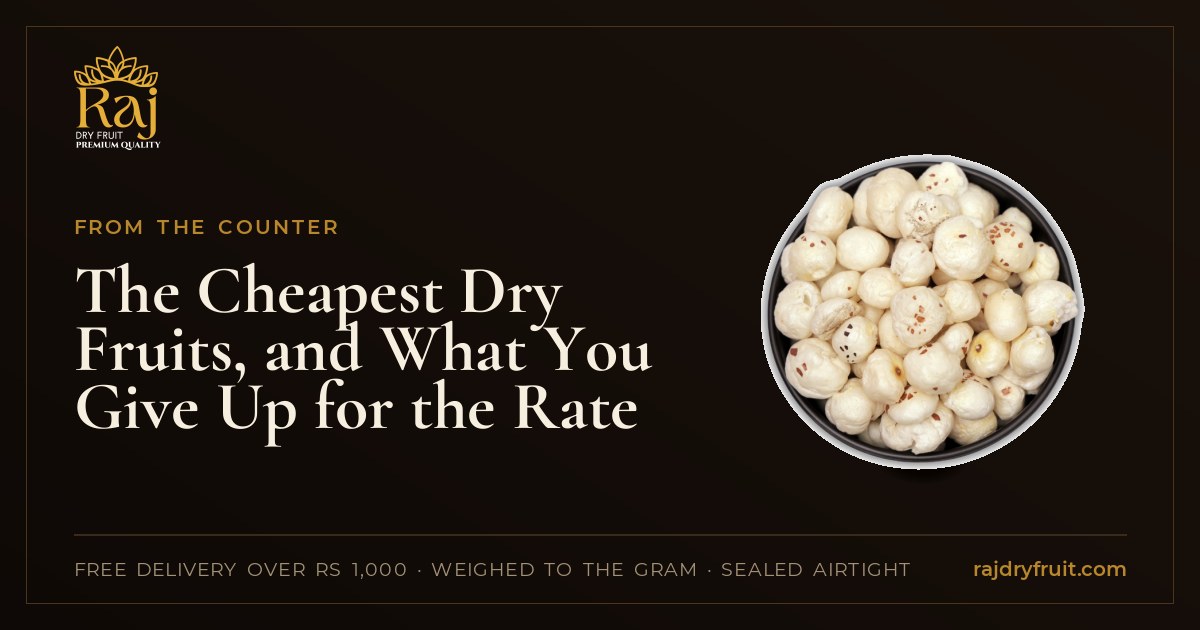
After that come the common raisins, then makhana, then dry dates. Makhana in particular surprises people: it looks like a luxury, puffs up to many times its weight and works out cheaper per serving than almost anything else — at today's shop rate a kilo today.
| Cheap and genuinely good value | Cheap for a reason |
|---|---|
| Alsi, chia, magaj, sunflower | Broken or chipped nuts sold as whole |
| Round seedless raisins | Small counts quoted under a premium name |
| Makhana | Last season’s stock cleared cheaply |
| Dry dates and chuara | Packs that are 180 or 450 grams, not 200 or 500 |
| Walnut kernels in two pieces | Nuts polished or oiled to look fresh |
What are the four ways a low rate gets paid for?
- Grade. A smaller count under the same item name is the commonest, and it is not dishonest unless the grade is hidden.
- Weight. A pack sold at a round-looking figure that turns out to hold less than you assumed.
- Age. Last season’s stock at this season’s name. It is the hardest one to spot and the one that tastes worst.
- Delivery. A low rate plus freight plus a cart minimum you were not told about is not a low rate.
Only the third one is really a problem. The other three are fair trade once you know about them, which is why asking for the grade and the net weight settles most comparisons in a sentence.
Does cheap mean the shop is cutting corners?
Not usually. Most of the gap between two honest quotes is grade and nothing else, and a shop that sells the smaller count at the lower figure and says so is doing its job. What is worth walking away from is a quote that will not name the grade at all, because the only reason to hide it is that naming it would explain the rate. Ask once; the answer tells you everything.
Where is cheap a false economy?
Three places, reliably. Walnut kernels, because they turn faster than anything else and a cheap old lot is bitter within weeks. Anjeer, because the small grades are fine to eat but the very cheap ones are usually hard, dark and past it — today’s honest range is at today's shop rate on the anjeer price page. And anything already ground or powdered, because grinding exposes oil to air and nobody can tell you when it was done.
The opposite case is worth saying too. Broken cashew for a ground sweet, walnut kernels in two pieces rather than halves, smaller almond counts for soaking — all of these are the same food at a lower figure, and buying the premium grade for those jobs is simply overspending. Akhrot in pieces runs at today's shop rate today on the akhrot price page.
How do you build a cheap order that is still good?
Decide what each item is for before you decide what grade to buy. A household that keeps two jars of almonds — a small count for soaking and cooking, a large one only for a tray — spends less over a year than one that buys the large grade for everything, and eats better, because the cooking jar gets replaced more often.
Then buy a month at a time rather than six. The cheapest kilo you ever bought is expensive if half of it is binned in August. Our orders start at ₹1,000 and every order ships free, so there is no penalty for ordering monthly, and the shop page shows what the whole list costs today in one place.
Questions people ask
Which is the cheapest dry fruit in India?
Seeds — alsi, magaj, sunflower — by a wide margin, then ordinary seedless raisins. Makhana is cheaper per serving than it looks because it weighs almost nothing.
Are broken nuts worse than whole ones?
Not to eat. They are the same lot, broken in handling or grading. For anything ground, blended or cooked they are the sensible buy; for a gift, they are not.
How do I know stock is not old?
Smell it, and buy from somewhere that moves stock quickly. Nuts do not look older as they age, so a date on the pack and a shop with turnover are worth more than any visual check.
Is buying a bigger pack always cheaper?
Per kilo, nearly always. In practice, only if it will be finished while it is still good. The seeds shelf is the one place where a large pack rarely goes to waste.
Written at our counter, where these questions get asked every week.