In this guide
Quick answer
Cashew is the item people most often overpay for, and it is not because shops are dishonest. It is because the grade is almost never named, the nicknames differ from counter to counter, and the biggest kernel looks like the best one even when the job does not need it.
What makes one kaju better than another?
Freshness first, then grade. A cashew carries a good deal of oil, so an old kernel tastes flat and faintly bitter however large it is, and no amount of size makes up for it. Grade comes second, and grade is about size rather than quality: the same lot sorted into four counts gives four rates for one nut.
Our own range runs at today's shop rate across the grades we keep, each with its pack weight printed beside it on the kaju price page, so the comparison can be made properly rather than guessed at.
What should you actually look at?
| Check | Good | Poor |
|---|---|---|
| Colour | Even pale ivory | Yellowed, grey or patchy |
| Surface | Matt, dry, clean | Oily film, or dusty with cashew powder |
| Shape | Kernels resemble each other | Mixed sizes and many chipped edges |
| Snap | Breaks with a clean crack | Bends, or crumbles into powder |
| Smell | Faintly sweet and milky | Sour, or of old oil |
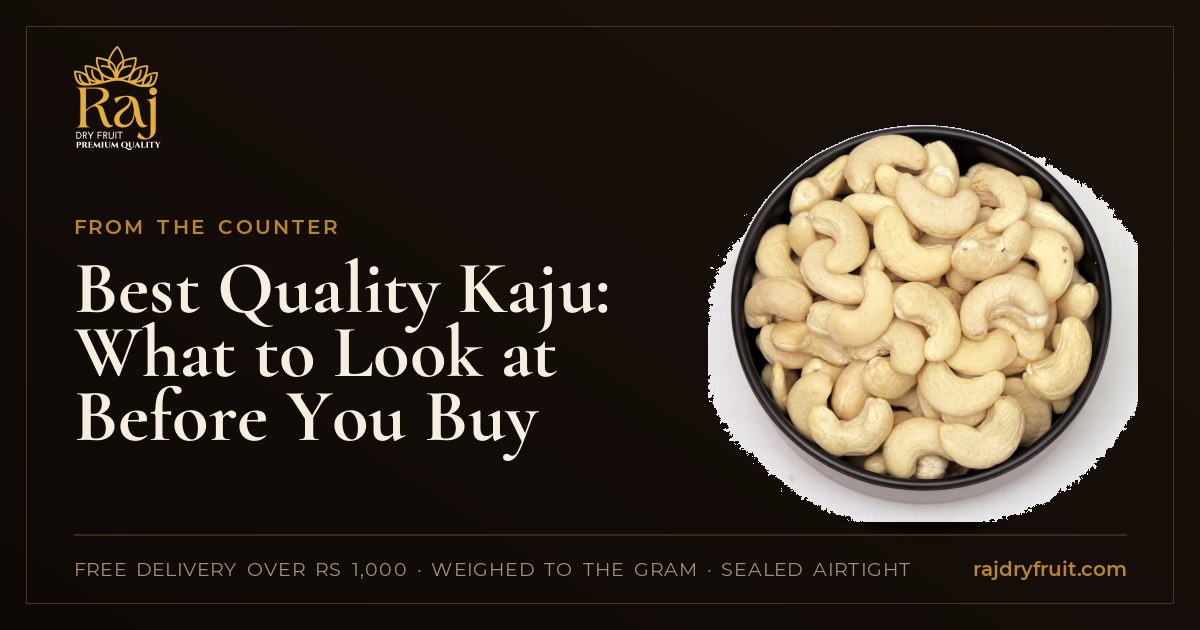
Colour is the fastest tell. A fresh cashew is pale and even; yellowing means age, and age in a cashew is the one fault you cannot taste your way around. Powder at the bottom of the bag is the second tell: it means the kernels have been handled hard or are drying out.
One more thing is worth a glance before paying, and it is the bottom of the bag rather than the top. Cashew that has been moved about a lot sheds a fine pale dust, and a bag with a layer of it has either been handled hard or has been opened and poured more than once. Neither makes it unsafe; both mean the kernels have had a longer life than the shop is implying.
What do the grade names mean?
There is a proper scale behind them, based on how many kernels make up a pound, and it runs from the largest whole kernels down through smaller, very even ones to butts, splits and pieces. Shops then sell those under their own names, and ours are Super and Jumbo for the large whole grades, with faad and tukda for the broken ones.
What matters is that none of those is better food than another. A broken cashew is a whole cashew that broke, from the same lot, and in anything ground or cooked it behaves identically. The guide to kaju grades sets out what the scale measures and where each name sits.
Which grade should you buy for what?
- Gift box or tray: the largest whole grade, because size is the only thing it is being judged on.
- Snacking from a jar: a mid whole grade. Even and generous without paying for the scarce top size.
- Gravies, kaju katli, sweets: broken pieces, every time. It is blended or ground within a minute.
- Roasted and masala kaju: a mid grade, as the coating is doing most of the work.
Buying the gift grade for cooking is the commonest way a household overspends on this shelf, and nobody at the table has ever noticed. The pieces are at today's shop rate a pack and do the same job.
How should cashew be kept?
Cool, dark and sealed, and in summer in the fridge. Cashew sits between almond and walnut on how fast it turns — slower than akhrot, faster than badam — and a jar on a warm kitchen shelf through April and May will be noticeably flat by June.
Buy a month at a time rather than stocking up, decant into glass rather than keeping it in the courier pouch, and keep the roasted and salted kind separate, as it draws moisture and softens faster than plain kernels. Our orders start at ₹1,000 and every order ships free, so ordering monthly costs nothing extra. The rest of the shelf with today’s figures is on the nuts page.
Questions people ask
Which kaju grade is the best?
For eating whole, the larger grades. For anything cooked or ground, the broken ones, which are the same nut at a much lower rate. There is no grade that is better food.
Why is my cashew yellowish?
Age, usually, or heat in storage. A fresh kernel is pale ivory. Yellowing is the clearest sign that a lot has been sitting too long.
Is broken cashew worth buying?
For sweets, gravies and anything blended, yes — it is the sensible buy. For a gift or a bowl on the table, no, because the look is the point.
How long does kaju keep?
A couple of months in a sealed jar away from heat, longer in the fridge. It turns faster than almond and slower than walnut. Today’s whole range is on the shop page.
We deliver across India See 87 city pages
Written at our counter, where these questions get asked every week.