
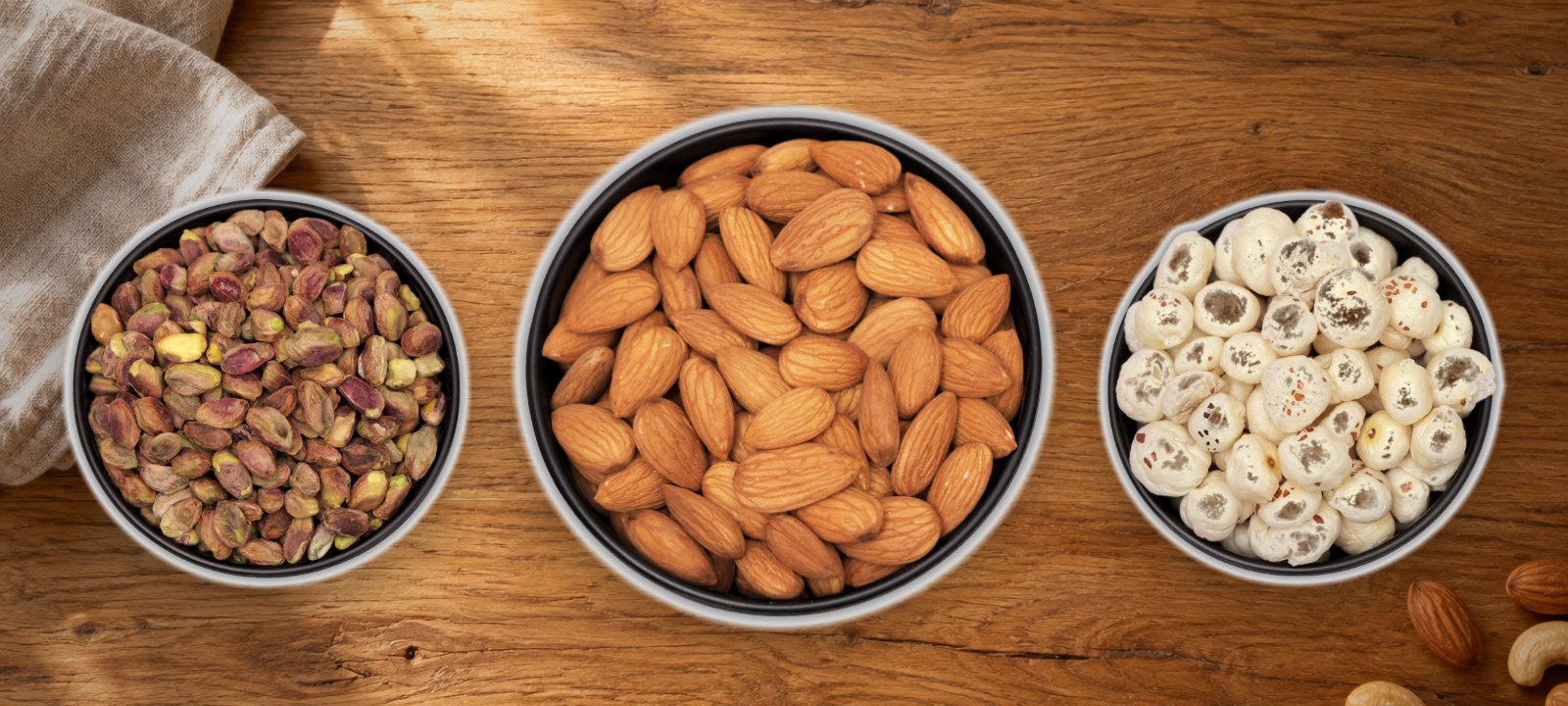


The highest protein nuts and seeds are watermelon seed kernels and pumpkin seeds at about 28 to 30 g per 100 g, followed by sunflower seeds and almonds (badam) at 21 g. Nobody eats 100 g at a sitting, so the handful column below matters more.
The ranked list
Values are USDA-style, rounded and conservative. Calories are shown because protein from nuts always arrives with fat.
| Item | Protein per 100 g | Calories per 100 g | Protein in 25 g |
|---|---|---|---|
| Pumpkin seeds | 30 g | 559 | 7.5 g |
| Watermelon seed kernels | 28 g | 557 | 7 g |
| Sunflower seeds | 21 g | 584 | 5 g |
| Almonds | 21 g | 579 | 5 g |
| Pistachios | 20 g | 560 | 5 g |
| Cashews | 18 g | 553 | 4.5 g |
| Flax seeds (alsi) | 18 g | 534 | 4.5 g |
| Chia seeds | 17 g | 486 | 4 g |
| Walnuts | 15 g | 654 | 4 g |
| Makhana (fox nut) | 10 g | 347 | 2.5 g |
What this means for a vegetarian day
If you eat no eggs or meat, a handful of seeds each day is a useful top-up. A 25 g mix of pumpkin and sunflower seeds gives roughly 6 g of protein, about the same as an egg. Add a tablespoon of flax or chia to curd, and you pick up another 2 g with fibre. Dal, paneer, curd and soy still do the heavy lifting.
- Snack: 25 g pumpkin seeds, about 2 tablespoons
- Breakfast: 1 tablespoon each of flax and chia in oats or curd
- Evening: a bowl of roasted makhana, light and low in calories
Roasted, raw or soaked
Dry roast pumpkin, sunflower and watermelon seeds in a pan for 3 minutes on low heat, with a pinch of salt or black pepper. Flax is better ground, as whole seeds often pass through undigested. Chia can be soaked for 15 minutes in water to form a gel. Almonds and pista kernels are best eaten plain, because salted and flavoured versions add sodium quickly.
Fat is the trade off. A 100 g jar of nuts and seeds carries 550 calories or more, so measure with a small cup if you are watching your weight. Store in glass jars, away from heat, and finish within a month for the best flavour.
Reading labels and mixing through the week
Protein per 100 g on a pack is not the same as protein per serving, and flavoured mixes often add rice puffs or sugar that dilute the count. Plain nuts and seeds are the simplest way to know exactly what you are eating.
Mix and match through the week: pumpkin and sunflower seeds on Monday, almonds and pistachios on Tuesday, a flax and chia curd bowl on Wednesday. Variety adds different minerals, such as zinc in pumpkin seeds, vitamin E in sunflower seeds and magnesium in almonds. Soak chia and flax if you find the fibre heavy at first.
Two practical tricks: grind roasted pumpkin and sunflower seeds into a coarse powder and sprinkle it on dal, sabzi or salad for extra protein without extra chewing, or blend a spoon of soaked almonds into your morning smoothie for a thicker, more filling drink.
One month supply of protein snacks
- Pumpkin seeds: 500 g
- Sunflower seeds: 250 g
- Watermelon seeds: 250 g
- Almonds: 500 g
- Flax and chia: 250 g each
More options are in our guide to protein rich dry fruits, and every seed sits in one seeds collection. Orders start at ₹1,000 and every order ships free. Payment is online only.
Questions people ask
Which nut has the most protein?
Among nuts, almonds and pistachios lead at 20 to 21 g per 100 g. Pumpkin and watermelon seeds are higher at 28 to 30 g per 100 g.
How much protein do nuts and seeds give in a day?
A 30 g handful gives 5 to 8 g protein. That helps but does not replace dal, curd, paneer, eggs or other main protein foods.
Are roasted seeds as nutritious as raw?
Light dry roasting changes little in protein. Avoid heavy oil roasting and salt, which add fat and sodium to an otherwise simple snack.
Is makhana a good protein snack?
Makhana has about 10 g protein per 100 g with few calories, so it is light and filling. Pair it with nuts for a better protein snack.