
In this guide
Quick answer
Prunes are dried plums, and kali dakh are seedless black raisins, which are dried black grapes. Both are dark, soft and sweet, and both are soaked overnight in Indian homes, which is why people mix them up. Prunes are larger, sweet-sour and usually have a stone; kali dakh are small, seedless and a little tangy.
In Hindi, prunes are usually called sukha aloo bukhara, the dried form of the aloo bukhara plum. Kali dakh goes by kali kishmish, black kismis or black dry grapes. If a recipe or a relative tells you to soak “a few black raisins”, they mean kali dakh, not prunes.
What are prunes called in Hindi?
Prunes are called sukha aloo bukhara in Hindi. The fresh fruit is the plum, aloo bukhara, and the prune is that plum dried whole until it is dark, wrinkled and sticky. Most prunes sold in India are imported, and they are sold pitted (stone removed) or with the stone in.
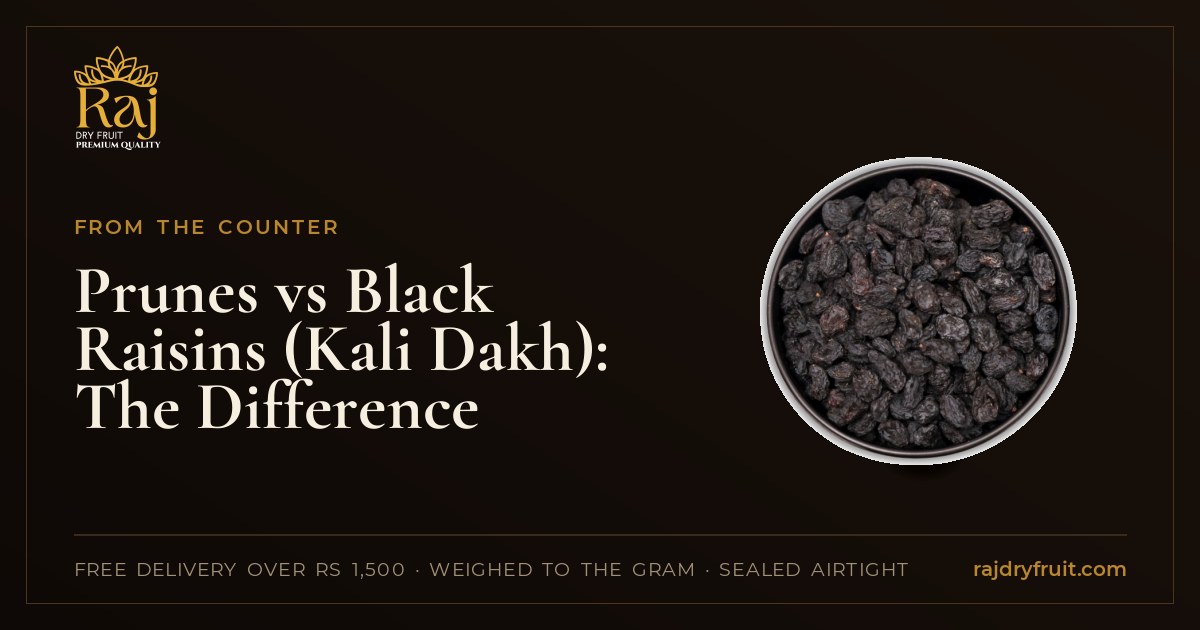
Black raisins are a different fruit altogether. They come from dark-skinned grapes, dried whole. Our Kali Dakh (Black Kismis, Seedless) is this kind: small, even, dark and ready to eat without picking out seeds.
Prunes vs black raisins: what is the difference?
The main differences are the fruit, the size and the taste. Nutrition per 100 g is broadly similar for the two, as both are concentrated dried fruit, but prunes carry a little more fibre and a little less sugar.
| Point | Prunes (sukha aloo bukhara) | Kali dakh (black raisins) |
|---|---|---|
| Fruit | Dried plum | Dried black grape |
| Size | Large, about the size of a walnut kernel | Small, fingertip size |
| Seed | One stone, unless pitted | Seedless |
| Taste | Sweet-sour, soft and sticky | Sweet, slightly tangy, chewy |
| Energy | About 240 kcal per 100 g | About 300 kcal per 100 g |
| Fibre | About 7 g per 100 g | About 3–4 g per 100 g |
| How much at a time | 2–4 pieces | 8–10 raisins |
The nutrition figures are rounded, typical values for dried plums and raisins; any single lot will vary a little.
Is kali dakh the same as prunes?
No. Kali dakh is not prunes. The confusion comes from the colour and the habit: both are dark, both are soft, and both are the dried fruit that families soak overnight and eat first thing in the morning. But one is a plum and the other is a grape, and they taste quite different.
For most Indian kitchens, kali dakh is the easier one to live with. It is seedless, it is small enough to drop into milk, kheer, halwa or a lunchbox as it is, and a pack goes a long way because you only need a small handful.
How to soak prunes and black raisins
Both are soaked the same way. Soaking softens them and makes them easier to chew; it does not change what is in them very much.
- Rinse the fruit once in plain water.
- Put 8–10 kali dakh, or 2–4 prunes, in a small bowl with about half a cup of water.
- Cover and leave overnight, 6–8 hours.
- In the morning, eat the fruit and drink the soaking water, which carries some of the sweetness.
If you are diabetic, pregnant, or watching your sugar for any other reason, ask your doctor how much dried fruit suits you. For small children, soak and chop both; whole dried fruit can be hard for them to chew.
Which one should you buy?
Pick kali dakh if you want a small, seedless, everyday dried fruit for soaking, snacking and cooking, and something that works in Indian sweets and pulao. Pick prunes if you specifically want the plum flavour or a larger, softer piece and do not mind the stone.
If you like the kali dakh idea but want something sweeter and larger, look at Munakka Dakh Jumbo, the big dried grape that many families use the same way. For a lighter, golden raisin for pulao and kheer, there is Kishmish (Lambi Dakh). Our guide to black raisins and how to eat them soaked goes further into kali dakh, and kishmish, munakka and dakh explains how the three names overlap.
Other dark dried fruit people soak overnight includes anjeer (dried figs). You can see every raisin we keep on the dakh, kishmish and raisin shelf. We send these across India; orders start at ₹1,500 and every order ships free.
Questions people ask
What is the Hindi name for prunes?
Prunes are called sukha aloo bukhara in Hindi, meaning dried plum. They are not the same as kali dakh or kali kishmish, which are black raisins.
Is kali kishmish the same as prunes?
No. Kali kishmish is dried black grapes, and prunes are dried plums. They look similar in colour, but prunes are much bigger, usually have a stone, and taste sweet-sour.
Which is better to soak overnight, prunes or black raisins?
Both soak well. Black raisins are seedless and easier to add to milk and cooking; prunes carry a little more fibre per piece. Many families simply soak a small handful of kali dakh every night.
How many black raisins should I eat a day?
A small handful, about 8–10 raisins, is the usual amount. If you have diabetes or any health condition, ask your doctor first.
Written at our counter, where these questions get asked every week.