In this guide
Quick answer
Charoli in English is usually just called charoli nuts or chironji seeds; its less common English names are almondette and Cuddapah almond. Chironji and charoli are the same thing: the small, flat kernel of the Buchanania lanzan tree, which grows wild in the forests of central India.
It is not an almond, even though one of its names says so. It is its own seed, and it behaves differently from any nut on the shelf.
What charoli is and where it comes from
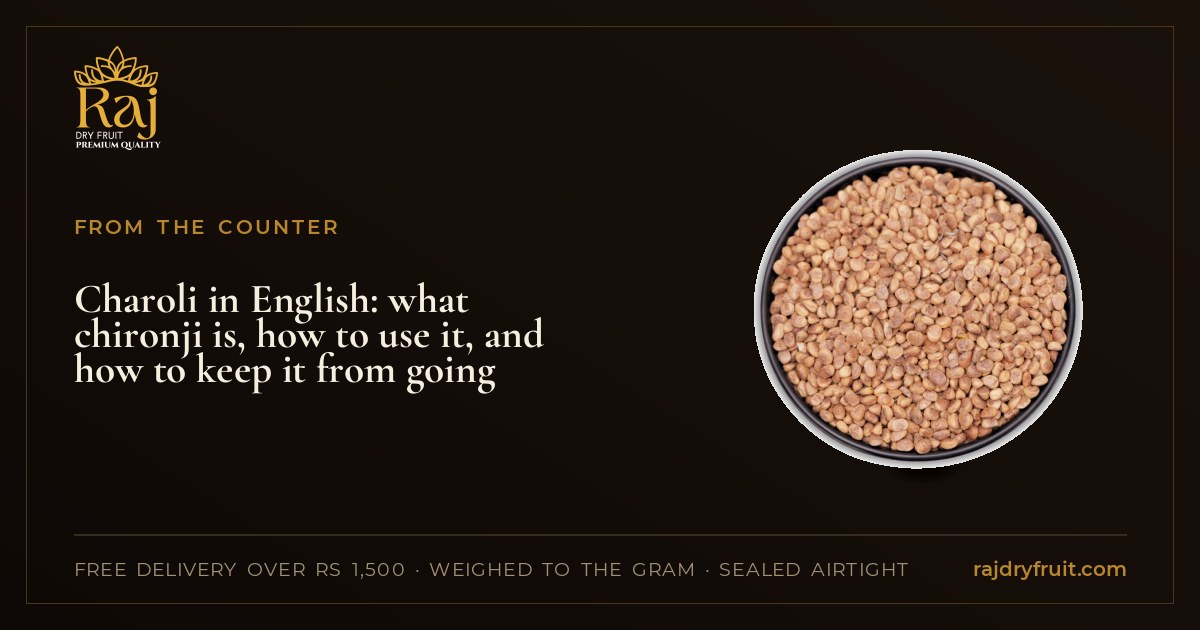
The tree bears small fruit, each with a hard stone. Inside the stone is one soft kernel about the size of a masoor dal grain, slightly flattened, pale brown to beige. That kernel is charoli.
Most of it is gathered from forest trees rather than farmed, in states such as Madhya Pradesh, Chhattisgarh, Jharkhand and Odisha, and the stones are cracked to get the kernels out. It takes a great many kernels to make a kilo, which is why charoli sits near the top of our range at around ₹2,800 a kilo. You rarely need more than a spoonful at a time, so a 100 g pack goes further than the price suggests.
Prices on this page were checked in September 2026 and are a guide only. Dry fruit rates change with the crop and the season, so our product pages always show today’s price.
What it tastes like
Mild. Raw charoli is soft, a little sweet and faintly nutty, somewhere between an almond and a pine nut, with none of the bitterness a badam skin can have. Toasted for a minute in a dry pan or in ghee, it turns golden and much nuttier. That quick toast is the difference between charoli that disappears into a dish and charoli you can actually taste.
How charoli is used
- Kheer and payasam. Stirred in at the end, or toasted and scattered on top with Pista Katran and a few strands of kesar.
- Sheera and halwa. Suji sheera is the classic. Fry the charoli in the ghee before the suji goes in.
- Shrikhand and basundi. A garnish that adds bite without the hardness of a whole nut.
- Mithai. Pressed onto barfi, mixed into laddoo and panjiri, and used in chikki.
- Qorma and rich gravies. In Mughlai and Hyderabadi cooking, charoli is ground into a paste with other nuts to thicken a gravy and give it body.
For garnish it pairs naturally with Badam Katran and kishmish. Our guide to pista kernels, katran and pishori covers the other half of a good sweet-dish garnish.
How to store charoli, because it goes rancid
This is the one thing most people get wrong. Charoli is rich in oil and has no shell to protect it once it is out of the stone. Left in a jar on a warm kitchen shelf, it can turn stale in a few weeks, and a stale charoli tastes bitter and soapy.
- Keep it airtight. A glass jar with a good lid, not the paper cone it may have come in.
- Keep it cold. In the fridge it keeps for several months. In the freezer, longer. Take out what you need and put the jar back.
- Keep it dark. Light and heat both speed up the fat going off.
- Buy small. A 100 g pack at a time is better than a large bag that sits for a season.
Charoli also attracts small insects in warm, damp months, which is another reason the fridge is the right place for it.
How to check charoli quality
| Check | Good charoli | Walk away if |
|---|---|---|
| Look | Even size, whole kernels, pale brown to beige | Lots of broken bits, dark spots, grey patches |
| Dust | Very little at the bottom of the pack | Fine powder or webbing between the seeds |
| Feel | Soft but dry | Oily to the touch or clumping together |
| Smell | Faint, sweet, nutty | Sharp, paint-like or musty |
| Taste | Mild and slightly sweet | Bitter or soapy aftertaste |
Tasting one seed is the most reliable test. Rancid fat cannot be hidden by toasting, and if the first seed is bitter the whole lot will be.
We keep Charoli (Chironji) on our spices shelf in 100 g packs. Delivery is free on orders over ₹1,500, and it takes a few days to reach most of India.
Questions people ask
Are charoli and chironji the same?
Yes. Charoli is the name more common in Gujarat and Maharashtra, and chironji the name more common in north India. Both mean the kernel of the Buchanania lanzan tree.
Is charoli a nut or a seed?
It is the kernel inside the stone of a small fruit, so botanically it is a seed. In the kitchen it is used like a nut.
Should charoli be soaked before use?
Not usually. It is soft enough to use as it is. Some cooks soak it briefly before grinding it into a paste for gravy.
Why does my charoli taste bitter?
Almost always because the oil in it has gone rancid from heat or age. Throw that lot away and keep the next one airtight in the fridge.
Written at our counter, where these questions get asked every week.